Today, the 4th of December, is Rainer Maria Rilke’s birthday. Honoring the poet, three biographies appeared in 2025, which I am about to read: Sandra Richter’s “Rilke or The Open Life”, Manfred Koch’s “Rilke – Poet of Anxiety” and Ruediger Shaper’s Rainer Maria Rilke: The Prophet of the Avant-Garde.
All three in the German Language. In the biogaphy by Manfred Koch, Rilke’s traumatic experiences are shown to be pivotal in forming his psychological make-up and artistic drive. Several reviews confirm that Koch presents Rilke’s anxieties not as much as an obstacle but as the very creative engine for his poetry.
Being interested in ways in which art and literature are utilized to cope with pain, and trauma, I will be reading eagerly…
Happy to see the feature “Haiku for Parkinson’s,” on the blog of The Haiku Foundation, flourishing!
Blog posts offered recently: “On the importance of connection in haiku” by Philomene Kocher; Through the lens of Positive Psychology” by Scott Mason; An update on the free course introducing Haiku to those living with Parkinson’s, their family and friends, taught by Sonam Chhoki. Poems by the participants painted a picture of where they are on their haiku journey.
Informative, comforting, healing reading. I copy it from the THF site below.
If you or a loved one live with Parkinson’s Disease, visit the site and see!
May 12: Haiku for Parkinson’s: Inviting Connection—Philomene Kocher
July 7: Haiku For Parkinson’s: July 2024 Course Update—Sonam Chhoki
This is the blog post:
Haiku for Parkinson’s is a feature of The Haiku Foundation (THF): introducing haiku to those of us living with Parkinson’s Disease (PD), as well as introducing PD to those ‘living with haiku.’ You will find previous posts from this series here.
As part of this feature, renowned poet and editor Sonam Chhoki is teaching a free course introducing haiku as a tool in the Parkinson’s toolbox, helping face and negotiate the challenges of the disease and improve quality of life. In this post, Sonam, and the course participants, update us on the progress of their haiku journey.
Sonam writes:
Arguing against the pejorative associations of “parochial” with narrowness, insularity and sectarianism, the Irish poet, Patrick Kavanagh (1904 – 67) said, “The parochial mentality … is never in any doubt about the social and artistic validity of his parish.” For Kavanagh, the “parish” or the “parochial” was not a boundary but an opening. An aperture through which the world could be experienced. It was based on the idea that we learn by scrutiny at close-hand. For the poet, it is the depth of experience rather than the width, that counts. He concluded, “Parochialism is universal; it deals with the fundamentals.”
Inspired by Kavanagh’s insight, I would say that the poets in this update are “parochial” in the most wide-ranging sense. Each poet deals with the “fundamentals” of what it is to live with Parkinson’s either personally or through a close family member. Here are their unique and precious experiences and insights, through the lens of haiku.
1. Why haiku? How did your interest in haiku start?
Simon Duncan: As a means of matching emotion and landscape while on mountain walks and later summarising a day’s cross-country skiing as I was losing my ability.
Tania Haberland: That’s what was offered as a service for people going through Parkinson’s personally /in family. But in reality, I love haiku, wrote my first one at 8 at school.
Margaret Ponting: I have always been interested in writing poetry. I wrote longer prose during an extended lockdown of the coronavirus pandemic. I joined a writing group at this time and was impressed how haiku writing was therapeutic for Parkinson’s sufferers. My brother and sister encourage me to write and are enthusiastic in their support.
Haiku appeals to me because I have family connections to Japan and the history and cultural aspects are intriguing. I feel closer to my Japanese daughter-in-law and grandsons as it gives us something to share, discussing the history and philosophical aspects. I like the way haiku has evolved with a variety of styles and topics and how a few simple words can create an emotional impact on the reader.
Jen Pacini: I started writing poetry after receiving my Parkinson’s diagnosis is 2018. Playing around with different kinds of poetry has been a wonderful creative outlet ever since. In 2021, Stella Pierides offered a haiku class through a Parkinson’s site. At first my interest in haiku was to help refine my poetry. Along the way, I fell in love with the style and the way haiku’s simplicity of form conveys meaning in complex ways and on multiple levels. Reading haiku makes me smile
2. Which of your own recent haiku are your favourites? Please share some of your poems.
Simon Duncan:
Cold sun, coarse gritstone Thin moves As my bouldering mat shrinks
Botox cackles Drag Queens strut Emptiness
A window opens Ladybirds cascade Hard red confetti
Cold canal-side fishing “Hello, have you caught anything?” Deep silence
this morning’s delivery truckload of firewood and a tiny green frog
king parrots gorging on rose hips a palette of green and orange
giant red gums mirrored in the river as we reflect
mismatched, shiny, bright we put the pieces together a mosaic of love
threading daisy chains of memories sepia photos
a present arrives a silk scarf from my sister
the night leaves a pale parting gift translucent crescent
along the river bank djiti-djiti, willy wagtail cries for her drowned mother
Jen Pacini:
at the back of the drawer a letter, folded in three the life she never shared
sunrise yoga the taste of sweet candy
midday heat the hum precedes the hive
summer solstice there’s no going back
3. What do you enjoy about haiku writing?
Simon Duncan: Concise emotional imagery.
Tania Haberland: The focus and stillness haiku creates and the way it declutters my mind, also the challenge is fun.
Margaret Ponting: I enjoy the immediacy of haiku writing and the mindfulness aspect. It makes me more aware of my magnificent natural environment and I feel enriched through expressing my feelings. I appreciate sharing my thoughts with loved ones through this medium and enjoy reading haiku contributions from other people.
Jen Pacini: I enjoy it when I surprise myself after reading a haiku I’ve constructed.
4. What is the most challenging aspect of haiku writing?
Simon Duncan: Writing about Q3 activities is important to me but others know little about – e.g.- climbing.
Tania Haberland: Editing out what is not necessary..
Margaret Ponting: Initially, I thought there were few rules, but found haiku to be very complex, much like all aspects of Japanese culture. I sometimes find it difficult to pare back my writing. I have been encouraged by the support given to me through this program and appreciate the feedback. Looking back, I think I have grown in confidence and am trying to challenge myself more..
Jen Pacini: I find keeping the meaning of the haiku from becoming too identified with my own story or adding too many details challenging at times. Sonam Chhoki, is very helpful, providing useful feedback that helps me continue to learn the craft.
5. Do you make notes or do you write directly?
Simon Duncan: Write directly.
Tania Haberland: Directly and then keep changing..
Margaret Ponting: I write directly and that is another thing I like about haiku. It doesn’t take too much time. I usually refer back and add or change the structure or flip the lines to create a different effect.
Jen Pacini: I play around with ideas, lines, wording in a notebook. Then set it aside. Later, I return to the process with fresh eyes to create a digital version. Sometimes I merge and edit two original haiku drafts to create a fresh haiku.
This one-to-one course by email is free and available for a year. The main purpose is to work with the participants at a pace suitable to their particular circumstances and needs. We welcome people from all backgrounds and levels of knowledge, and respect their wish to participate anonymously..
Notes:
Patrick Kavanagh: ‘The Parish and the Universe’, in Collected Pruse, MacGibbon & Kee, London, 1967.
Biography
Sonam Chhoki finds the Japanese short form poetry resonates with her Tibetan Buddhist upbringing. She is inspired by her father, Sonam Gyamtsho, the architect of Bhutan’s non-monastic modern education, and by her mother, Chhoden Jangmu, who taught her: “Being a girl doesn’t mean you can’t do anything.” She is the principal editor, and editor of haibun for the online journal of Japanese short forms, cattails. Her chapbook of haibun, The Lure of the Threshold was published in May 2021. Mapping Absences, a collaboration of haibun, tan bun and tanka prose with Mike Montreuil was published in 2019. Another collaboration with Geetanjali Rajan: Unexpected Gift was published in November 2021. An ebook of a second collaboration with Geethanjali Rajan, “Fragments of Conversation” is in the process of being published.
The second installment of Haiku for Parkinson’s is the interview of a British poet, now living in New Zealand, Tim Roberts.
Tim describes his haiku practice and the ways it helps him with his Parkinson’s symptoms. It has not been an easy ride. He says:
I had to stop work shortly after being diagnosed. I was adrift. I didn’t have any real hobbies and lost my identity. I felt rudderless and scared. I didn’t know who I was anymore – perhaps that means I never had. I had confused who I was with what I did. Now, having developed such a rooted haiku practice, I have a solid sense of who I am and an exciting sense of purpose. I love poetry and I like to use it to connect to others. I see it as my vocation – and a part of my spiritual practice. Now, thanks to the challenges of PD, I am much more me than the person who was a leadership coach, or any of my previous personas, the university teacher and the detective.
Take a look here for Tim’s informative, inspiring, and from-the-heart account of his journey with Parkinson’s Disease.
Then this is for you! Jim Kacian, The Haiku Foundation Founder and President, and its Haiga Gallery Curator, invites submissions.
“The Haiku Foundation is accepting submissions for the THF Haiga Galleries. If you’ve been creating haiga for a while and are looking for a place to exhibit, have a look at what our space looks like https://thehaikufoundation.org/haiga-galleries/. If you like what you see, you’ll find contact information there. Maybe you could be the next THF Haiga Gallery Featured Artist!”
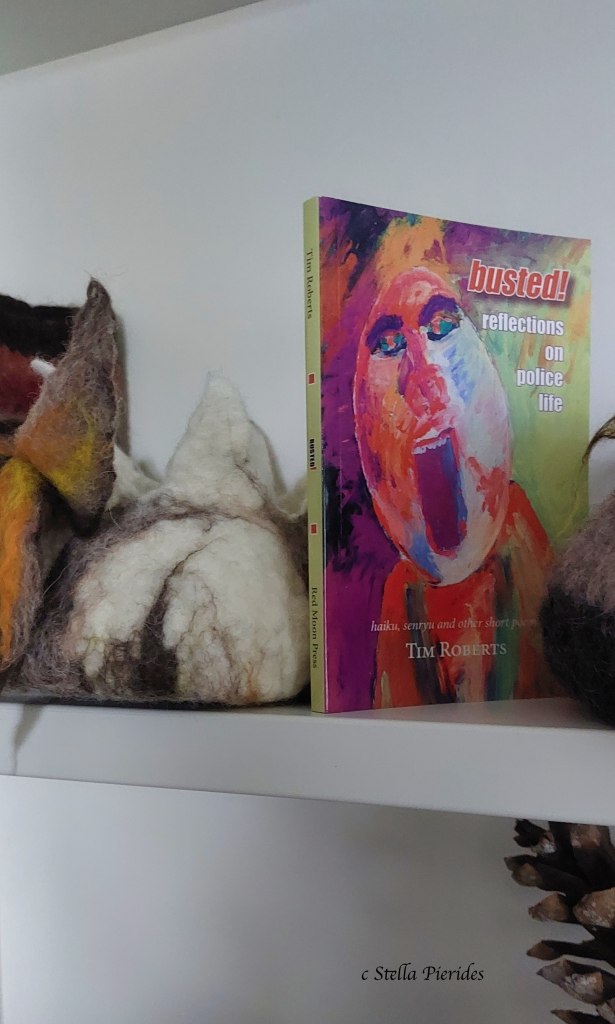
I just received Tim Roberts’s wonderful book, “Busted: Reflections on Police Life” published by Red Moon Press. Congratulations Tim!
A poignant, powerful, and at the same time sensitive rendering in haiku of police life that shocks, informs, disturbs, engages, and changes the reader. Alan Summers sums it up: “….beyond bravery…”
Honored to have contributed the Introduction to this book. As Robert Epstein writes in his Foreword: “Prepare to be arrested by Tim Roberts’s bold, graphic, and gut-wrenching haiku memoir”! Indeed!
Filled with excellent work by fellow poets, it makes for a great read! I am particularly chuffed to have 3 of my micro-haibun included from “Censored Poems,” a series in progress. My heartfelt thanks to Clare MacQueen for giving them a home.
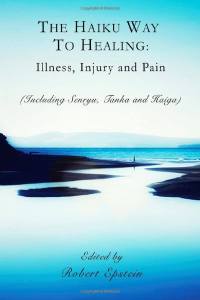
Pleased to see Robert Epstein’s anthology is out! “The Haiku Way to Healing: Illness, Injury and Pain” is a significant contribution to haiku literature, a testament to the power of this very short form of poetry to express and share even the most painful of moments.
Honored that my work is included in this collection.
Here is one of my poems from page 207, initially part of a haibun published in “Contemporary Haibun Online” 17.1, and recently included in my juxtaEIGHT article ‘Parkinson’s Toolbox: The Case for Haiku’ (pp.37-61)
The end of April, Parkinson’s Awareness month, is not the end of the effort required to increase Parkinson’s awareness. The work to develop ways to make life easier for those living with the disease, as well as to find a cure, continues year-round.
Parkinson’s disease (PD) is an immensely complex and multifaceted illness affecting millions of people around the world. Characterized by “progressive dopaminergic neuronal dysfunction and loss,” it is expressed in motor, cognitive, mood, and behavioral symptoms. Alleviating symptoms, and fighting the disease depends on improving our, at present, incomplete understanding of it: as sufferers, as activists, as researchers.
In my reading of blogs, articles, and social-media posts about PD written by people living with it, and others, I come across presentations that seem to fall into two broad categories: On one end of the spectrum are accounts wishing to convey what the disease is “really like;” these writings are often of the pain, emotional and psychological impact the physical deterioration has on those suffering from it. On the other end, whatever the manifestations of the disease are, the emphasis is on ways the writers have found to deal with their symptoms and even slow the progression. There are, of course, presentations that, to some extent, balance these two extremes, but they are only a few. Both strands are discernible in the contributions featured this April.
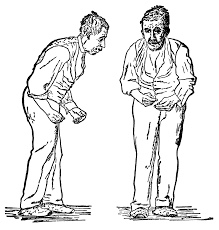
So what is PD like? One moment the person with PD looks like the acute sufferer according to the former category; the next, like the exercising enthusiast keeping the disease at bay. There is clearly a disease that is highly variable, multi-faceted and in urgent need of attention. And yet, if you search for depictions of PD, you will most often encounter an infographic like this
Well, I look nothing like it!
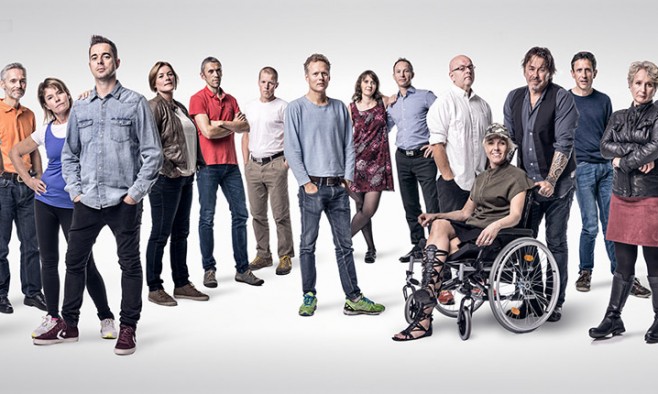
Norwegian video journalist Anders M. Leines used still images to portray younger, “early-onset” Parkinson’s patients in a series of portraits at his exhibition “This is Parkinson’s.”
In an interview by Geoffrey Chang, a post published in 2015 in Parkinson’s Life, the online lifestyle magazine for the international Parkinson’s community by @euparkinsons, he says
The idea is to give the image of Parkinson’s disease a ‘total makeover’. There is huge potential for better and more powerful storytelling within the Parkinson’s community. In medical textbooks, as well as in the media, people with Parkinson’s (PwPs) are traditionally depicted as tiptoeing, shaking and stooping seniors with whispering voices and a staring glare, imparting the impression of an apathetic or asocial person who lacks empathy and is uninterested in taking part in normal social interplay. This image is of no help to the patient as it fosters prejudice.
Journalist Teresa Borque when diagnosed with PD at an early age, underwent a huge identity crisis. In her post on Parkinson’s Life, she says
Being a woman is a daily struggle in this society. At work, we struggle to be considered as good as any man there; we struggle in relationships to be respected as a whole person; we struggle during motherhood not to be reduced to the role of just a mother. But with Parkinson’s disease diagnosis, the fight increases by 100.
While we all base our self-esteem on the other people’s recognition of ourselves, she points out – women have to learn to be their own highest priority in life. “Parkinson’s disease feels like an ally of sexism,” she writes, emphasising why it’s crucial for women with PD to learn to prioritize their own wellbeing.
Then there are depictions of PD outside the two poles. So negative depictions, or silences, that are painful to read; many of the writers drove themselves to suicide. Or, so positive, so glowing with challenges, achievements and enjoyment of every minute of the day, that upon reading them, a healthy person might wish they had Parkinson’s. I appreciate the motivational power of such accounts and often read them to inspire myself to do more.
We need to keep talking. We need to keep listening. We need to keep producing the pieces that will one day complete the puzzle that is Parkinson’s.
April 11, 2021 is World Parkinson’s Day. Check out live events and Parkinson’s Community videos in honor of the day on YouTube here
Interested in finding out about Parkinson’s Disease? The Michael J. Fox Foundation describes it as follows:
Parkinson’s disease (PD) occurs when brain cells that make dopamine, a chemical that coordinates movement, stop working or die. Because PD can cause tremor, slowness, stiffness, and walking and balance problems, it is called a “movement disorder.” But constipation, depression, memory problems and other non-movement symptoms also can be part of Parkinson’s. PD is a lifelong and progressive disease, which means that symptoms slowly worsen over time.
The Michael J. Fox Foundation has a wealth of information for those wishing to understand the disease, as well as the newly diagnosed.
Another good place to start is the Davis Phinney Foundation which offers a plethora of useful information. The site also features performance poetry by Wayne Gilbert who, using metaphor, describes his experience of living with this disease.
Did you know that a number of people with Parkinson’s find it helpful to personify the disease, to see it as an enemy to fight against? From Journeys with Parkinson’s, the personal blog of Frank C. Church, in the first three out of Ten Things to Keep You Living and Not Just Existing With Parkinson’s, the disease is presented as an opponent of the person with PD:
What makes you happy? Think about it; think deeply about what do you do every day that makes you happy. Your Parkinson’s will not like you being happy.
Stay busy; be active every day for many hours during the day. Do not just sit. Your Parkinson’s would prefer to have you sedentary doing as little as possible.
Make sure you get plenty of sleep and the best quality kind of sleep. You know you used to get it before you had Parkinson’s. Your Parkinson’s would prefer to do whatever it can to keep you from sleeping because you being tired and listless gives an advantage to Parkinson’s.
Finally, here is a video of a Belgian septuagenarian with Parkinson’s who took up boxing to alleviate her symptoms:
This badass grandma is fighting Parkinson’s one punch, jab, and hook at a time 🥊 pic.twitter.com/AViHCRG97t
Highlighting articles, blog posts, news, poems, films about living with Parkinson’s in honor of Parkinson’s Awareness Month and beyond.
April is Parkinson’s Disease Awareness Month, set aside each year for drawing attention to this little understood and still under-researched neurodegenerative disease that affects around 10 million people globally (with numbers growing rapidly). At the center of this observance is World Parkinson’s Day April 11. Patients, families, care workers, support groups use the month, and the day, to heighten awareness of the disease as well as inform of the resources that are needed / available to support those afflicted by it.
April is also National Poetry month in the United States, with April 17 set to celebrate international Haiku Poetry Day. Poets, publishers, teachers of poetry, librarians, poetry lovers come forward to inform about, promote and celebrate poetry the whole month. The Haiku Foundation honors International Haiku Poetry Day (IHPD) with HaikuLife, the yearly Film Festival, and EarthRise Rolling Haiku Collaboration, a poem written by haikuists on the day, from sunrise to sundown around the world.
Since both Poetry and Parkinson’s are of particular relevance to me, I will be posting links to interesting articles, information, and Parkinson’s poetry in this blog.
Here is my favorite poem about Parkinson’s (the first one of four) by Robin Morgan:
A post by Minter Krotzer on her husband Hal Sirowitz’s need to keep the disease secret as long as possible, illustrates a common problem faced by people with Parkinson’s known as staying in the Parkinson’s closet! In her post The hardest Secret, she observes, “It’s interesting to me that people aren’t in the closet about many things anymore but they are about disease.”
And here you will find Michael J. Fox‘s story, one of the most well-known figures in the Parkinson’s world, diagnosed in 1991:
A detailed and brave description of personal experience of the disease and the healing practice of Haiku, titled Haiku and Parkinson’s Disease, by Tim Roberts, can be found in the New Zealand Poetry Society website
I hope that my posts will make a small contribution to addressing the heart-breaking dilemma those afflicted with PD find themselves in: on the one hand, the stigma associated with this disease, which creates and reinforces the need to stay in the closet and so deprive those living with it of the support there is; and, on the other, the paucity of information about the disease, which leads to and feeds misunderstanding and stigmatization.
If you are wondering about the title of this post: A red tulip is the symbol chosen for Parkinson’s Disease.
Happy to see 2 of my stories from Feeding the Doves (Dream Island and Written) included (pp. 61-62) in issue 6 of the Romanian Journal Revista Kibo Titan! Grateful thanks to Clelia Ifrim and Dani Dumitrache!
A Happy New Year 2021 to all my friends! A year filled with Health, Love, Creativity, Happiness, and Peace!
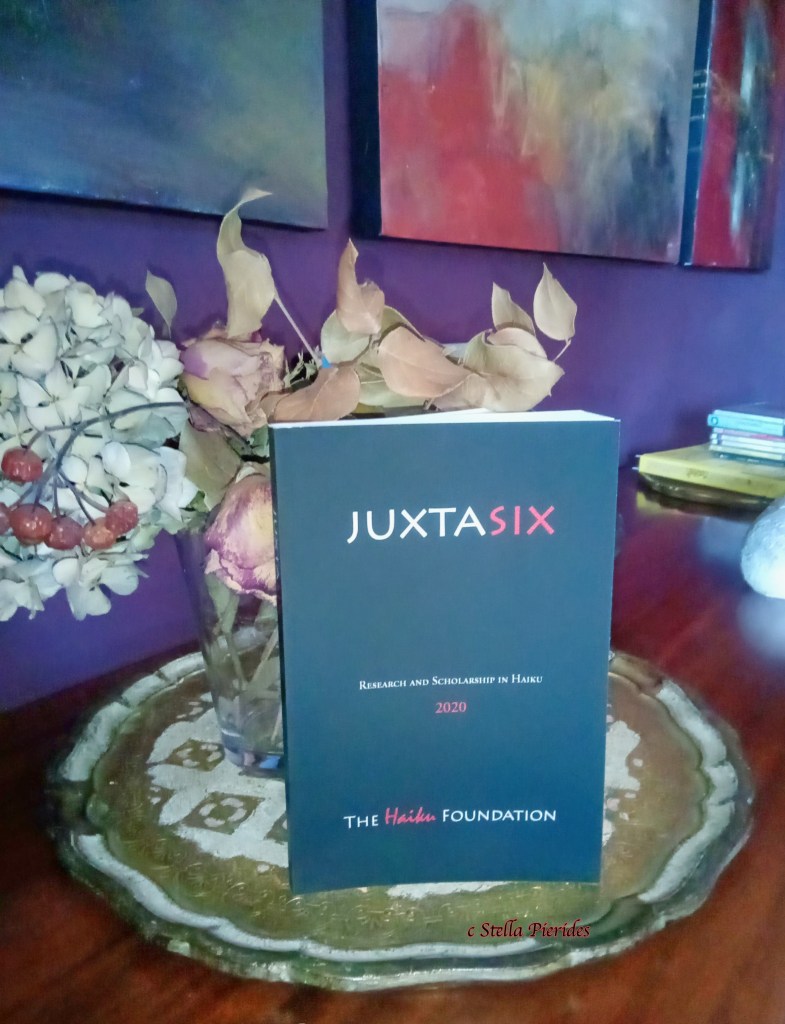
Meanwhile, still in 2020, JuxtaSix: The Journal of Haiku Research and Scholarship, the print issue, is available! I just received my print copy from Amazon. It is a very interesting and well-presented issue. I am happy to say it includes an article on Haiku and the Brain that I co-authored. Many thanks to the editors, and reviewers, and well-done to my fellow authors!
What a wonderful project! The brainchild of Krzysztof Kokot, the International Picture Postcard Project “Haiku Connects Us” brings together poets and poetry from around the world. Beautiful pictures, coupled with haiku…what a treat! So pleased to see my contribution included here!Thank you, Krzysztof!
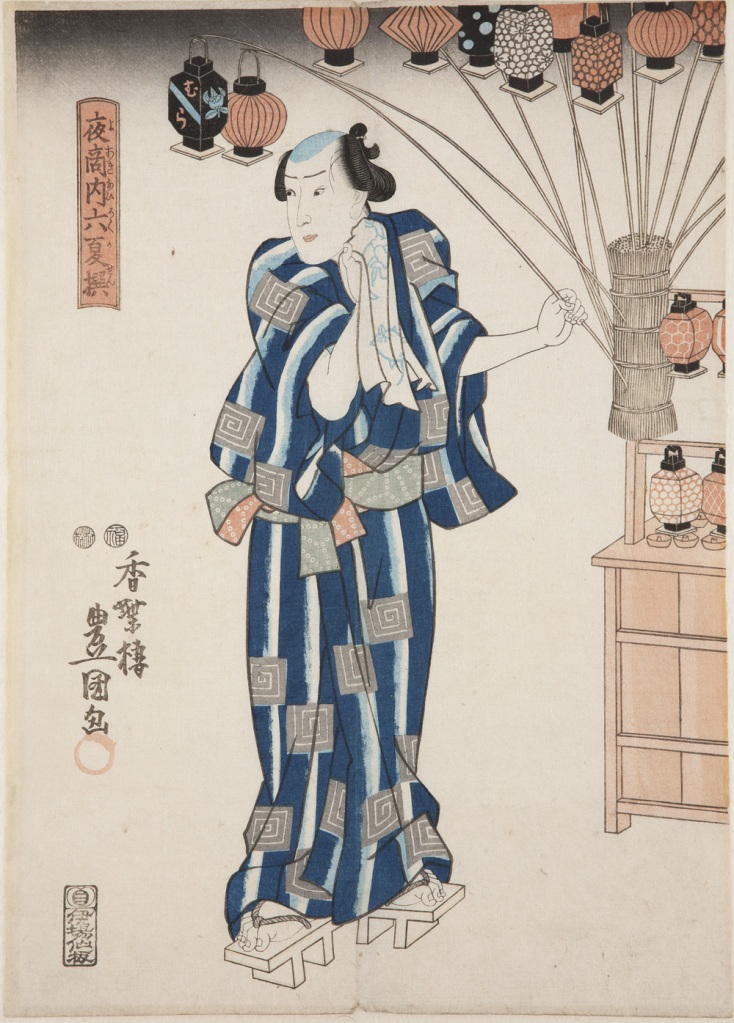
Great news about the project arranged by Alan Summers, Karen Hoy, and Bertel Martin in collaboration with the Bristol Museum and Art Gallery. Haiku sent by a number of haiku poets (one of mine included), were matched with Japanese block prints and are now displayed on the Museum website. A big thank you to Alan and Karen, and congratulations to all poets who took part.
From the Museum website:
In autumn 2019, poets from around the world responded to a call for haiku, a form of short Japanese poetry, based on Japanese prints in the collection at Bristol Museum & Art Gallery. People sent in more than 800 beautiful, thought-provoking poems from thirty countries worldwide. See the selection below.
Many poems were inspired by woodblock prints in our popular 2018-2019 exhibition series, Masters of Japanese Prints.
The project was arranged by haiku poets Alan Summers and Karen Hoy of creative writing consultancy Call of the Page. The call for poems was linked with a haiku workshop delivered at the museum with writer and producer Bertel Martin of City Chameleon.
Huge thanks to Alan, Karen and Bertel as well as to all the poets who took part. You are bringing the world together through poetry.
Great news! JuxtaFive is ready and available to read online! This edition of the Haiku Foundation Journal of Haiku Research and Scholarship includes several articles, reviews, haiga and a special section on Women Mentoring Women (and the article Knocking on the Doors of Perception on Haiku and the Brain contributed by me and co-authors: Thomas Geyer, Franziska Guenther, Jim Kacian, Heinrich Liesefeld, and Hermann J. Mueller). Here
Everything you wanted to know about Haikupedia, the Haiku Foundation encyclopedia of haiku! Watch the presentation on Haikupedia given by Charles Trumbull, Dave Russo, and Jim Kacian at the Haiku North America Conference, August 2019.
This September I took part in the Haiku for Change Event organised by Michael Smeer of the Facebook community My Haiku Pond, in conjunction with 100 Thousand Poets for Change (Global) 2018. Poets were asked to write one haiku (or senryu, haiga, or photo-haiku) on change: climate, environment, earth.
Entries were included in the Haiku for Change Event ebook Anthology, a pdf posted on the 100 Thousand Poets for Change blog, and archived by Stanford University as part of their program to document the 100 Thousand Poets for Change movement and community.
Here is my offering:
rising seas
a clutch of turtle eggs
in the park sandpit
clover in flower
the Holsteins come
with four stomachs
This week’s poem by Dan Schwerin (Modern Haiku 49:2, Summer 2018), discussed at The Haiku Foundation feature Re:Virals, attracted delightful responses that illuminated the poem from different and serendipitously complementary angles.
The week’s winner, Garry Eaton, provided an interesting and robust commentary seeing the poem’s environmental concerns, alluding to 19th century farming changes by
… highlighting the mindless, mower-like and digester-like efficiency of cows as in massive numbers they convert landscapes into milk and excrement in an endless search for more green.
The other commentators too, in their own way, provided fascinating inroads to the ku.
One paragraph from Julie Warther’s commentary caught my eye:
We each have our empty places looking to be filled. We hold common yearnings for love, acceptance, safety, sustenance and purpose. The natural world and those in it have much to offer. Do we come ready to receive? Do we return hungry for more? Do we have the capacity (four stomachs worth?) to take in the goodness, beauty and bounty surrounding us?
In the commentaries, desire, pleasure and insatiable hunger come together through the poem’s image of cows with multiple stomachs, mowing down environmental resources. Perfect metaphors for humans for whom – on individual and societal levels – the grass is always greener on the other side of the fence, and who will employ all means necessary to consume, to obtain the next piece of land, the next oil field… The effects on nature, climate, resources are all around us to see. As Warther asks, do we have the capacity to process and digest what we receive, to ‘stomach’ it, to experience ful/fillment? To contain our desires? To create a sustainable environment, where the milk we receive is both sufficient and good enough to nourish us?
In Schwerin’s poem, c/love/r is in flower. It is not the first time, and it won’t be the last. In the optimist’s reading, the ‘clover in flower’ in this rural idyll has survived previous years, and it sounds that, with care, it is going to survive the next ones.
Refreshing to see clover — considered an invasive weed in the context of gardening — standing for ‘milk’ in its use as animal fodder, and the cows — whose milk is usually associated with nourishment — standing for ruthless, destructive urges. But that’s another poem, and another story.
If, like me, you enjoy thinking about these matters, make sure you receive The Haiku Foundation posts. Re:Virals, managed by Danny Blackwell, appears Fridays.
Last weekend, VSSA IV, the fourth international quadrennial symposium on Visual Search and Selective Attention, took place in the Bavarian School of Public administration, Holzhausen, nr. Utting, on the shores of the beautiful Lake Ammersee. I wrote a haiku sequence in honor of the symposium using themes and terms from the talks and social life of the meeting. I understand this haiku sequence was briefly projected on screen before the concluding session of the symposium.
Here is book cover 7 for the book cover challenge from Shrikaanth Krishnamurthy. No explanation required, no reviews, just the covers.
Thank you, Shrikaanth, for sending the challenge my way! I enjoyed presenting the book covers in the form of an installation and I plan to continue this practice beyond the 7 covers…
Book Stuff: swaps, gifts, small talk is a (closed) Facebook group founded and administered by poet Gillena Cox. It is a place to highlight and share our work: whether already published or to-be-published/forthcoming.
Today, I was thrilled to see Gillena’s post, reproduced here with her permission:
❧✿❧Saturday Share # 42❧✿❧
Stella messaged me telling me she wants to send me 2 of her books, so i sent her my snail mail address. I received her gifts on 14th June 2018. Both these publications resonate well with me, since i am an ’empty-nester’. My husband left our home wanting to broaden his horizons. When they were ‘broad enough” he returned to Trinidad and opted to live in a house owned by his mother. My children left our home wanting their own space, when they thought, they were “big enough”. All of these leavings, i handled gracefully, giving each one, my blessings. What does this have to do with gifts from Stella, well…
Her haiku mirror life – the non linear journey, of evolving stations. Her themes of loneliness, absence and the capacity to be creatively alone are her flag poles. We are given insights into views from her garden, just when she opens her door, at the market place. We are treated to light bouncing off aubergines, flowers opening and coquettish butterflies. Ordinary yes. Yet peculiar to her, Stella the haiku poet. These scenes she freezes for us readers , leaving us in awe.
My favourite from the book ‘In the Garden of Absence‘
“on the clothesline
three skirts four blouses
missing you”
❧✿❧
‘Ekphrasis: Between Image and Word‘ is a collaborative work of [painting], of oils and words. Stella’s daughter [Maria Pierides] uses her oil and mixed media, Stella her words. Beautiful pictures are given to us, resulting from the creativity of these two. They paint for us the pictures of nature and her fickle heart. By her colour, sound, seasons.
My favourite is #21 ‘Colours surround me, swirls. Oil and mixed media on canvas 60 x 60cm’ To which Stella replies
“blue note
the baker’s dog
howling”
THANKS AGAIN STELLA for these sweet treats.
much love
gillena
❧✿❧Its Saturday Have a good one❧✿❧
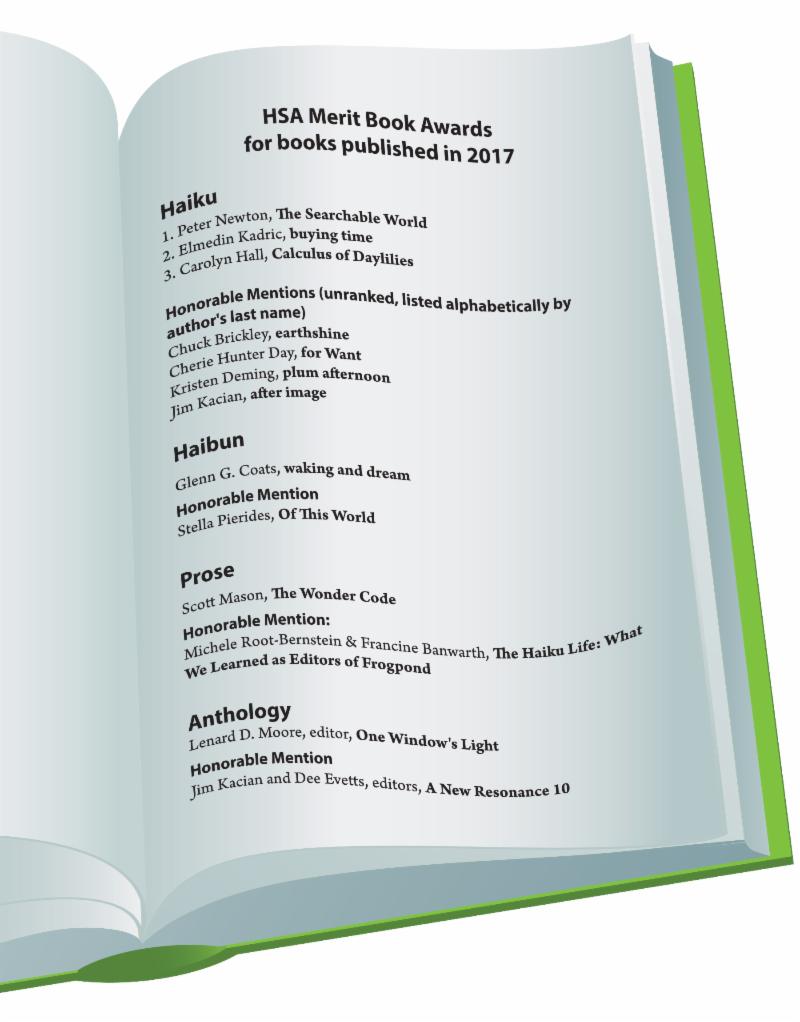
The Haiku Society of America has announced the names of winners of its Merit Book Awards for books published in 2017.
I am delighted and honored to see my book Of This World (Red Moon Press) included with a honourable mention in the Haibun category! Congratulations to all winners!
And heartfelt thanks to Michelle Elvy, Jim Kacian, Clare MacQueen and Johannes S. H. Bjerg for their help and support with bringing this book to life.
*
So, excellent news! It becomes 64/100 #The100DayProject #100daysnewthings