Tag Archives: The Haiku Foundation

World Parkinson’s Month

April is World #parkinson ’s Month! A month to increase awareness about this complex neurological disease, and support those impacted by it.

While scientists race to find a cure, there is a lot that can be done to help with quality of life.

Take a look at Parkinson’s Europe, the section on Self-help and Living Well:

https://parkinsonseurope.org/…/self-help-and-living-well/

The Davis Phinney Foundation is a good resource to explore: https://davisphinneyfoundation.org/resources/

The podcast series Two Parkies in a Pod offers advice and tips on how to cope with chronic illness, and the specific challenges of Parkinson’s: https://www.2parkiesinapod.com/

The Haiku Foundation year-long (2024-2025) series ‘Haiku for Parkinson’s’ features #haiku as a tool that may help calm, reframe problem(s), and generally improve the quality of life for those living with disease and the psychosocial entanglements it involves:

See, e.g., ‘My Dyskinesia’: https://thehaikufoundation.org/haiku-for-parkinsons-my…/

Interview of ‘Tim Roberts living with PD’: https://thehaikufoundation.org/haiku-for-parkinsons…/

‘From Haiku for Parkinson’s to Haiku for Healing’: https://thehaikufoundation.org/haiku-for-parkinsons-from…/

‘Through the Lens of Positive Psychology’: https://thehaikufoundation.org/haiku-for-parkinsons…/

And a song by Birdie Belgium, tribute to her mother who lives with Parkinson’s Disease: https://www.google.com/search?q=birdie%20belgium%20song…

https://parkinsonseurope.org/2025/04/07/birdie-belgium-releases-new-song-for-parkinsons/

What do I find helpful in my own journey of the disease? My family and friends; the ‘Betreutes Laufen‘ walking for Parkinson’s group in Augsburg, the Ping Pong Parkinson (PPP) group in Augsburg and the dedicated PPP Course in Koenigsbrunn (see also the nationwide PPP Association https://www.pingpongparkinson.de/); being part of the international online community, writing and reading haiku; felting, gardening…

wildflowers
the lightness of hope
and renewal

Haiku for Parkinson’s: Introduction

The new project of The Haiku Foundation, Haiku for Parkinson’s was launched on the 17th of December 2023! I very much look forward to seeing it develop along the various themes and issues arising from Parkinson’s. The Introduction to the feature can be read by clicking here

I have copied it on this site too, see below.

Haiku for Parkinson’s is a feature of The Haiku Foundation, introducing haiku as a tool in the Parkinson’s toolbox, helping negotiate the challenges of the disease and improve quality of life. And, introducing Parkinson’s Disease (PD) to people living with haiku.

What is Parkinson’s Disease?

Parkinson’s Disease has mainly been attributed to the deterioration and eventual death of brain cells producing dopamine, important for organizing movement. This has been addressed by dopamine replacement therapy. Over the last few years, the role of dopamine and its involvement in the production of other brain chemicals has come to be understood better, leading to improved treatment of the many symptoms increasingly recognized to be part of the disease – over 40 and counting. Besides shaking, stiffness, difficulties with swallowing, problems with walking, balance, and coordination, there are also many ‘non-motor’ symptoms, including anxiety, depression, fatigue, apathy, insomnia, visual hallucinations. Moreover, several of the body’s autonomic functions, such as heart rate, blood pressure, temperature, breathing, and digestion become compromised.

thud!
a bird flies into
a closed window

— Catherine Mair

While this is a formidable list, and at present there is no cure, several programs have been developed amounting to what is often referred to as the Parkinson’s toolbox. Creative therapies are becoming available, offering considerable benefits, including lifting mood, increasing energy and motivation, as well as adding to the paradoxical phenomenon of increased creativity reported by (some) people living with the disease (see Parkinson’s Europe, Parkinson’s Creativity).

Haiku for Parkinson’s (H4P)

Haiku poetry is being used by some people living with PD to support life with this condition. Its qualities include:

Brevity: Haiku can be written or read in a single sitting, enabling feelings of completeness and accomplishment.

Concentration: Concentrating on the moment and our embodied being, haiku anchors us in the world, providing a counterweight to ‘Parkinson’s moments’ – when one feels stuck or caught in acts such as buttoning a shirt or trying to turn over in bed.

Exercise of the mind: Crafting a haiku, in the effort of finding the images and rendering them in words that best convey the experience, exercises brain and mind.

dreaming of birdsong
I wake to a wolf shaking me—
tremors again!

— Tim Roberts

Connectedness: Writing and reading haiku involves attending to the relationship or interaction between writer and reader, and nature – restoring our connection to the world and so becoming a healing force.

Identity: haiku helps enable exploration of the self by overcoming the embarrassment and stigma of the disease, and coming to terms with the constant challenges faced …

Parkinson’s
losing the power
to be myself

— Catherine Mair

while making the various symptoms and the uncertain future manageable.

the last page missing
from the library book—
late autumn evening

— Stella Pierides

In the coming posts, we will hear more about the qualities, and practice, of haiku in supporting people living with PD. And we will be venturing into the realm of haiku’s partner, haibun: the marriage of haiku with prose.

Coming up next: British poet Tim Roberts, living in New Zealand, will be telling us about his haiku practice and how it helps him manage the condition.

References and Bios

“Thud!” and “Parkinson’s” in Catherine Mair, keeping my head above water, 2015. This chapbook is available from The Haiku Foundation Digital Library.

Catherine Mair was born on a winter’s night in the family’s farmhouse in 1938. She has been published widely locally and internationally. In later years she has gravitated to the Japanese forms of Haiku, Tanka, etc. She has grandchildren and great-grandchildren, and the family has grown.

“dreaming of birdsong” in Tim Roberts, Haiku and Parkinson’s Disease: A Practice, in New Zealand Poetry Society Archives, 2020.

Tim Roberts was diagnosed with Parkinson’s Disease at 49 and has found freedom and joy in writing haiku and other Japanese-style short-form poems. He enjoys foraging for experiences and inspiration with his dog and lives a life that, he hopes, makes poetry inevitable. His book Busted! (Red Moon Press, 2023) is haiku and micro-poetry about his experience as a British police officer. Tim lives in New Zealand and is in awe of the scenery, wildlife, and southern stars. His favorite Maori phrase is ‘Kia kaha’, which means ‘stay strong’.

“the last page missing” in Stella Pierides, Frogpond 41.2 Spring/Summer 2018, p. 27

Parkinson’s Toolbox in Stella Pierides, Parkinson’s Toolbox: The Case for Haiku, 2022. Available from The Haiku Foundation Digital Library

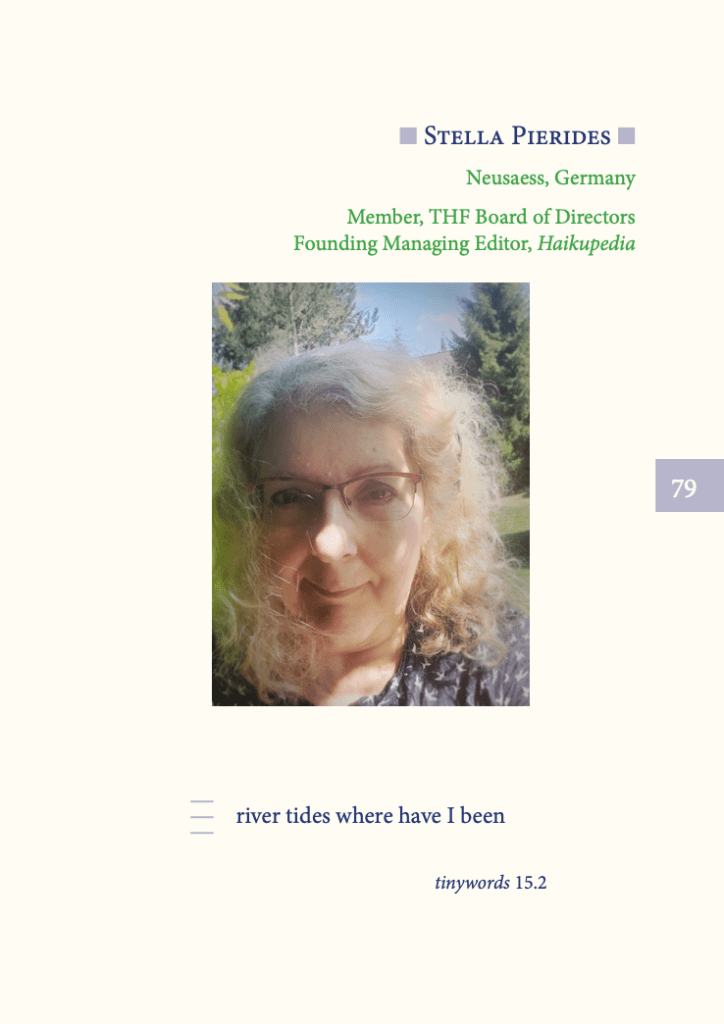
Stella Pierides, who lives with Parkinson’s herself, is a writer and poet. Her books include Of This World (2017) and In the Garden of Absence (2012), both HSA Merit Book Award recipients. Her article “Parkinson’s Toolbox: The Case for Haiku” appeared in Juxtapositions: A Journal of Research and Scholarship in Haiku, issue 8, 2022.

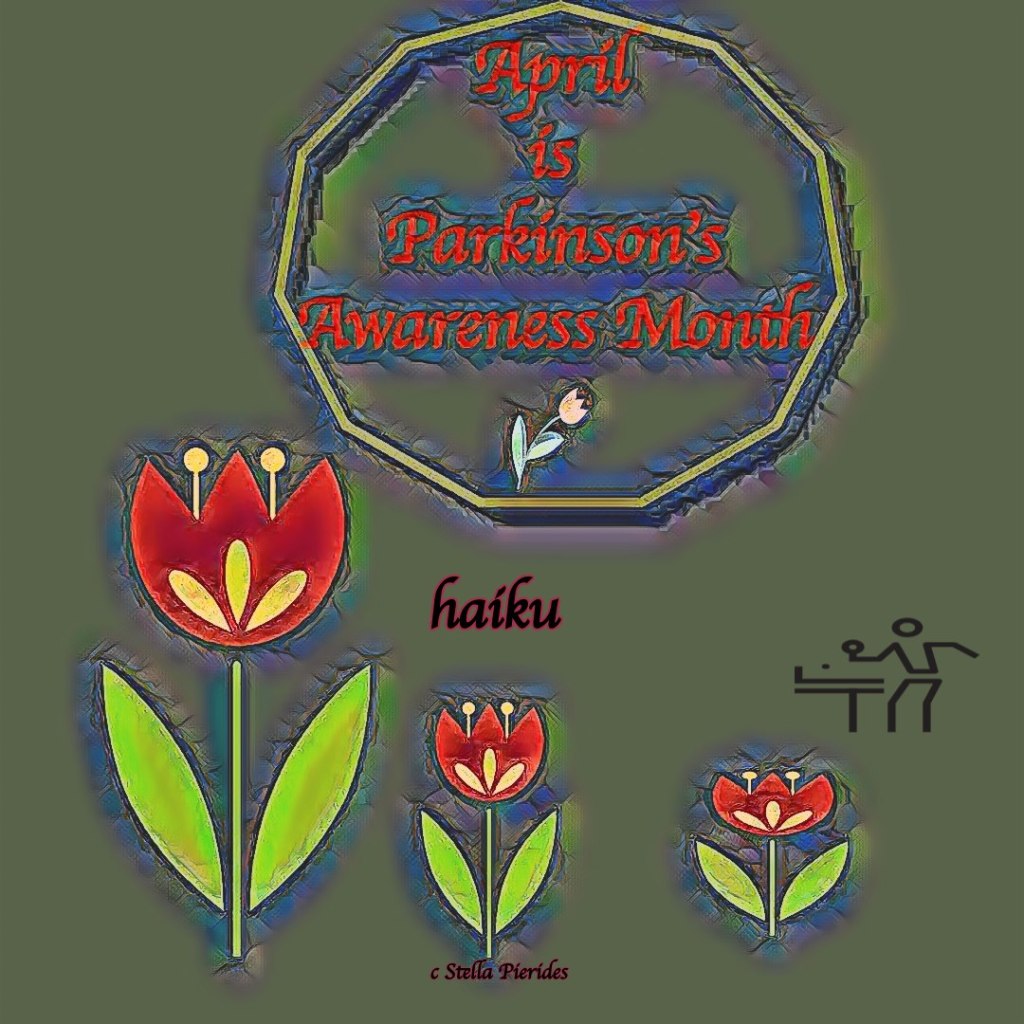
April is Parkinson’s Awareness Month

How to live well with Parkinson’s Disease? What helps me: Haiku for #Parkinsons and #tabletennis!

I have haiku in my Parkinson’s toolbox! Poetry, exercise grounding the senses, living in the moment. And I am sharpening my table tennis skills, as it has been found to help with the disease.

For all things haiku, including advice for absolute beginners, check out The Haiku Foundation https://thehaikufoundation.org/

For haiku for Parkinson’s see Parkinson’s Life, the magazine of Parkinson’s Europe, https://parkinsonslife.eu/the-aim-of-the-haiku-poet-is-to-capture-the-essence-of-a-moment/

More information about table tennis for Parkinson’s on Facebook and  website https://www.pingpongparkinson.de/

Live well and prosper! Or as I am increasingly learning, “bleib’ am Ball”!

Parkinson's Awareness Month

Parkinson’s Toolbox: The Case for Haiku

Juxtapositions

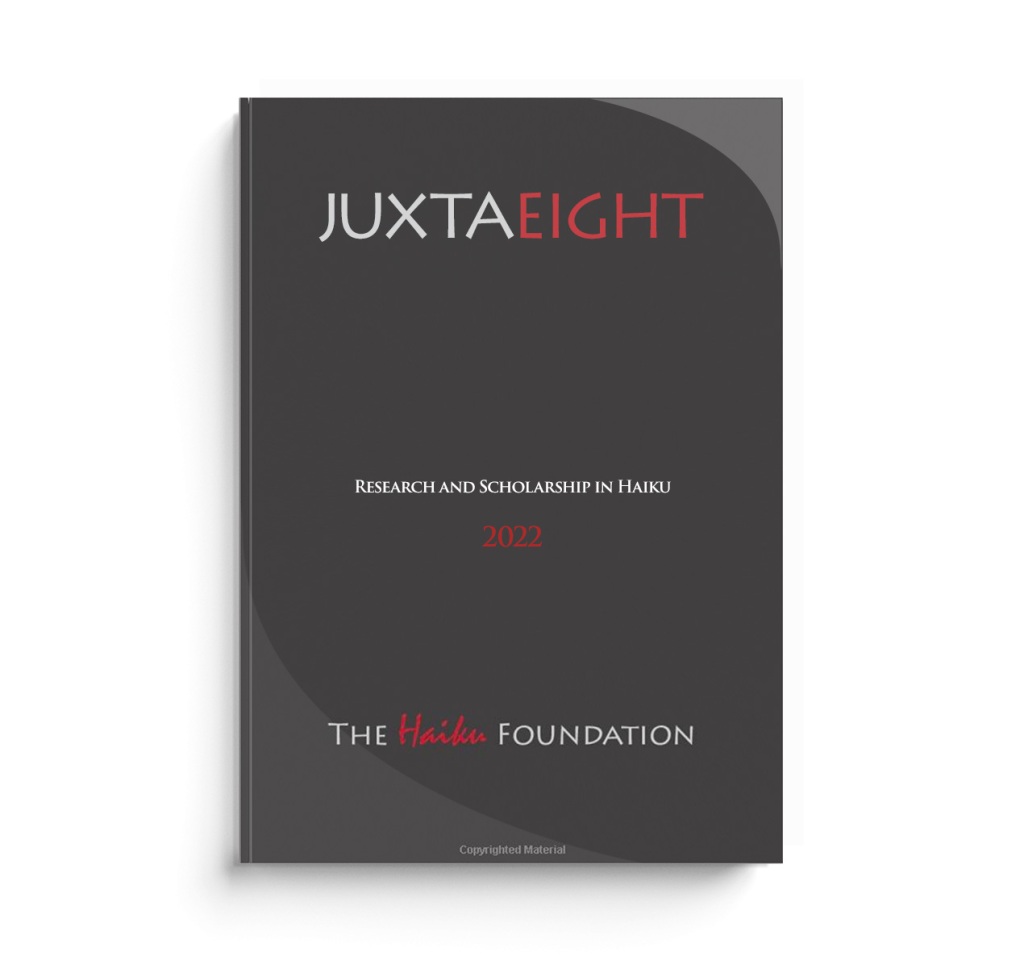
 The eighth issue of Juxtapositions: Research and Scholarship in Haiku is out. JuxtaEIGHT is a themed issue on “haiku and wellness,” with several articles, interviews, and resources addressing this theme. And it includes two contributions by yours truly: the article “Parkinson’s Toolbox: The Case for Haiku” is now available to download (pp 37-61), as well as a description of Haikupedia from the Resources section of Juxtapositions: Check them out here https://thehaikufoundation.org/wp-content/uploads/juxtaeight.pdf

I copy below the Abstract of the Parkinson’s article:

Parkinson’s Disease (PD)—the fastest growing neurodegenerative condition worldwide—affects a wide range of motor and nonmotor functions. At present, there is no cure. Only symptomatic treatment is available, aiming to improve quality of life and slow progression. The aim of this paper is to recommend haiku as a therapeutic tool helping with symptoms and, potentially, rate of progression. To this end, following a brief description of PD, and its symptoms grouped under two areas of loss resulting in life diminishment, I touch upon the general role of art and literature in augmenting pharmacological treatment of the disease, before focusing on some of the qualities of haiku (in the process of writing as well as the created poem) that collectively make haiku a containing vessel that can hold and transform the distress associated with the disease into a more bearable experience.

icicle

Happy to have won third prize in The Haiku Foundation February 2022 Kukai

theme: icicle

icicle . . .
how long will he take
to forgive me

     — Stella Pierides (51 points – 4; 3; 2; 5; 3)

kukai haiga

Remarks below are by Dee Evetts, THF Monthly Kukai Commentator. He is an internationally known haiku poet and author of “The Conscious Eye” series on contemporary themes in Frogpond in the late 1990s and early 2000s.

I find that a great deal is implied here. It is winter. There has been a falling out, and apparently a felt culpability on the part of the writer. Possibly the weather (or another circumstance) has forced the couple or pair to be together when they might otherwise have chosen to put some distance between themselves –– at least for part of the day. There is a prevailing silence, and at best, monosyllabic and toneless exchanges when strictly necessary. This is one of those “suit yourself” kind of domestic stand-offs. It is true that I am embroidering –– even weaving my own version of the poem. Another reader will come up with a different story. What counts is that the poet has given us room to speculate, while at the same time giving us the very concrete image of the (how gradually?) thawing icicle.

JuxtaSix

A Happy New Year 2021 to all my friends! A year filled with Health, Love, Creativity, Happiness, and Peace!

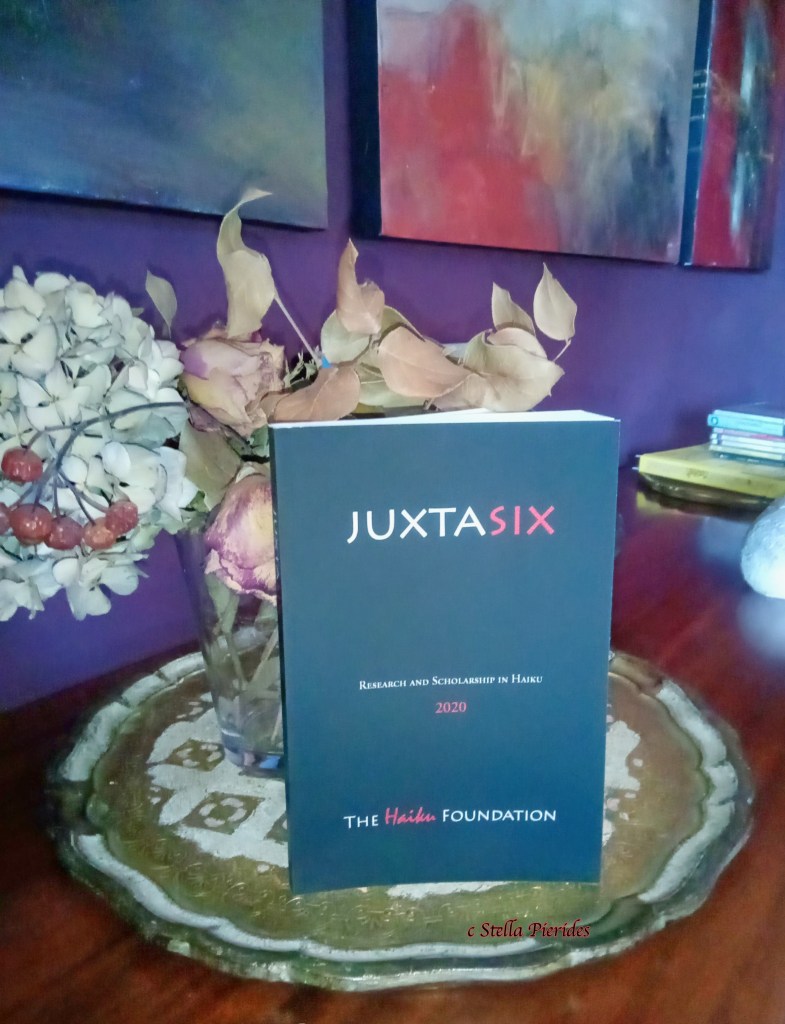
Meanwhile, still in 2020, JuxtaSix: The Journal of Haiku Research and Scholarship, the print issue, is available! I just received my print copy from Amazon. It is a very interesting and well-presented issue. I am happy to say it includes an article on Haiku and the Brain that I co-authored. Many thanks to the editors, and reviewers, and well-done to my fellow authors!

Haikupedia

Haikupedia opened its doors on 21 June 2020. Now in its seventh week, it has released articles on haiku in several countries, biographies, awards and contests, and other articles for study, for research, and enjoyment. All you ever wanted to know about haiku is being written by experts and gathered in one place: Haikupedia. Every week new material! It is growing and it is getting better.
And it is always open, always there. You can visit anytime you like: https://www.haikupedia.org

21 June: Biography of Issa, the Matsuyama Declaration, and Haiku in New Zealand
https://www.thehaikufoundation.org/2020/06/21/this-week-in-haikupedia-june-21-2020/

28 June: Biography of W. G. Aston and Haiku in Finland
https://www.thehaikufoundation.org/2020/06/28/this-week-in-haikupedia-june-28-2020/

5 July: The Genjuan Haibun Contest and West African Haiku
https://www.thehaikufoundation.org/2020/07/05/this-week-in-haikupedia-july-5-2020/

12 July: The Touchstone Awards over the years
https://www.thehaikufoundation.org/2020/07/12/this-week-in-haikupedia-july-12-2020/

19 July: All about England and Wales
https://www.thehaikufoundation.org/2020/07/19/this-week-in-haikupedia-july-19-2020/


26 July 2020: Southern Africa and The European Top 100 Most Creative Haiku Authors https://www.thehaikufoundation.org/2020/07/26/this-week-in-haikupedia-july-26-2020/

2 August: More to come! So much more …

Haikupedia

It is June 21st, 2020, and The Haiku Foundation just announced the debut of Haikupedia, its encyclopedia of all things haiku! I copy below the Troutswirl blog post about the first week of Haikupedia’s existence:

Each week for the next several months we will release a few new articles in our ever-expanding encyclopedia of haiku. These we hope will give you a sense of the potential scale of this enterprise, as well as entice you to become a part of the project.

We begin this week with a long biographical article on Japanese master poet Kobayashi Issa. We present the full English text of the Matsuyama Declaration, a landmark in the establishment of “world haiku.” Our featured country this release is New Zealand, not least because of their supremely executed management of the Covid-19 pandemic. You will also find short biographies of this week’s featured writers, David G Lanoue and Sandra Simpson, as well as the several people behind the start-up of Haikupedia: Editor in Chief Charles Trumbull, Managing Editor Stella Pierides, Photo Editor Iliyana StoyanovaHaikupedia (and Haiku Foundation) Website Manager Dave Russo, and THF Founder and President Jim Kacian.

Haikupedia is a vast and wonderful project and I am both humbled and honored to be part of it.

Introducing … Haikupedia

For the past year and a half, I’ve been working on Haikupedia, the new project of The Haiku Foundation. This is how it was introduced by Charlie Trumbull, Haikupedia editor in chief, in the June edition of the Newsletter of the Haiku Society of America.

Introducing … HAIKUPEDIA!
We are excited to announce the launch of a new source for the enhancement of haiku scholarship and enjoyment!  HAIKUPEDIA, an online encyclopedia about all aspects of everyone’s favorite verse form, will debut on The Haiku Foundation website in a few days.

Background
My name is Charlie Trumbull and I have been accumulating English-language haiku in English for almost 30 years and making my digital Haiku Database—now containing almost a half million haiku. I have also been collecting bibliographic and biographic information about haiku poets (mostly from back-cover blurbs, obituaries, and the like), haiku organizations, and general information about Japanese verse that I often had trouble locating in my library or online. As I passed 75 years old I began to realize that I had better do something with these massive collections before they get buried along with me. The idea of creating an encyclopedia of everything about haiku seemed to be a good and feasible solution. Online rather than print also seemed to be the way to go. Ergo, HAIKUPEDIA.
Now, I am not a particularly comfortable resident of the Internet, and I knew I lacked the experience and smarts to make a complex website on my own. So about two years ago I approached THF President Jim Kacian with the idea. He was enthusiastic and immediately saw how the Haikupedia project dovetails with The Haiku Foundation’s mission. We have a marvelous marriage of resources and capabilities: I have the basic idea and much of the content in my voluminous databases, Jim has the organizational resources, especially in the areas of Web design and access to persons who could help out in the commissioning, writing, and editing of Haikupedia articles. Dave Russo has taken on supervision of the website design and maintenance. 
For the Haikupedia editorial team Jim also recommended Stella Pierides, a member of the THF Board and recent editor of the Per Diem feature on the THF website. Stella is the Haikupedia Managing Editor. Our search for a Graphics Editor netted us Iliyana Stoyanova, whose experience with the United Haiku and Tanka Society, the British Haiku Society, and the Living Haiku Anthology, are proving invaluable.

Definition and basic structure
Haikupedia is a Web-based encyclopedia dedicated to all aspects of haiku worldwide. It is a project of The Haiku Foundation compiled, edited, and published by the volunteer Haikupedia editorial staff under the direction of Charles Trumbull. Haikupedia articles are written and signed by specialists. A title list is being developed for Haikupedia entries as follows:
Core Articles—Long and short essays on major topics in haiku. This category will include chapbook-length articles on fundamental topic such as “Haiku,” “Renku,” etc. Countries Also articles of appropriate length detailing the discovery and development of haiku in the principal countries, nations, and regions where it has taken hold.Biographies—sketches of haiku poets, translators, critics, etc. The number of subjects for biographical treatment runs into the tens of thousands. In the beginning for Haikupedia we have adopted a temporizing strategy favoring quantity over quality—well, at least thoroughness—and created a subcategory of ‘Short Biographies” of 50–100 words with just the basic facts. At the same time we will be commissioning regular long Biographies.Glossary—Definitions and glosses of terms used in and about haiku.Gazetteer—Information about places mentioned or otherwise important in haiku.Organizations—Information on international, national, and local haiku organizations and groups, their sponsors and organizers, members, and main activities.Events—Reports about haiku meetings and other events, dates and locations, sponsors and organizers, attendees, and main activities and presentations.Awards & Contests—A tally of all haiku-related contests worldwide with information about the sponsors, adjudicators, number of entries and countries represented, prizes, and winners for each.Publications—Information on haiku publications in print and online, including major books of haiku, translations, and criticism; anthologies, journals, websites and blogs, etc.Bibliographies—topical lists of books, articles, and online sources.

Where we’re at and where we’re going
You’re reading this message before Haikupedia is available to the public. Stella and Jim worked out a schedule for releasing the first volley of Haikupedia articles. We’re going live on Sunday, June 21 Jim will post an inaugural message, announce the Haikupedia URL on The Haiku Foundation’s Troutswirl blog a few days before the launch. Mark your calendars!

For the formal launch we plan to post these items
Kobayashi Issa by David G. Lanoue [Bibliography; 9,000 words] an essay based on Dave’s longstanding interest and many books about everybody’s favorite Japanese haiku poet. The article also includes a comprehensive annotated bibliography of work by and about Issa.Haiku in New Zealand by Sandra Simpson [Country; 8,000 words], a detailed history of haiku and report on the status of the haiku enterprise in New Zealand/Aotearoa. The bibliographic sections list the important work of or about Kiwi haiku.Matsuyama Declaration [Document; 4,700 words], the text of the landmark 1999 statement by a group of leading Japanese haiku poets and scholars essentially acknowledging that haiku is no longer exclusively Japanese and presenting standards for “world haiku.”Mini-Biographies of Haikupedia principals [unsigned abstracts of longer Biographies that will come later; 50–100 words each] (Haikupedia dignitaries Charles Trumbull, Stella Pierides, Iliyana Stoyanova, Dave Russo, and Jim Kacian) and the authors of the posted major articles (Lanoue and Simpson).
In the following weeks, every Sunday, two or three major articles and a handful of short Biographies will be posted, each release billboarded on Troutswirl. We’ll stick to this schedule through the end of October, then take a breather and decide how to go forward.

A caveat
Perceptive readers will quickly notice that Haikupedia is currently set up to serve only an English-speaking audience: all articles are in English and nolens volens our focus hews pretty closely to North American topics. We hope this will not be so for long. We plan to expand our coverage of non-American topics. Moreover, we want to “double” some of the key articles by posting a translation of, say, “Haiku in Croatia” in Croatian side-by-side with the English version. Alternatively, we may commission essays to be written in, say, Japanese and have them translated into English. Wouldn’t it be fabulous to have, side-by-side, a Japanese and an English article on, say, Richard Wright or renga!

Join us!
The Haikupedia concept is virtually limitless — and far grander than a half-dozen editors and two dozen authors can possibly realize. We welcome [read: “desperately need”] volunteers. Can you write us an article in one or more of the categories mentioned above? Would you like to help out by taking charge of a “cluster” of related articles? Would you have the skills to help with administrative tasks, data entry or other website work? Contact me at trumbullc\at\comcast.net or Jim at jim.kacian\at\thehaikufoundation.org and let’s talk.
Charlie Trumbull,Editor, Haikupedia

‘Noir’ on HaikuLife

Happy International Haiku Poetry Day 2020!
And what a day it was! The Haiku Foundation announced the Touchstone Awards, hosted HaikuLife, the haiku Film Festival, and administered the collaborative poem “EarthRise” on the theme “Nurse.” And everyone had fun!

I contributed a video haibun, “Noir,” to HaikuLife as well as five poems..

My haibun triptych “Noir,” published in MacQueen’s Quinterly, made into Video haibun “Noir,” in collaboration with Rob Ward, was presented as part of HaikuLife on IHPD! Many thanks to Rob Ward, after-effects artist and animator, for bringing the stills to life, and Alex Menzies for permission to use his haunting piece Gretchen from his composition Faust for this video.

Noir

http://www.thehaikufoundation.org/omeka/items/show/5991

Enjoy!

New Resonance Community video

Check out this video: “How I found my voice: A new Resonance Community Reading” from the Haiku North America Conference 2019. From Jim Kacian and Julie Warthers’s presentation on this Community of poets, including members reading out their work. Julie read out haiku by members not able to attend.

Here

My own poem was read out, too:

atlas
the weight
of my dreams

The video was featured as part of this year’s Fundraiser running from Thanksgiving to St. Nicholas’s Day.

Clover and Cows

clover,

clover in flower
the Holsteins come
with four stomachs

This week’s poem by Dan Schwerin (Modern Haiku 49:2, Summer 2018), discussed at The Haiku Foundation feature Re:Virals, attracted delightful responses that illuminated the poem from different and serendipitously complementary angles.

The week’s winner, Garry Eaton, provided an interesting and robust commentary seeing the poem’s environmental concerns, alluding to 19th century farming changes by

… highlighting the mindless, mower-like and digester-like efficiency of cows as in massive numbers they convert landscapes into milk and excrement in an endless search for more green.

The other commentators too, in their own way, provided fascinating inroads to the ku.

One paragraph from Julie Warther’s commentary caught my eye:

We each have our empty places looking to be filled. We hold common yearnings for love, acceptance, safety, sustenance and purpose. The natural world and those in it have much to offer. Do we come ready to receive? Do we return hungry for more? Do we have the capacity (four stomachs worth?) to take in the goodness, beauty and bounty surrounding us?

In the commentaries, desire, pleasure and insatiable hunger come together through the poem’s image of cows with multiple stomachs, mowing down environmental resources. Perfect metaphors for humans for whom – on individual and societal levels – the grass is always greener on the other side of the fence, and who will employ all means necessary to consume, to obtain the next piece of land, the next oil field… The effects on nature, climate, resources are all around us to see. As Warther asks, do we have the capacity to process and digest what we receive, to ‘stomach’ it, to experience ful/fillment? To contain our desires? To create a sustainable environment, where the milk we receive is both sufficient and good enough to nourish us?

In Schwerin’s poem, c/love/r is in flower. It is not the first time, and it won’t be the last. In the optimist’s reading, the ‘clover in flower’ in this rural idyll has survived previous years, and it sounds that, with care, it is going to survive the next ones.

Refreshing to see clover — considered an invasive weed in the context of gardening — standing for ‘milk’ in its use as animal fodder, and the cows — whose milk is usually associated with nourishment — standing for ruthless, destructive urges. But that’s another poem, and another story.

You can find the full re:Virals post here.

If, like me, you enjoy thinking about these matters, make sure you receive The Haiku Foundation posts. Re:Virals, managed by Danny Blackwell, appears Fridays.

The Haiku Foundation Fundraiser: Check it out!

The Haiku Foundation,Fundraiser, Once a year, The Haiku Foundation asks for our help to meet the financial challenges it faces to continue its work. It does so during the period from Thanksgiving through St. Nicholas Day, the time set aside by many to think about our blessings and give thanks. Each day between the 23rd of November and the 6th of December, a blog post on the Foundation site highlights one of its many features, presents a video, offers a sale item from the Gift Shop, and more!

Do visit the blog every day, find out what the Foundation offers, what the people involved with it do, celebrate the offerings, and help in whatever way you can to support the Foundation continue to promote the cause of haiku.

Day 1

EarthRise Rolling Collaborative Haiku 2017

The EarthRise Rolling Collaborative Haiku 2017, the world’s longest poem, on the theme of Reconciliation, is now collated and ready to treasure! You can find it in The Haiku Foundation site by clicking here
Many, many wonderful haiku.

I copy below my own contributions to the poem:
melting snow…
a pressing need
to confess
.
and who would hear
the sound of the sea…
reed ears
.
Passion Week—
letting the wild garlic
grow
.
daily grind
a stork pair picking
worms
.
revving up the engine
despite the rain
because of it
.
First appeared in Haibun Today Volume 11, Number 1, March 2017
.
refugee child–
folding and unfolding
his paper boat
.
First prize, Sharpening the Green Pencil, 2017
.
juggling
a pen and a feeding spoon –
the baby’s laughter
.
First appeared in Inner Voices, International Women’s Festival, 2017

.


Fight on! (in re:Virals 80)

What does it mean to wake up facing a fist pressing hard against your window?
How does one cope with such a threat, day in, day out?

The morning presses
its hot fist against the window:
the fight starts.

— Bart Mesotten, Haikoe-boek (self-published, 1986; translation by Max Verhart)

Pleased to share that my take on Bart Mesotten’s excellent poem is featured in this week’s re:Virals, The Haiku Foundation’s haiku commentary feature.
Take a look here 

And try your hand at writing a commentary on the poem I chose (as this week’s winner) to be discussed next: LeRoy Gorman’s “the good soldier.”

re:Virals 49

A haiku is worth a thousand words: paraphrasing this well-known English idiom, I wish to point to this week’s re:Virals, the weekly haiku commentary over at The Haiku Foundation.
Robert Mainone’s poem

my haplogroup
shows the sponge gene —
distant lightning

(Modern Haiku 40.3, 2009)

was featured on re:Virals 49 and commented upon by a number of poets, yours truly included. So interesting to see how much is packed in this haiku! Take a look here

‘Arrivals’

In my presentation ‘Arrivals‘, a HaikuLife format reading of some of my recent poems, I weave responses to the refugee arrival crisis in the Arrivals video trainsMediterranean, and the conflicting reception refugees received so far, with the more general human challenge of ‘arriving’ anywhere…

The film, edited by Rob Ward, After Effects artist and animator, was presented during HaikuLife 2016, part of International Haiku Poetry Day, an initiative of The Haiku Foundation, held 17 April 2016.

What a Day! International Haiku Poetry Day 2016

April 17, International Haiku Poetry Day, IHPD for short, is the day of celebration of all things haiku.  The Haiku Foundation encourages public events on local, national and global levels, including readings, exhibitions, excursions, collaborative projects and competitions. Since 2015, the event is listed in the World Kigo Database,  a great source of advice and information. (see Kigo Calendar).

pottery,jug, While waiting for next April 17 to come round, don’t miss the opportunity to watch the wonderful haiku films that were presented at this year’s HaikuLife, the Foundation’s Film Festival 2016.   And scroll through the longest haiku collaborative poem, EarthRise Rolling Haiku Collaboration 2016. This year, in acknowledgement of the United Nations Year of Pulses, the theme of the project was Foodcrop Haiku.

Here are my own offerings to EarthRise:

earthquake
the seed in the child’s
open palm
.
picking over lentils—
quiet
of the evening hour
.
mice-nibbled sack—
edging closer to
the real
.
at the back
of the late night bus
whiff of wild garlic
.
all seeds accounted for dawn chorus

.


The Haiku Foundation re:Virals 31 and my Commentary

This week, a terrific haiku by Melissa Allen was up for discussion at The Haiku Foundation  re:Virals. Interesting commentaries looking at the poem from different perspectives. You can read the whole post with the poem and all the commentaries  here. I am pleased to say mine was this week’s winner. I copy it below:
.
Melissa’s poem:

radiation leak moonlight on the fuel rods

          — Melissa Allen, Haiku in English: The First Hundred Years (2013)

And my take:

In current usage, the word leak refers to a variety of situations: from leaking a document and bringing into the light a secret, to taking a leak, to a wasteful dripping of water, to seepage of radiation. This poem, with its radiation leak, immediately opens up a danger zone. Step in at your peril into an image that gives rise to paralyzing fears, to the dead zones of Chernobyl, Fukushima; to the forbidden zones. Anything could happen here.

From a leak to a fireball, from the atom to the apocalyptic mushroom cloud, you could be walking into a minefield of the results of unbridled ambition and unscrupulous greed, a Faustian deal . . . Whether the leak is from a technological or scientific project, where man sees himself tirelessly bent on expanding knowledge and power over nature, finding solutions to the human problems of illness, poverty, and environmental degradation; whether hubris or dedication to the common good, here is a consequence: the spewing of poisonous material, the fall into a dark, man-made Hell.

But now the poet brings moonlight on the scene. Like a benevolent, all-seeing Eye of God, moonlight bathes the fuel rods in light we associate with understanding, with cool logic, in forgiveness. I am reminded of the Greek poet Yiannis Ritsos’ Moonlight Sonata, where moonlight hides smaller-scale follies such as showing white hair as golden, at the same time relentlessly intensifying shadows. In Allen’s poem too, moonlight is both kind and cooling, as well as relentless and permanent, not allowing the fuel rods to hide in the shadows. An image burned into the mind.

Note that the fuel rods are not spent. The young man in Ritsos’ poem too, is present all through the poem, at the end leaving full of energy, bursting into laughter as he walks away. Life continues in its boundless energy, in its perpetual flow, beyond leaks, beyond the night, beyond our human follies, beyond life itself.