Thrilled to see that my ‘lifting the veil’ poem was featured on The Haiku Foundation Per Diem: Daily Haiku on the 6th of January 2019!
Many thanks to guest-editor Simon Hanson for including it in his wonderful collection ‘Darkness’!

Thrilled to see that my ‘lifting the veil’ poem was featured on The Haiku Foundation Per Diem: Daily Haiku on the 6th of January 2019!
Many thanks to guest-editor Simon Hanson for including it in his wonderful collection ‘Darkness’!

The ossuary, a white-washed, rectangular building, is dark and cool. A musty smell envelops me as I enter. I am searching for the metal box containing my mother’s bones.
I’ve been told she is confined to one on the shelves that run the length of the room. I start searching methodically. Each box has a small hand-written label with the deceased’s name on its front. Several labels are blank. One has a dried daisy flower stuck on it with Sellotape; another, a star in cross stitch; yet another, a tiny motorcycle sticker. Photographs of the dead looking youthful are taped to several boxes, or placed next to them, complicating identification of the containers’ occupants.
Disheartened, I leave the grim building to walk in the dappled shade of the graveyard. The hum of the city mixes with birdsong. So many years since I was in Athens. I stop to read the names of the deceased on headstones, marvel at the stone angels, at the oil lamps. Soon my head is swimming. A woman burning sweet-smelling incense over a grave turns to look at me. I quickly look away, but then, returning her gaze, I nod and she smiles.
noon heat
a hairline crack
in the angel’s wing
In Unbroken Journal, issue 20, 2019
Reality Bites
In my teens I spent school holidays in the local library. From opening to closing time, the library was my home. In the sizzling Athenian summers, it was the only cool place to be. The silence in the reading room felt like a blessing. Sitting at my desk I listened. A page turned. Someone shifted in their chair. Someone sighed. Silence again. I revelled in the sounds of human presence in this magic emptiness. A paradise. Except one day, when a cicada started singing. Having found its way in, it perched on Borges’s “The Book of Sand.” Heads turned. There was a commotion. A reader screamed, “Get this thing out of here!” The librarian, arm raised, raced to the shelf to swat the culprit, but the insect was no longer there.
turning the page
I come across the truth …
midsummer darkness
And yet
The road twists and turns for miles ahead. The refugee caravan moves haltingly forward. Mothers carrying their babies; dazed children, old people, the young, all stagger towards a safer future. Crossing the Red Sea, walking through deserts, wading across the Suchiate River, the caravan camps at Calais, rests for a night on Lesvos, repopulates the Sicilian city of Sutera, rows across river Evros. Razor wire carves memories on children’s skin. A voice over the megaphone: “Achtung, Achtung!” Babies are born, grow teeth, learn to speak. It rains, it snows, it shines. New words enter dictionaries. Poems emerge from sleeping bags.
each spring
breaking through the soil . . .
the human heart
We carry on
We turn out the lights, fall asleep and emerge head first into the real world. Belief, disbelief, nuance, knowledge; science, art, even poetry we leave behind. We enter this eternal world without walls, where we have control over nothing, yet we are nothing less than the seed of the cosmos. Here is our true home: fluid, quiet, boundless.
In the morning, once the alarm clock’s trill drags us back into consciousness, we dress in soft flesh, teeth and nails, and catch the bus to work.
oak leaves …
planning to live past
one hundred

In Blue Fifth Review, The Blue Collection 9: Home
Image: ‘Boat’ by Maria Pierides
Grateful thanks to Michelle Elvy and Sam Rasnake for publishing my Haibun Triptych in the special issue “The blue collection 9: Home” of the phenomenal Blue Fifth Review!
Photo magic “Boat” by Maria Pierides accompanies the triptych.
Check it out:
Blue Fifth Review … the blue collection: 9: home (Winter 2018 / 18.10)

The main course is boiled beef with green beans, mushrooms, and sautee potatoes. A typical dish in this part of the world. What is atypical is the sauce that accompanies it. Unlike the horseradish recipes that make your nostrils flare, this delicate sauce introduces a surprisingly mature interpretation that sings to rather than stings the palate. My neighbour has chosen condiments that balance the flavours to perfection. I can feel the character of the well-tempered sauce on my tongue. No excess. No diversions. Clear limits. Boundaries.
noticing
the rose after the rain starts –
petrichor
In Blithe Spirit 28.3, 2018
another spring
the knotted branch
in the shredder
Blithe Spirit, 27:2, 2017
Stella Pierides
Chinese Translation (Traditional)
另一個春天
將一根打結的樹枝
扔到切碎機中
Chinese Translation (Simplified)
另一个春天
将一根打结的树枝
扔到切碎机中
Chen-ou Liu, 劉鎮歐December 7, 2018
Butterfly Dream: Another Spring Haiku by Stella Pierides
Stella’s shasei (sketch from life) haiku is tightly structured with an emotional undercurrent: “another” in L1 shows the narrator’s attitude to the passing of time while the symbolically rich image of the “knotted branch” in the shredder in Ls 2&3 makes this haiku visually and emotionally effective.
This September I took part in the Haiku for Change Event organised by Michael Smeer of the Facebook community My Haiku Pond, in conjunction with 100 Thousand Poets for Change (Global) 2018. Poets were asked to write one haiku (or senryu, haiga, or photo-haiku) on change: climate, environment, earth.
Entries were included in the Haiku for Change Event ebook Anthology, a pdf posted on the 100 Thousand Poets for Change blog, and archived by Stanford University as part of their program to document the 100 Thousand Poets for Change movement and community.
Here is my offering:
rising seas
a clutch of turtle eggs
in the park sandpit
The pdf is now up and can be downloaded from the 100 Thousand Poets for Change Blog
invisible ink—
and then we become
history
.
Ephemerae, 1, B, 2018, p. 62

Thrilled to have my poem featured on Per Diem: Daily Haiku, The Haiku Foundation site. The poem will be up all day today the 23rd of September 2018 here
Many thanks to editor Rob Scott for selecting it!
This poem was written for the AFL Grand Final Kukai 2017 and included in The Tigers’ Almanac 2017, p. 187 (Malarky Publications)

or not to be. . .
on a day like this
there’s no question
.
Ephemerae, vol 1B, August 2018, p.28
the last page missing
from the library book—
late autumn evening
.
Frogpond 41.2 Spring/Summer 2018, p. 27

.
72/100 #The100DayProject #100daysnewthings
In March 2018 I judged the British Haiku Society’s Haibun Contest (and announced it here in a brief post ). The contest was reinstated this year, and honouring two outstanding members of the Society, was named The Ken and Noragh Jones Haibun Award.
Following is the report of my choices and commentaries published in the Society’s Journal, Blithe Spirit, 28:2, May 2018.
A PDF of the British Haiku Society’s announcement of the awards (haiku, tanka, haibun sections) as well as winning entries can be found here, as well as in the Society’s Journal Blithe Spirit.
*
In reinstating the Haibun Awards, the BHS continues to encourage both, the creation of new work and the exploration of the possibilities offered by the form as it develops over time.
It was a great privilege to read the 50 haibun in a range of styles and lengths submitted to the British Haiku Society’s Ken and Noragh Jones Haibun Contest 2017. I thoroughly enjoyed reading the work, and wish to thank the poets for their submissions and the Society for entrusting me with this task.
 The BHS Ken and Noragh Jones Haibun Awards 2017
The winner is David Bingham (UK): Sleight of Mind
The runner up is Jean James (UK): The Visit
Winner: Sleight of Mind, by David Bingham, UK
Sleight of Mind refreshingly starts with placing the reader in the magician’s audience. Our minds’ eyes are glued to the shining light bulbs coming out of his mouth, his miraculously escaping from the straightjacket. The title, and the opening main clause, have warned us: this is a trick! Yet, in focusing on the ‘what,’ rather than the ‘how’ posed in the question, in a momentary suspension of disbelief, we fall for it, allowing the magic world centre stage.
How is it done? How does magic work, and how does the magic of haibun work to enable us to re-experience the writer’s epiphany and emotional truth? There is no answer here, only a question well put. Hopefully, there won’t be an answer anyway soon – though the poet, as well as we, know that there are perfectly ‘mundane explanations’ for the magician’s conjuring tricks and, to some extent, the haibuneer’s craft!
This is the haibun that kept me going back to read and re-read, finding new things as I followed its vertical axis. From the child-like awe (‘switching off the rational mind’) in the beginning of the prose, to nature brought in by the snowdrops in the haiku at the end, it leads the reader from illusion and mystery (the stage) to questioning and reflection (snowdrops and pondering what is) putting flesh on the bones of an old question about reality, perception and the mind. From associations to the Allegory of the Cave to reference (in the title) to wizardry as well as a neuroscience book on magic and perception, this brief haibun affords a variety of possible readings and stretches the reach of the form.
In having the narrator directly address the reader in short, sparse sentences the piece achieves immediacy, reinforcing the illusion of involvement. Weaving skilfully together the constituent elements of haibun (title, prose, haiku, content), it engages this reader on so many levels, and wins!
Runner up: The Visit, by Jean James, UK
The haiku at the beginning of the poem, through the ‘hare’s cry,’ warns us of painful content, getting the heart pounding. Yet in the prose the subject is handled delicately, drawing a picture of a family visiting the grandparents’ grave. The mother fetches water for the flowers she brought and is arranging in a jug, the children lark about, the father waits outside in the car. Then the children come across the grave of a baby, with violets in a jam jar under the inscription: ‘Mary Millicent, only a year in this world.’ The idyll is interrupted. Here lies the mystery of the poem. What happened, why? In the reader’s mind, the associations branch out: an unlived life, illness, suffering, poverty, the famine… From the individual to the social to the political dimension…
In the middle of what may be seen as a family idyll lies the dead baby, forever open to our interpretation. Yet life continues for the living. Hearing the crows’ caws, the children ‘come alive again’ and start cawing back. Life, learning and death in a nutshell.
I enjoyed the consistent voice of the child narrator in the prose, and the parallels in the poem: the beech and the violets, the hare’s cry and the soft murmur of voices, the bronze jug and the jam jar, the haiku in the beginning and the end – though the end haiku could have been stronger. I also liked the way the text, sandwiched between the haiku, moved the healing process between the beginning and end haiku: from the hare’s cry to the soft voices murmuring to each other, we glimpse a real family in its encounters with death as it becomes a fact of life, part of the life cycle.
*
Honourable Mentions:
1. Games People Play, Gautam Nadkarni, India
Games People Play, by Gautam Nadkami, India, describes a childhood memory of playing cricket without knowing anything about the game. The haibun works well in a light-hearted, good-humoured way, with local children attempting to make sense of unfamiliar objects, cricket stumps, by inventing a use for them based on their environment: keeping cattle from straying onto the pitch. At the same time, the choice of game in this haibun, cricket, connects to colonial themes. The title too points to layers of meaning.
2. Fake News, by Marietta McGregor, Australia
Fake News, by Marietta McGregor, Australia, inserts a surprisingly modern take into the form, whisking the reader on a whirlwind journey of tracing how it all came to pass. The haiku at the end adds an interesting change of tone that helps contain the energy and drive in the prose. I liked the contrast between the ‘mechanical’ sounds in the beginning of the prose and the ‘ethereal’ song in the haiku at the end.
3. Last Autumn Apples, by Marietta McGregor, Australia
Last Autumn Apples, by Marietta McGregor, Australia, relates the story of a lonely ten-year old’s memories of living in a house on an apple orchard where her mother worked, their moving to the city and eventually hearing about the place years later. This haibun – about place, belonging, and loss – has a sensuous, cinematic quality to it. I enjoying reading the monoku in this piece: two monoku in the middle read as if dividing the prose into ‘chapters,’ while a third, at the end, punctuates the theme of a lost childhood.
*
 I am filling out the form with a trembling hand. I am gripping the pen a bit harder than usual and the letters look tense and angular. Why? I am opting out of organ donation. As simple as that. I am not donating my eyes to anyone. And when it comes to my heart, I want to have a say in who receives it.
late autumn—
aboard the last boat
home
*
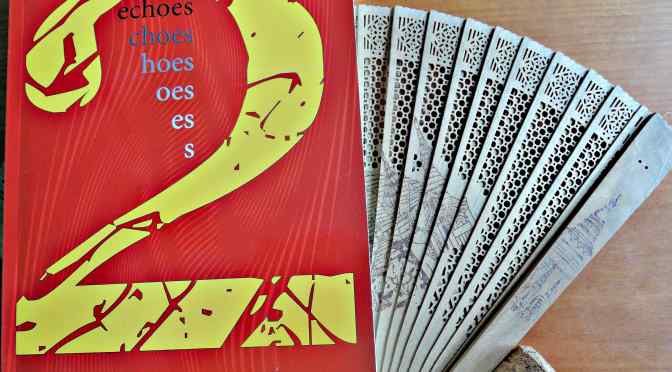
Grateful to be included in ‘Echoes 2,’ the yearbook of the New Resonance Community and its 170 poets, celebrating the 20th anniversary of the New Resonance series!
37/100 #The100DayProject #100daysnewthings

You can read the whole PDF in The Haiku Foundation Digital Library
or you may wish to order print copies of the book (for $8 a copy) from createspace
Enjoy!
unfurling fronds
my digital legacy
in the cloud
Gratitude! Originally included in Robert Epstein’s Beyond The Grave: Contemporary Afterlife Haiku, 2015, this haiku
has been translated into Chinese by Chen-ou Liu, 劉鎮歐 and included in Butterfly Dream!
Chinese Translation (Traditional)
展開的蕨葉
存儲在雲端平台中
我的數位遺產
Chinese Translation (Simplified)
展开的蕨叶
存储在云端平台中
我的数位遗产
Fragments
.

In Ephemerae vol. 1, A, 2018
26/100 #The100DayProject #100daysnewthings
rubber dinghies—
what they fled from
where they’re going
Haiku in Ephemerae, vol.1, A, 2018 24/100 #The100DayProject #100daysnewthings

My video ‘Lake Constance,’ filmed on location, with haiku by yours truly, and edited by Rob Ward, is now featured as part of The Haiku Foundation HaikuLife FilmFest 2018! (with the sound of waves and wind)
It’s at its loudest in the early morning hours. Before light dissolves darkness, before the neighbour leaves for work, before the birds start singing, his laboured breathing comes over the baby monitor whispering, gurgling, rattling, spluttering…
I lie awake listening to the crack of thunder, the roaring waterfall, the sounds of the sea emitted from his chest. A car starting, the exhaust backfiring, the train leaving station. The boat reversing in the harbour. Light rain. A soft mieow. His breathing renders a whole world. In this soundscape, I make out the stories he told me when years ago he put me to bed.
Soon, light dispels the apparitions, and his breath comes over the monitor soft, steady, regular, lulling me to sleep.
music of the spheres
how we became
human
*
In the inaugural issue of Wales Haiku Journal, Spring 2018
Honoured to be included in ‘old song,’ The Red Moon Anthology of English-Language Haiku 2017, edited by Jim Kacian and the Red Moon Press Editorial Staff:
The Red Moon Anthology of English-Language Haiku assembles each year the finest haiku and related forms published around the world in English into a single book. old song, the twenty-second volume in the most honored series in the history of English-Language haiku, includes 151 poems (haiku & senryu), 17 linked forms (haibun, renku, rengay and sequences), and 5 critical pieces on the reading, writing and study of the genre.
refugee child—
folding and unfolding
his paper boat
p.54
(This poem had received First Prize in the Sharpening The Green Pencil Haiku Contest 2017)
Delighted to have two poems featured on Jennifer Hambrick’s blog Inner Voices, for a second year hosting the International Women’s Haiku Festival 2018! This is how Jennifer introduces them in her blog:
Two laser-sharp senryu by poet Stella Pierides explore women’s age dynamics and the eternal question of women’s dress and sexuality.
dressed to kill
she asks
if I’m retired
Jennifer says:
Well. Why not just ask about her final wishes? The picture is this senryu is crystal clear: a younger woman, in full heat of professional and/or personal ambition and wearing the clothes to prove it, asks the poetic speaker, whom I read to be an older woman, if she’s retired – read: no longer competition, no longer someone to be concerned with. To be charitable, maybe it’s just an observation: the older woman looks older, looks perhaps comfortable in her own skin, and the younger woman just doesn’t get a) that retired doesn’t equal out to pasture, and b) that remarking, even obliquely, on someone’s age is at best insensitive. And what if the poetic speaker actually is retired? Picasso said it best: “It takes a very long time to become young.”
 and:
and:
knee-length skirt
the extent
of her rebellion
.
Jennifer writes:
This little senryu is situated perfectly between the rock and the hard place that, eventually, every woman encounters. Look sexy, be sexy, the world instructs. But not too sexy. In this poem, rebellion against the social expectations that a girl or woman be prim and proper results in a shorter skirt. But rebellion against social expectations doesn’t necessarily eliminate the expectations. There is potentially a price to pay – the demise of one’s reputation – for breaking the rules, hence the “extent of her rebellion” is defined by the knees. It could be fear from social pressure that keeps everything north of the knees covered, or it could just be the poem subject’s authentic assessment of her own comfort.
Many thanks to Jennifer Hambrick for including my poems!
I am very much looking forward to reading and enjoying the rest of the month’s contributions with Jennifer’s insightful commentaries.
beyond Mars
all wars fought
in silence
*
alpha centauri. . .
reaching for a cup
of tea
*
no matter what
roses
on Venus
*
small wonders
the cosmic dust particles
on my roof

In Scifaikuest (print version only), February 2018, p.13 (ed. t.santitoro)
Available from:
http://store.albanlake.com/
We die alone. We disembark on the Isle of the Dead with our heads filled with illusions. Vague memories of loves and hurts, envy and resentments. Perhaps holding hands with those who still can bear us, but alone with our regrets. Turning around for a last look, our eyes, swimming with sadness, rest on the ramshackle boats we leave behind.
white light beyond the crucible
*
In Modern Haiku, 49:1, 2018

My poem on tinywords yesterday:
river tides where have I been
.
(I almost missed it!)
Thanks to the tinywords team for the beautiful background image.
Pleased to see my ‘Intertextuality,’ a haibun diptych, in issue 4 of Sonic Boom, published under ‘Fiction.’
Issue 4, is an anniversary issue. Happy Birthday to Sonic Boom, many happy returns!
Intertexuality
(a diptych)
I
A reader asks for help with a patch of garlic plants forgotten and left to overgrow in their garden. Well, I say, dear reader, we are caught between a rock and a hard place. Garlic doesn’t like to be transplanted. And this text is not the right place to ask, or answer such a question. But I can’t resist. It is spring, after all, and I am stuck for ideas. So, to your garlic clump: Let it be. Let it grow, and when it is ripe and ready, when the tips of the green shoots start to brown, dig the plants out. They will be pungent, crisp, and juicy, the plant oils moistening your tongue. Then plant a few individual cloves for next year’s crop. Enjoy the rest.
writer’s block
the school of life
full of lessons
II
Spelt flour, baking powder, butter, milk, and salt. Mix, pat down, shape into rolls, and bake. Serve with olive oil, and garlic from another haibun to dip the bread into. Enjoy!
a frog jumps in—
intertextuality
for beginners

bicycle thief—
on her blouse
cherry blossom
.
2015 Haiku Invitational, International Sakura Awards Honorable Mention.
In time with the first snowfall…my haibun “Pandora’s Box” is now online at Haibun Today. A political haibun, looking back at the period of the Greek Junta and its aftermath.
The entire winter quarterly issue of Haibun Today can be found here
Do you sometimes wonder what happens after the gravediggers return to their workstations and the grieving relatives go home?  What is it of the self or soul that’s left inside the box or urn, or floating in the air? Do you think there may be life after death, a life after this life, an afterlife? Do you fret over reincarnation, heaven, or hell? Poets do.
resting in peace
her mobile phone
keeps ringing
Robert Epstein, a licensed psychologist, and haiku poet, has just edited Beyond The Grave: Contemporary Afterlife Haiku (Middle Island Press, 2015), an anthology of poets’ haiku on the life beyond. Thoughtful, sensitive, measured and moving, as well as studded with moments of humour, and brilliance, the anthology proves an invaluable companion for thinking about the limits (and beyond) of existence.
lilies the meaning of life after death
Leafing through poems on life after death, I let myself be led along lines of uncertainty, of hope, as well as humour, of the ineffable, of mysteries, without the certainties that dispose of thought.
afterlife
that turn of phrase
in her haiku
.
(Poems included in the anthology)
I must be on a roll! Delighted to learn that my haibun “Time” received third honourable mention in the “Best of Haibun and Tanka Forms” 2015, for the KYSO Flash Anthology due out in December 2015.
Roberta Beary, award-winning poet and haibun editor of Modern Haiku, the judge of this contest, wrote:
Stella Pierides’ haibun shows how time, which is also the title, turned the narrator’s expectations of her life’s autumn upside-down. The haiku at the haibun’s end effectively juxtaposes the images and original word choice in lines 1 and 2, lulling the reader along until the surprise of line 3. At first glance the haiku does not seem relevant to the prose. A deeper reading shows that the haiku echoes and expands the feelings of surprise and mortality elicited by the prose, which is exactly what is supposed to happen in haibun.
You can find “Time” here