Category Archives: Poems

‘blue moon’ haiku in 3 languages

blue moon

why am I reminded

of Mount Fuji?

.

in French:

.

lune bleue –

pourquoi me rappelle-t-elle

le mont Fuji ?

.

and in Romanian :

.

lună albastră

de ce îmi aminteşte

de Muntele Fuji ?

.

I wrote this haiku as a response to the painting  by André Derain: Mountains at Collioure, 1905, posted on FB by  Virginia Popescu (see here).

Virginia very kindly, and enthusiastically, translated my haiku into French and Romanian! Once again, thank you, Virginia! I like this idea!

You can see Virginia Popescu and other poets’ responses to paintings, and indeed contribute to her project yourself, on her FB page here

‘writing on the wall’ haiku in 3 languages!

.

writing on the wall
the drum beat grows
faster

écriture sur le mur
le rythme du tambour s’accélère
rapidement
.
scriere pe perete –
ritmul tobei se accelerează
cu rapiditate
.

Virginia Popescu posts paintings on her FB page and invites poets to write a haiku on them. I wrote this haiku to go with Rembrandt‘s Balthazar’s Feast, and Virginia translated it into French and Romanian! Thanks, Virginia!

It is also a response to the NaHaiWriMo prompt: drums

The Haiku Foundation: where the party continues…

The Haiku Foundation, a non-profit organization whose aim is “to preserve and archive the accomplishments of our first century of haiku in English, and to provide resources for its expansion in our next,” is the place to hang around if you are trying to make April, the National Poetry Month, last all year long!

There’s a lot to do there! There’s the Per Diem: Daily Haiku, in its box, on the Home page, bringing you specially selected haiku each and every single day of the year;  the Haiku Registry, with over 400 poets and poems to browse through; archives of contest-winning poems, and awards, with judges’ commentaries; an exciting blog with thought-provoking posts and information; contest and event calendars, a digital library, and forums for any haiku-related questions you can come up with…

And now, there is going to be more! The Haiku Foundation plans to create

“the first collection of in-depth interviews documenting the development of 20th century haiku. Poets, translators, and scholars…will share their work and discuss their ideas. The resulting video and audio recordings will be available FREE of charge on the The Haiku Foundation (THF) website: http://www.thehaikufoundation.org …”

Now that’s a worthy cause!

The Foundation is asking for your help with this project. Running a Video Archive Campaign, it aims to collect through donations the $6,000 it needs to buy the audio and video equipment necessary. Will you help them reach their goal?

They say:

“Imagine if you could watch your favorite poets talk about their craft and lives and respond to questions you always wanted to ask them. While the technology wasn’t available during the lifetime of some of our favorite poets, today we have the opportunity to create a rich resource for our generation and those to come. As we move forward into the 21st century, many haiku poets who led the way in the 20th have already passed away. We need to start working immediately to preserve the voices of those who are still with us. Their stories deserve to be heard.”

I can well imagine…

“If a haiku has ever stirred your heart, pitch in! We will return your generosity with hours of enriching interviews, and you will help preserve a fast-fading history.”

Please follow this link here for a lot more information, including various gifts/perks you receive with your donation, tax free advice, gallery of gifts, comments etc.

The party is over…

The National Poetry Month is now over. What a month it has been! Such wonderful celebrations!

The big, month-long party at ‘Couplets,’ the multi-author poetry blog tour, organized by Joanne Merriam of Upper Rubber Boot Books, has now finished. If you are already missing the buzz, missing seeing more of the new poet friends you’ve made, then you can at least look back and reminisce; leaf through the posts again: the whole month is summed up (posts and links, names and titles of posts) here

See if you can find my entries there!

A big THANK YOU to Joanne Merriam; and a big WELL-DONE!

NaPoMonth Guest: Mary Alexandra Agner

In the continuing  celebrations of National Poetry Month I am thrilled to host

Mary Alexandra Agner, whose wonderful poetry I have been recently savoring.

She can be found online at: www.pantoum.org

Mary writes:

Female Science Professor (FSP) posted an article last month entitled “The
Hate Stage of Writing
“. She discusses the ups and downs of attachment to your
work while writing scientific papers, including a brightly-colored graph showing her
attachment to the papers she’s written (ranging from hate to love) as a function of
the writing lifetime of the paper. I was struck by the similarities and differences
between her commentary and that in Diane Lockward’s thoughtful
discussion of when a poem is finished
.

FSP’s article explores the idea that you know the paper is finished when you hate
it. And while Diane’s article doesn’t address that directly, her advice about
letting the poem sit while you “get uninvolved with it” is, to me, a similar stance.
Anger can make you objective. (It can also make you completely subjective, so
apply it to your writing process with caution.) Anger can give you a distance like
the one Diane is discussing but I’m intrigued that I don’t see poets blogging about
hating a poem and knowing it’s ready to go out, while a scientist does. Undoubtedly
my sampling technique needs improvement.

It is the graph in FSP’s post that catches at me. I would like to see similar ones
for poems, especially some that include the impact of the publishing process on our
attachment to our own work. We should all take to heart FSP’s comment that she
“certainly [doesn’t] submit or finish any of [her] papers in the hate stage.”
Diane, perhaps, might add that we shouldn’t submit our poems in the love stage
either, when you are too close to the work to be objective.

It should not surprise you, this many words into my own commentary, that I enjoy
crossing the boundaries between science and literature, two cultures that have never
seemed that different to me, even after all the energy expended to display how far
apart they are. All the poems in my newest book, The
Scientific Method
, came to me as a guilty pleasure, bridging that gap and making
art out of what I was told was not possible. And the majority of them finished the
revision process with a resounding thump, excepting “Jump the Chromosome”
which I fear I revised away into too little, mostly based on some kind commentary by
an editor (who did not publish the poem). My graph, for the book as a whole, was one
flat line up between “like” and “love”. The only thing that kept my spirits up,
waiting to hear back from publishers, was that the poems continued to ring true for
me year after year. And that, rather than the objectivity of hate, is what allows
me to keep offering poems to editors for publication.

.

You can read a really scientific poem of Mary’s here

.

This post is part of the multi-author poetry blog tour  Couplets, the brain-child of Joanne Merriam, of Upper Rubber Boot Books.

haiku in Bregengemme/Chrysanthemum

 .

jasmine rice                                                                   Jasminreis
the tongue twists into a new                                   Zungenbrecher in einer neuen
language                                                                        Sprache

.

In Bregengemme / Chrysanthemum Vol. 11.1, 2011

(With many thanks to the editors for the translation into German)

My Most Beautiful Thing


Schmutter Marsh

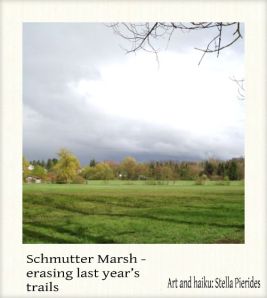
In November last year, I moved to a place near the river Schmutter, in the Greater Augsburg area. Some of you may remember my posts, and pictures, on ‘Leaving Ammersee’ from last year. Given the spectacular Ammersee lake and those sunsets – those sunsets! – it was difficult to imagine then how I would take to my new surroundings. Indeed, it has taken time for me to settle – still many unpacked boxes in the cellar! – but at least I have started going out for walks in the vicinity.

Almost next door, there are the Schmutter meadows: a nature reserve marshland by the river Schmutter (a tributary to the Danube), which is flooded several times each year. The soil is enriched by the flooding, and meadows become home to numerous rare plants, birds, and other animals.

And here, in the local marshland, its grassy paths, sludgy mud, numerous water channels, sluices, and flooded pools, the river itself twisting and turning, I have found beauty, again! This is a beauty I can neither own nor grasp in one go, i.e., in one picture, in one season, or one year. It is a beauty that develops, changes; a fragile, weather-beaten, marshland eco-system that I can only experience piecemeal on my walks through it.

If you have the time, take a look at this picture and haiku, imagine walking by the Schmutter. I will be posting more pictures from this area and writing haiku responding to my walks in the future. Am I trying to make this area ‘mine?’ Perhaps I am! You can come along for the experience.

Better still, choose an area near your own home, observe it, write about or take pictures of it, and turn it into your ‘most beautiful thing.’

This post is written in response to Fiona Robyn’s call for writers to write (and blog) about what they consider to be their most beautiful thing: a ‘blogsplash’ . In the context of her launching her new novel ‘The Most beautiful Thing,’ Fiona is making the novel available for free on the 24th and 25th of April 2012. Visit her blog for details here
