Drawing his knees to his chest, he felt the rock with his hand. The air stunk of campfire. A suffocating fog was rising from the rugged hills below.
Alerted by a stir in the scrub, he made out a wounded bird beside him, limping. A pigeon. The bird looked him in the eye as if trying to pass on a message, then scampered away.
After years of war, first against the Italians, then the Germans, now their fellow Greeks, even the fertile valleys in the Grammos mountain range below had been exhausted. The fighters had eaten everything that could be eaten, even the homing pigeons that they used as messengers when they had to maintain radio silence. Hunger drives men mad.
His eyes searched for the bird, absurdly worrying that it might be shot.
His hand caressed his breast pocket, where he kept his postcards to his wife. Poor Eirini, he thought. She didn’t even know he was still alive; still fighting.
He had been “writing” to her without words since they retreated to the top. The silence, the isolation and above all the awareness of approaching defeat robbed him of words. He drew on the rough paper the hills, the scrub, rocks that looked as if made by God, scree; the few cypresses, plane trees, and pines he remembered from his village. Recently, the faces of men who died in his arms.
One day, he thought, his postcards to his wife would be found – these drawings would be his last words to her.
———-
I am fond of this short story, as it touches on themes from my forthcoming novel, Alexandrias 40: In the Shade of the Lemon Tree.
A version of this short sotry appeared in 52/250 A Year of Flash, on the 26th of November 2010.
This month’s theme of the Festival of the Trees is “The Magic of Faerie Trees.” Hosted by Salix of Windy Willow, it is an interesting if bewitching topic. If you are into magic and fairies, fine. If you are not, what can you say about mystery or magic in a tree?
On the other hand, how is it that the olive tree is capable of living thousands of years? Is there magic involved? With its strong roots surviving underground, even when the trunk looks dead, the olive tree can make a claim to magic – though less so to mystery, if the strong roots explain its longevity! Then there is its outstanding beauty: its silvery foliage, almost like a whispering cloud, fused with its ragged, gnarled, twisted trunk, providing a unique image. This tree has so many associations for me that I decided to find a space for it in my second novel, When the Colours Sing. An olive tree in pre-alpine Bavaria! We’ll see how this strand is going to develop. But first things first.
There is the lemon tree (for which I made space in my first novel, Alexandrias 40: In the Shade of the Lemon Tree) to talk about. Glossy foliage, waxy, white-purple flowers, divine fragrance, fruit to grace any table, book or poem!
Lemon trees are said to have originated in Asia and spread in the Mediterranean regions after Alexander the Great’s soldiers brought them back from India. They are treasured trees in the Mediterranean lands. They are as important as olive trees and vines. They are vital to the health and well-being of the people living in those lands, as they have numerous medicinal, hygienic, cooking and culinary uses. From the abundant vitamin C, to the taste-enhancing addition to salads, soups, and various dishes, to decorative and aesthetic uses, to the perfume industry, lemons are most versatile.
In Northern Europe and America, there are additional associations which emphasize the lemon’s bitter taste, as in the expression “when life gives you lemons,” or the “lemon car,” referring to a defective, multi-flaw car. In a painting by Paolo Morando, The Virgin and Child, Saint John the Baptists and an Angel, Christ as a child is being offered a lemon, an act frequently associated with learning a variety of tastes and therefore being weaned off baby food.
In this sense, the lemon bridges opposites in taste (bitter-sweet), between cultural perceptions, and generations (weaning the baby off baby food). Is that a clue for interpreting the Italian, unknown artist’s painting Man and Wife, in the National Gallery of London, which has a lemon tree as a background?
Readers’ Digest lists 34 uses for the lemon. In Alexandrias 40: In the Shade of the Lemon Tree, there is a whole number of other uses – some surprising ones – for the lemon. But please note: try them at your own risk!
My haiku made it to the top five in the Iron Horse Literary Review haiku competition! I am delighted, especially since I wrote this haiku prompted by the name of the Journal and in response to their asking for haiku with either the word iron or horse.
I am particularly pleased because the competition caught me in the middle of writing my second novel, When the Colours Sing, set around the Blue Rider movement – it fitted so well.
The five winners: Marty Smith, Lauren Tamraz, Sarah Spencer Pokla, Benjamin Vogt, and Stella Pierides.
The IHLR is a review of poetry and literary non-fiction published six times per year by Texas Tech University. I am going to follow them and read what they are getting up to from now on!
You can find the results of the competition together with my poem here
The more one thinks about this story, the couple in it, and the twist at the end, the worse it gets … so, perhaps, it may be best if you don’t read this story!
The first edition of the Language/Place blog carnival is out. Why not visit here.
I quote from “virtualnotes,” where this particular blog carnival originated:
“The idea of “> Language > Place” is to create a collaborate virtual journey through different places, in different formats, and with different languages included – the main language is english, yet the idea is that every post also includes snippets or terms of other languages, and refers to a specific place, country, region or city.”
For more information and how to join this monthly event, here
I just watched a short youtube video trailer of a fantastic video poetry project, City Breath, bringing the poetry and art of South African cities to life! The link to this trailer is here
.
I was sent the following information about the City Breath project:
.
“Through their common city theme, these short video ‘gasps’ or ‘breaths’ of South African cities give voice to the private dreams and nightmares of local poets, dancers, performance artists and filmmakers. They interrogate, with or against rational logic, the way South Africans understand their cities and urban life. Rebellious in their nature, under 4 minutes each, the films represent a genre seldom seen in South African film and television.
“Inspiring, sometimes beautiful, sometimes challenging, and over-all very impressive.” (Trevor Steele-Taylor, Director of the National Arts Festival Film Programme)
The City Breath video poetry project was shown in several cities round the world – Johannesburg being the most recent, after Berlin, London, Cape Town, and Vancouver. Curator Kai Lossgott is looking for more venues and festivals around the world interested in showing the project. She can be contacted directly at info@kailossgott.com
Apart from selecting existing works, the CITY BREATH project has initiated and developed new collaborations in the areas of the video poem, screen dance and experimental film.”
I happen to know the work of one of the poets quite well: the immensely talented Tanya van Schalkwyk’s work, fusing imagination with sensitive observation and dynamic expression.
But watching the trailer (a few times!) made me want to see the whole thing!
Tania’s contribution to the video project is her poem “The Electrician” included in her book Hyphen. It can be seen here
My flash fiction story “A Private Person,” appears in the 52/250 flash fiction project, week 25.
52/250 is a project involving around eighty writers from all over the world who made the commitment to write and publish weekly, flash fiction stories for a whole year: 52 weeks, 250 words max! There is a theme for each week, and contributors can suggest themes to the editors.
I joined during week number 25, and my first flash appeared on Friday 5 November 2010. It is a short story about two individuals who see themselves as “private” persons. You can read it here.
The 52/250 project feels like a very encouraging, inspiring and warm place to be. I am going to hang out there… so, watch this space!
Three of my poems have now been published by Vox Humana Literary Journal,“a literary journal focused on international writing, with a sub-focus on works from Israel and Palestine”
Winter Picture started its life at the North London writers’ workshop Word for Word, after a writer circulated photographs she had taken of a snow sculpture: two human-like figures made of snow on a Hampstead Heath bench. In my poem, the sculpture became a war-torn couple… read it and see.
Mystery Train was inspired by a photograph used as a writing prompt in the Tuesday poetry group of Word for Word. The photograph was of Elvis, on a train platform at the beginning of his career in the 1950s… so soon after the War…
The refugee grew out of a scene in my novel “Alexandrias 40: In the Shade of the Lemon Tree.” A refugee from Smyrni lies in her hospital bed in Athens, unable to join the other patients; she is forever caught in her own private despair.
The Festival of the Trees is “a periodical collection of links to blog posts and other online sites, hosted each month on a different blog.” Bloggers, poets, writers with an interest in arboreal matters post related material on their own blogs and submit the links to the host of each month’s co-coordinator. This month’s host was Arati, of the Bangalore-based blog Trees, Plants and More.
My own contribution to this month’s Festival of the Trees, I wrote some time ago. In “If Trees, then Olive Trees,” I use the olive tree, a precious, almost sacred tree in the Mediterranean, western Asia, and northern Africa countries; a symbol of peace and hope, connecting to the “olive branch,” and the sighting of land after the biblical flood.
Short, gnarled and twisted, the olive treeeven looks appropriately old. It is said to live for hundreds of years, as its roots are capable of regeneration even if the trunk above ground is destroyed. Radiocarbon dating has confirmed 2000 year old trees in several countries! A tree known to be situated in the grounds of Plato’s Academy, in Athens, lived till the 1970s. An olive believed to have been planted by Peisistratus, the tyrant of Athens in the 6th century BC, is still to be found in Athens. Even older trees have been found in Israel and Arab lands, dating from 3000 and 4000 years ago. The trees of the Garden of Gethsemane are said to be dating from the time of Jesus.
In literature too, we know of several millenary trees: Homer featured olive trees in his poetry. Remember Odysseus bed?
My own poem is about putting down roots, both literally and metaphorically. You can read it here.
My novel “Alexandrias 40: In the Shade of the Lemon Tree” is also set around a tree, and it includes a number of surprising uses for its fruit. Not long now till the book is out. Watch this space.
For instructions on how to submit to the next Festival of Trees here.
What is a blog carnival? And do you have to wear carnival costume?
You can tell I am a late learner. I found out about blog carnivals yesterday! I immediately liked the idea. I learnt that a blog carnival is the regular appearance of a central post containing links to other blog posts on a previously specified theme. This post is written by the blogger who hosts the carnival. Hosts rotate. I quote from the originator of this particular blog carnival:
“there’s a given theme, and to join, you put up a relating blog post in your blog, and then send the link to the host of the carnival – who then puts a central page with links to all participating blogs / posts together.”
The > Language > Place Carnival will be of particular interest to bilingual authors living outside the country of their birth, or learning another language. There are so many of us… I take this to mean emigrants, immigrants, expats, exiles, also refugees of all kinds…all those finding refuge, or asylum, or arbour in a second language/place … travellers… after the Fall wanderers…
Visit the site for the full details.
Finally, no, you don’t have to wear carnival costume, though respecting the dress code of others is essential. And no, you don’t have to worry about eating/avoiding meat (carne). http://en.wikipedia.org/wiki/Carnival Though the idea is to beef up your content!
For a succinct definition of “blog carnival” and festival have a look here
Papa Osmubal’s poem “A Bum’s Demise,” published in Asian Cha, is nominated for a Pushcart. You can read the poem here. A very perceptive and thorough analysis of this poem is also published by Asia Cha, in their section A Cup of Fine Cha, here
I felt both moved and haunted by this poem; compelled to comment on it. It kept me thinking. It is a powerful poem, with many levels and even more twists of meaning. Verlaine is implicated. His liver also, though I was more interested in the state of his heart. Read my own comment in the comments section of A Cup of Fine Cha. You can also find it copied in my own Scrapbook.
Researching my novel When the Colors Sing, I came across information about a new memorial to the victims of National Socialism that has opened in Munich. It is a virtual memorial, with personal accounts of the victims being read out from the specific locations where the events described occurred across the city.
Michaela Melian, artist, musician, professor for time-based media in Hamburg, won the first prize for this audio art work in the competition “Victims of National Socialism: New forms of remembering and remembrance” held by the city of Munich in 2008. She was awarded the city’s art prize in 2010.
Melian collected material from newspapers and Holocaust archives, interviewed survivors herself and put together a sensitive and remarkable collection. The individual accounts, read out by actors, are indicated by blue circles superimposed on a digital map of the city, and people can click on them to hear the stories.
The digital memorial can be accessed from across the globe, especially by the younger generation more interested in digital forms of communication. In Munich, some museums are lending their mp3 players to those wishing to tour the places where the events described took place. Bayerischer Rundfunk supports the project, broadcasting narratives in special programmes. The Munich Department of Arts and Culture is also offering its support.
Incidentally, the visual image of Memory Loops reminds me of Anselm Kiefer paintings: “the dark light falling from the stars” for instance. Here is the link to Memory Loops, by artist Michaela Melian.
Giorgos Seferis, the Greek poet and Nobel laureate, 1900-1971 (born in Smyrni, lived everywhere else, almost), wrote:
I woke with this marble head in my hands; It exhausts my elbows and I don’t know where to put it down. It was falling into the dream as I was coming out of the dream. So our life became one and it will be very difficult for it to separate again.
(From “Mythistorima,” quote: Wikipedia; read the whole poem here)
Seferis was expressing an important element in the Greek identity, an element which weighs heavily on the Greek psyche. But while this has been written about, there are other “marble in the hands” issues in modern Greece. Take the recent “reporting” on the demonstrations, discontent, and rioting that has been taking place in Athens in the last year. The last event to make the news was the one that took place on the Acropolis.
The Persians sacked the Parthenon while it was still being built on the Acropolis of Athens, along with the rest of the city in 480BC. The Athenians raised it to the ground – I should say: rock – and then rebuilt it. There had been temples on the site earlier, and more were added later. It served as a mosque after the Ottomans took Athens in the 15th century. The Acropolis survived millennia of attacks and war damage, including being bombarded by the “Venetian Army” when it was used as a weapons arsenal by the Ottomans. Only last year, 2009, the new museum was opened at the foot of the Acropolis. And now, the Acropolis is being used as a place of protest. Culture Ministry employees, protesting about working for 22 months without pay, barricaded themselves inside, not allowing the tourists in until their demands were met.
A sad story, for the tourists were reported to have been unimpressed by the protest. They had travelled a long way to see the ancient site and were understandably disappointed. Sad for those Athenian workers too, those seeing no other way of exercising their legitimate right to protest and no other venue. Perhaps they thought this was going to make the world sympathize with their plight: after all, what would you do if you hadn’t been paid your salary for twenty two months? Sad, also, that the violence continues.
And yet, the people of Athens, and of Greece must be equally disappointed that their social, political, and financial predicament is not being put in the context of the unique Greek experience and history, but is instead too readily compared with ‘that of Western European countries. Brendan O’Neill, in an interesting article in Spiked, writing about the riots at the time of the killing of the Greek teenager, argued that the Greek problems were not simply due to the credit crunch (the pet idea of the Press) but stemmed from a historical crisis of legitimacy. Without necessarily agreeing with all the points O’Neill makes in this article, one might say that by putting the situation in a wider, complex historical perspective, O’Neill went beyond the usual media fascination with violence and money. Sad that this kind of writing is not found more often in the media. Because absence of interest in what lies beneath the “news” is a form of violence too.
The poet Constantine P. Cavafy, or Konstantinos Petrou Kavafis, one of my favorite poets, wrote the following about his origins:
.
“I am from Constantinople by descent, but I was born in Alexandria—at a house on Seriph Street; I left very young, and spent much of my childhood in England. Subsequently I visited this country as an adult, but for a short period of time. I have also lived in France. During my adolescence I lived over two years in Constantinople. It has been many years since I last visited Greece. My last employment was as a clerk at a government office under the Ministry of Public Works of Egypt.”
.
I have pasted his poem Ithaca below – he knew what he was talking about. For more of his poetry and resources on the web, see the Cavafy Archive
The poem, quotation, and Wikipedia url can be found here
Ithaca
English Translation
When you set sail for Ithaca,
wish for the road to be long,
full of adventures, full of knowledge.
The Lestrygonians and the Cyclops,
an angry Poseidon — do not fear.
You will never find such on your path,
if your thoughts remain lofty, and your spirit
and body are touched by a fine emotion.
The Lestrygonians and the Cyclops,
a savage Poseidon you will not encounter,
if you do not carry them within your spirit,
if your spirit does not place them before you.
.
Wish for the road to be long.
Many the summer mornings to be which with
pleasure, with joy
you will enter ports seen for the first time;
stop at Phoenician markets,
and purchase the fine goods,
nacre and coral, amber and ebony,
and exquisite perfumes of all sorts,
the most delicate fragances you can find,
to many Egyptian cities you must go,
to learn and learn from the cultivated.
.
Always keep Ithaca in your mind.
To arrive there is your final destination.
But do not hurry the voyage at all.
It is better for it to last many years,
and when old to rest in the island,
rich with all you have gained on the way,
not expecting Ithaca to offer you wealth.
.
Ithaca has given you the beautiful journey.
Without her you would not have set out on the road.
Nothing more has she got to give you.
.
And if you find her threadbare, Ithaca has not deceived you.
Wise as you have become, with so much experience,
you must already have understood what Ithacas mean.
“Poetry helps us to revive, heal or endure” and the official website for this day provides a number of resources to help celebrate this poetry day 2010. There is a small selection of poems on this year’s theme of Home here
Poets of all shapes, ages and sizes sent in work; 43 of them “from established Scottish poets such as Sheila Templeton and Eleanor Livingstone to a group of schoolchildren from Aberdeenshire and attendees at an Adult Learning Centre on the West Coast…to south of the border and as far away as Germany…” Andy Jackson, who edits the North Carr Light blog, writes. (Indeed, myself included!)
Using a line from each poet’s contribution he produced a wonderful poem:
In Oberammergau they waited for ten years – they prepared for several. And finally, this year, 2010, they performed the Passion Play all summer. For those new to his event, it is laid on by the villagers of Oberammergau once every ten years, to fulfil a vow made by their ancestors in 1633. They had pledged to stage the Passion of Christ in exchange for protection from the devastating plague, wars, and poverty that had been raging in the area in the 17th century.
Now, the last performance of this decade’s Passion Play, the 109th of the season, has taken place; more than half a million people from all over the world attended this year’s production.
The costumes have already been mothballed for the next set of performances in 2020! The performers have been allowed to have their hair cut (after a year of growing it long in order to appear “authentic”), and the village to relax for the time being.
There is cause for celebration and merriment. The village has done well in this climate of global depression and economic unease. The performance was excellent and the hospitality unique.
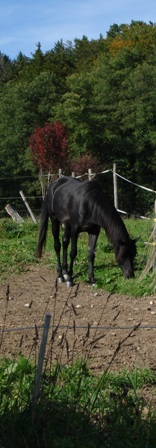
A sad note, however, must not be left unheard. The animals that took part in the performances will be returning to their usual, mundane jobs. This would be unremarkable if it did not involve a heart-breaking separation. According to the Sueddeutsche Zeitung, the camels (Campari and Opi) and the black horse (Garko) – who starred in and enriched various scenes of the play, strutting their stuff nonchalantly on stage day after day – became infatuated with each other. Now however, they must go their separate ways: Campari and Opi to their home farm in Schwabmuenchen, and Garko back to his job of pulling coach-loads of tourists around Oberammergau.
A few days ago I visited Bremen, Northern Germany, and was fascinated by the
number of statues, photographs, and references to the Grimm brothers’ fairy tale The Bremen Town Musicians.
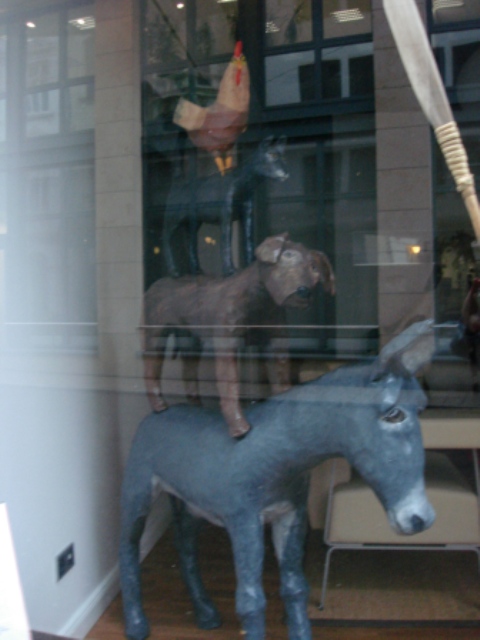
Bremen Musicians
In this tale, four animals: a donkey, a dog, a cat and a cock, having worked hard for their human owners, but getting on in years, are facing redundancy, abandonment, abuse, and slaughter. This unsavoury predicament brings them together and they decide to set off for the town of Bremen to find work as official musicians there.
Before reaching the town, however, they come across a house in the forest, as one does in fairy tales, and agree to try to scare away a gang of robbers feasting inside it. The dog stands on top of the donkey, the cat on top of the dog, the rooster on top of the cat, and each making its own, unique cry – their concerted braying, barking, meowing, and crowing – they crash through the window inside the house and scare the robbers off. In this remarkable way of co-operation, the four animals repel an attack by the robbers during the subsequent night, and settle to live there for the rest of their lives.
Bremen Town Musicians
(I took a picture of this sculpture from the street; it is made of papier mache by Gaby Bertram ofscrap-pap.de)
I wonder why this fairy tale has become so important to the city. Might it have to do with a wish for all kinds of people, of all backgrounds, ages, ethnic origins to live together happily, like those seemingly incompatible animals did in the story? I hope so anyway.
Readers of this blog will know about my novel Alexandrias 40: In the Shade of the Lemon Tree, and my interest in the ways people (in this novel, mainly Greeks and Turks) come together – or not. It seems that having a sense of shared humanity and a common purpose, and project helps: this Grimm tale shows us how.
In any case, I had fun walking around and finding depictions of the animals to photograph.
I just read that Einstein’s Theory of Relativity was shown to apply to altitude differences as small as 33 centimeters. Scientists at the US National Institute of Standards and Technology in Boulder, Colorado, using the latest and most accurate atomic clocks, found that the higher you are above sea level, the faster time runs for you.
In addition, as Einstein had also suggested, the scientists found that travel through space influences clock speed. A stationary clock ticks slower than a moving one. So, if your clock is moving rather than stationary and, in addition, you live high up, then you might start thinking about botox, moving to sea-level, or buying a bungalow! x
The time differences at these small distances are minuscule, but now measurable. x
This demonstration of time dilation leads me on to another, though I believe related, track. Einstein conceived of his Relativity Theory more than one hundred years ago, and yet we are only now able to confirm its predictions on our, human level! Atomic theory, stating that matter is composed of discrete units called atoms, according to Wikipedia, “began as a philosophical concept in ancient Greece and India” and only entered scientific thinking in the early nineteenth century. Thus, “time” is also relative, depending on the prevailing culture, socio-political conditions, etc., when it comes to the interval between ideas being born and their progressing to proof and acceptance. Just think of the effect of certain periods of the Middle Ages on the progression of ideas! x
Moving on to a more experiential level: In my forthcoming novel Alexandrias 40: In the Shade of the Lemon Tree, a little girl is obsessed with time. She fears changes of plan, the adults changing their mind, things happening unexpectedly – “Can you do that?” she wants to know. If you change your plans, then time becomes unpredictable. She keeps comparing the time on her watch with that of other family members, to reassure herself of the stability of her world. Like most of us, she confuses the subjective timeline of our lives, and its curves, ambits, u-turns and roundabouts, with the instrument of its measurement, her watch. x
On the other hand, shrinking or speeding up time, for instance through time-lapse photography, can provide us with a new, marvelous perspective on the world. The BBC has a great video on this, “Timelapse: Speeding up life” Watch it; I added it to my previous post. x
For musings and poetry on Time, read AsianCha’s Random musings on Time: “Pray, my dear, quoth my mother, have you not forgot to wind up the clock?” They claim their clock does not tick. Not even tock? x
Perhaps this, the dilation of time, the arrhythmia of time, where the interval between “tick” and “tock” is unpredictable, or different to what our current understanding would lead us to expect, is a major, crucial point where the arts and the sciences intersect – where the subjective and objective meet. Let us stay with this thought for a minute. Stop all the clocks!
Murnau is a small market town in the foothills of the Bavarian Alps. It is the place where Gabriele Münter, Wassily Kandinsky, and Franz Marc, inspired by the landscape, created The Blue Ridermovement.
This is how the tourism office describes Murnau:
In Murnau nature, art and culture form a special bond. World-renowned artists like Kandinsky, Münter and Horváth lived here and found inspiration in the picturesque landscape at the foothills of the Bavarian Alps with its romantic lakes and unique moorlands.
The moor,Murnauer Moos as it is called in German, right next to the town of Murnau, is an enormous nature reserve, the largest in Central Europe and, surrounded by the Bavarian Alps, benefits from a micro-climate that supports an extraordinary range of animals and vegetation.
Meadows, marshes and mires; bog and creeks invite and nourish butterflies, insects, and rare birds. The light is translucent, the air uplifting, and the colors of the wild orchids, irises, grasses, and innumerable other plant varieties are thought to “sing.” Painters, photographers, art, nature, and bird-lovers make their pilgrimage to the moor to hear these songs.
Whenever I can, I go for walks there. My poem Murnau, published in escarp.org on the 8th of August 2010 is a twitter-sized attempt to condense the experience of walking on the moor without losing sight of some of the cultural associations of the area.
While working on my novel When the Colors Sing, about The Blue Rider (Der blaue Reiter) movement, especially Kandinsky, Münter and Marc, I came across the work of Emil Nolde and his struggles with the development of his art. Readers of this blog will know I recently visited his house – now a museum – in Seebüll, North Frisia, to get a better feeling of his surroundings and the areas where he liked to work.
Having dipped a bit deeper in Nolde’s bio, I came back with more questions than I went with; which is something I appreciate. For instance, I kept thinking, how did Emil Nolde hold the tension between his art and his craft; between his personal, conservative philosophy and his experimental and liberating work; between his roots in the farming community and artistically, in a German tradition of painting, and freedom of expression in his own artistic explorations of landscape, nature and humans. In other words, how did Nolde carry his own, individual cross to produce such work of great depth, intensity, and appeal?
A tribe in India has won a stunning victory over one of the world’s biggest mining companies. The Dongria Kondh, a tribe of 8000 people, with the help of Survival International and others, has won a victory over a multibillion company which proposed to mine bauxite on the sacred hills of the tribe. The Dongria Kondh’s struggle had a happier ending than that of the film Avatar, in which a tribe was pitted against a ruthless mining company. The Dongria Kondh’s perseverance, courage, and victory will encourage indigenous tribes everywhere.
Well done to Dongria Kondh, their supporters, and to Survival!
I brought back from my holiday this picture of the Frisian landscape ( I’ve never seen so much sky! ) and a freshly-penned poem. Read it in escarp, “a text-message-based review of super-brief literature.”
I wrote this poem during the 2010 World Cup, when everyone was talking about vuvuzelas. It appeared in escarp: ” a text-message-based review of super-brief literature,” 17 June 2010.
Having seen an exhibition of Emile Nolde’s“unpainted pictures” in the Berlin branch of the Nolde Foundation earlier on this year, I came to visit his house in Seebüll, North Friesland, Germany, where he lived and worked.
The house is built on higher ground – this used to be a tidal area – providing a panoramic view of the garden below and the surrounding flatlands. The “unpainted pictures” refer to the small-scale watercolors Nolde produced from 1941 onwards, after he was formally forbidden to paint by the Nazi regime. Even before that, the Nazis considered his work to be “un-Germanic” and “degenerate.”
In order to continue working, Nolde used watercolors since they do not emit the typical smell of oil paint and turpentine that would have been easily detectable by the Gestapo during unannounced inspections. Nolde considered the watercolors of this period “unpainted,” because he had planned to render them in oil after the fall of the regime.
Some of the “unpainted pictures” are of flowers, with vibrant colors that overflow the boundaries set by the line and spill over. Perhaps this is one expression of Nolde – like Kandinsky – seeing music in color: his color notes blending across space in the way musical notes blend in time.
Nolde found ample inspiration for these motives in his own garden, which abounds with joyous color and diversity of form illuminated by the immense skies of North Friesland.
At this year’s (2010) Munich Film Festival I watched Nikos Perakis’ new film “ArTherapy”. I found it an intelligent, exciting and enjoyable film, mixing documentary with fiction.
The protagonists, young students of the National Theatre School of Drama, mostly middle-class, politically conscious and wholly devoted to their art, work tirelessly in the face of adversity in the Athenian capital. The portrayal of the young, the intensity and aliveness of Athenian life, the wonderful development of the culture centre in the centre of historic and multicultural Athens, aptly named Technopolis, made me feel proud of my Greek roots. And yet, however much I enjoyed the movie, I felt there was something missing: something about the context, the place, the area was lacking. There were interviews with a few locals, but overall, I was left wondering who was the art therapy for, who is in need of it and why? An unfair question, perhaps, or even an irrelevant one. And yet.
Of course one answer to this question might be that it is the young generation addressed in the film that needs it, the generation of Greeks facing high unemployment, debt and deficit, of a politically traumatized youth, but this too did not seem enough to help understand my unease. In addition, a more complete answer might be that the fans need the art therapy too: “There is no better time to offer your fans an artistic therapy against the period of an economic crisis and fear from the forthcoming social shock. Told in the style of Fame Story…” the GR reporter wrote about the film. Of course…and perhaps!
I followed my usual pattern when in doubt: I googled Gazi. Taking its name from the Public Gas Works, which existed there for over a century, Gazi was, for most of its existence a poor area, where poverty, prostitution and immigration went hand in hand. And then I came across an article in Balkanologie about the people of Gazi.
The author of the paper, Dimitris Antoniou, wrote about the late immigrants to the area who arrived from the 1980ies and 1990ies onwards: Muslims from Northern Greece, from the Western Thrace migrating internally to Athens. Influenced by the Treaty of Lausanne, as well as the Greco-Turkish volatile relations and tit-for-tat policies, these people had found it hard to settle in Western Thrace, with scores migrating to Turkey, other countries, as well as to Athens, whenever possible. Antoniou followed their settlement patterns in the capital, their struggle for survival from earning a living through establishing cultural and religious associations to working out a distinct identity as a group.
Five years after the publication of this paper, I cannot find any further information about the people described and how they fared in the face of the massive redevelopment of the area.
Given the importance of this area as migration destination of Muslim Thracians, I now wonder what impact development has already had or might have on this group of people. Would it lead to the complete demise of this community in the name of progress, or might there be a new way of helping to engage and support the community in its search for and expression of its social and cultural identity? Would there be a way that the arts and crafts flourishing in the Gazi Technopolis might aid the survival of this community? That could also be a form of art therapy!
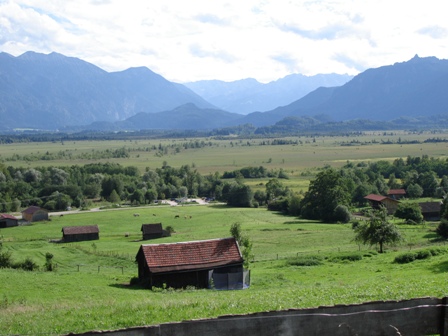
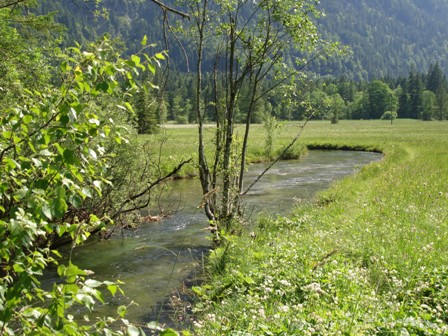
A steady flowing river, whispering reeds and listening fish; a flowering meadow, a gentle mountain breeze, green to delight the eye, colorful mosaic of insects. It certainly felt like the Garden of Eden.
If not, what does the Garden of Eden look like?
Perhaps my twitter poem earlier in the Spring caught something of this quality, though the Cornmill Meadows are in the outskirts of London while the landscape in this picture is in the valley of the river Ammer near Ettal and Oberammergau.
At the Cornmill Meadows
dragonflies rest on nettles
comfrey, buttercups
and the smooth stones
of the shallow stream.
(Published in Escarp, a “review of super-brief literature”)
Photo Credit: Attentive Eye
Literature, Art, and Life through the Lens of Haiku