At the beginning of this year, I wrote about my visit to Kettle’s Yard, University of Cambridge, to view their collection of paintings by Alfred Wallis. At that time, I was inspired to put together a presentation for the HaikuLife FilmFest, organised by The Haiku Foundation. The presentation, Haiku Journey, was shown on International Haiku Poetry Day, April 17, 2015, together with a good number of other films. It is now archived on the site here.
Poetry and arrangement: Stella Pierides; film editing: Rob Ward
Images: by kind permission of Kettle’s Yard, University of Cambridge
In 2015, The Haiku Foundation celebrates haiku on a global scale, encompassing the work and achievements of haiku poets from around the world. From this year on, International Haiku Poetry Day (IHPD), replacing the THF’s National Haiku Poetry Day, becomes the biggest celebration of haiku poetry word wide. On April 17 each year, haiku poets, haiku poetry fans, and organisations will be getting together under the auspices of the THF in order to honour the depth, reach, creativity, and joy of the genre we have come to love.
For this year, the Foundation has organised a series of events, from local haiku readings and celebrations, over HaikuLife, a FilmFest showcasing work submitted by individuals and organisations, to EarthRise, a rolling collaborative poem.
On April 17th, 2015, from 12:01 A.M. at the International Date Line, a wave of haiku contributions begins and rolls throughout the day, with poets offering their haiku at dawn their local time. The finished collaboration, on the theme of Light, will be permanently archived on the THF site.
I am very much looking forward to the day, and the many exciting contributions from poets around the globe. I will be setting my alarm, and posting my own haiku to the inaugural EarthRise.
I am also delighted that the FilmFest, HaikuLife, features a short film of my haiku together with paintings by Alfred Wallis (from the excellent Kettle’s Yard, University of Cambridge, collection). I created this film with the (much appreciated) support of Rob Ward, After-Effects Artist and Animator. Besides my presentation, there are at least 12 other contributions by haiku poets and organisations, amounting to almost 90 minutes of film.
I hope you will be able to join in the fun on IHPD.
For times, url, and other information about HaikuLife and EarthRise, as well as the local (to the US) readings, please visit the Troutswirl blog at The Haiku Foundation site.
Update April17, 2015
Happy International Haiku Poetry Day, folks! Contribute your poems to EarthRise, watch the HaikuLife films, go to the readings, enjoy the day!
My short film, Haiku Journey, is shown today — together with a number of other films — and will be permanently archived on the Haiku Foundation site. Please see here
For an introduction to the Foundation HaikuLife project, and the list of all projects shown, please click
A big thank you to the month’s editor, Sonam Chhoki, for including it in her collection “Writing the Difficult Thing.” Sonam Chhoki’s collection runs all through November, with lots of poems about difficult things to write… Each day, a new poem here. Enjoy!
On October 16th, 2014, a global discussion is being held on the topic of inequality. Organized by Blog Action Day, this year’s theme brings together bloggers from over 100 countries to contribute on a matter that becomes increasingly urgent.
Wars, civil and religious violence, scarcity of materials and ecological concerns, the spread of disease, are increasingly diverting our attention from the inequalities that abound, and increase in our societies. Yet, to a large degree, inequality is the result of all those processes individually and cumulatively. Wars, for instance, are about real or perceived biases in resource distribution, in turn often resulting in huge increases in inequality. Just think of the thousands of refugees looking for safety in the Mediterranean, and the response they get when (and if) they make it to the European shores. (see here
night chill…
all the refugees asleep
behind bars
It is ubiquitous, but so are the processes that ameliorate and even help reverse it: awareness and reflection, empathy, generosity; pooling of resources and co-operation; language, art, literature; institutions, policies, humanitarian approaches at national and international levels are just a few that come to mind.
Inequality is an urgent and vital topic for discussion, and you may have noticed, I am taking part this year with a series of posts.* Are you? If you are not sure what to write about, Blog Action Day on FB has a number of tips for bloggers. If you don’t have a blog, you may use your FB account or other social media. See also the Blog Action Day 2014 site.
If you are looking for literary inspiration on themes of poverty, homelessness, begging, and poetic resonances to these issues reflecting perspective and culture, see The Kindness of Strangers, a six-part series by Swedish poet Anna Maris on The Haiku Foundation site (you’ll need to scroll down the blog entries for the earlier posts).
February is National Haiku Poetry Month – wherever you might be on the planet. The shortest month of the year for the challenge that may become the longest-lasting commitment you will ever make!
But let’s start small. First write one haiku a day for the whole month. Join a community of poets around the world who endeavor to write at least one haiku a day. And see how it goes… I did, four years ago, when it all started.
The NaHaiWriMo Facebook community encouraged me, nurtured my writing; and this quiet, positive, non-critical presence of people helped me grow. This steady, unfailing presence provided a background for my daily attempts: poetic ventures, haiku versions to work on, check with others.
Other members let me know if they’d read my poem, if they ‘liked’ it, if a different version would work; if they shared my experience or predicament, my point of view, or appreciated my difference. Not often, but cumulatively, in doses that my ego could take…
It worked! I’ve made the commitment to haiku and its special way of seeing and conveying experiences.
Try it yourself. You may like it and start writing haiku each day of every month, all year round. It may help open up time, expand moments the way only haiku can.
To see how it works, take a look here
For how to go about finding out how to write these poems, there is help from the founder and co-ordinator of this project, Michael Dylan Welch here and in more articles posted on this site
You will find the NaHaiWriMo Community here
And for inspiring, prize-winning as well as thematic collections of haiku by poets the world over, you will do well to visit the The Haiku Foundation site here
There’s also a daily poem treat, the Per Diem: Daily Haiku ready for you to pick up here
What an exciting month December has been! And it is only the 4th of the month!
The Haiku Foundation’s Per Diem: Daily Haiku, a feature I project manage, is scaling new heights this month. Michael McClintock, in his collection “31 Ways of Looking at a Mountain” is taking us for a mountain hike. Each day a new view here
The Haiku Foundation Fundraising campaign is continuing up to the 6th of December with a number of releases of new material and features. On the 3rd, the new social media account on Pinterest was rolled out. I am pleased to have played a part in this one.
Then there is a new haiga by Jim Kacian, a new digital library interface… there is an endless stream of enthusiasm and creativity coming out of the The Haiku Foundation. And the fundraiser releases continue for three more days!
Are you missing out? Register for blog post notifications via email (see the THF contact page), follow the THF on Twitter: https://twitter.com/haikufound
Happy Thanksgiving, and Happy Chanukah to friends who celebrate it. And to the rest of my friends, wherever they happen to be in the world, who would be happy for the opportunity to give thanks for blessings received any time of the year, Happy Thanksgiving too!
I am giving thanks for my family and friends, the creative, nourishing and supportive haiku communities and writers’ groups I am involved with around the world, and the gift of every day on this Earth I continue to receive.
A special note of thanks to the The Haiku Foundation for its breathtaking work on the many and varied haiku projects it sustains and furthers. It too is giving thanks and fundraising for its work during the period from Thanksgiving through St. Nicholas Day. Please take a look to see what they’ve been up to this year, as well as the exciting program they have planned for the coming days here.
While you are visiting their site, I encourage you to sign up for their email notifications, follow them on Twitter and like them on Facebook: this way you will be kept up to date with all their offerings.
Over at the The Haiku Foundationblog, Troutswirl, Gene Myers asked “What do surrealists and haiku poets have in common?” A number of haiku poets contributed very interesting and varied responses. Spurned into action myself, I responded with the following comment:
Hochablass, Lech dam, Augsburg
“Thank you for sharing this, Gene. I have been thinking about connections between the arts and haiku poetry and so find it interesting to read people’s thoughts here.Re. your question: I understand (most) surrealists to have tried to bypass conscious mind and to make contact with the unconscious through dreams, word association, automatic writing, hypnosis, mind-altering substances… This aim to go beyond and beneath the conscious/reasoning mind and pull out a fresh, writhing, alive experience may be one of the things that surrealists and haiku poets share (though not all the means!).
Regarding two-part haiku, I like to see the juxtaposition of the two elements as displaying side by side, literally, unconsciously associated content. In a successful juxtaposition, a sense of strangeness, an uncanny feeling is being set up. Isn’t this central to the attraction for both reader and writer: looking at the seemingly disparate elements/parts of the poem, experiencing the tensions generated and their resolution in a moment of recognition in which the unseen / unconscious connections emerge?
In this sense, surrealists (at least those of the more constructive strand) and haiku poets may be said to use juxtaposition of the seemingly disparate as a means to reach underneath and beyond the well-trodden tracks of our conscious landscape; to (to use your words) ‘jar’ and encourage filling in the gaps/holes between the elements through reconnecting with deeper/hidden levels of the mind. Of course, this is only one of several commonalities; there’s also choice of words, images, form of presentation, and so on.
Happily, we have this month’s Per Diem, Kirsten Cliff’s collection “Dream Speak,” to help us explore this matter further.”
Noticed the last sentence? Why not keep me company, visit the THF Per Diem site, and pull out of the Per Diem box the daily poem; fresh, and only for a day, the daily poem can be found by clicking here.
“Fate” and “destiny” are often used interchangeably to refer to the notion of predetermination; of future events following a predetermined plan or path.
Yet, implicitly, we also make a distinction between the two in terms of the degree to which each is allowing for alterations in the course of events to which it is applied. Fate is usually associated with unalterable events; we are in the hands of the ancient Fates, Gods, or cosmic forces; our lives, and actions, are out of our control. There is a belief in a prescribed future: a higher/supernatural authority (or authorities) has the future laid out for us.
Destiny, on the other hand, involves a course of events where we have a say, or a hand, in preparing or making our future. We may be destined in one sense to higher or lower things, but we can underachieve or push ourselves hard to achieve better than expected.
This month’s The Haiku FoundationPer Diem: Daily Haiku reflects on both of these concepts. Deb Baker, this month’s guest editor, using “Kismet” as the title of her splendid collection, invites us to reflect on the “hinge” moments” or forked paths we encounter and the outcomes that result when we follow one or the other road, believing in fate, in destiny, or a choice we made. She writes,
Poems like these can make a reader feel a sense of momentum, a possible turning or smoothing path. Perhaps such a poem helps a reader discern something happening in the present moment in his or her own life. Or to see a new possibility, a different way forward, through someone else’s hinge moment.
.I’ll be reading with an extra eye for the different ways Kismet appears in the poems. I’ll be having fun too! Join me? You can find the daily poem here
.
The photo is of a path taken, crossing the river Schmutter, near Neusaess, Germany.
The new THF Per Diem collection, Songs of the Open Road, is up and running over at the Haiku Foundation site. Guest-edited by Tom Painting, it takes us on 31 exciting, meditative, and always inspirational journeys. Highways and motorways, straight paths and winding lanes are there for us to explore all through July. In his introduction to the collection, Tom Painting quotes from Walt Whitman’s poem, Song of the Open Road:
“ Afoot and light-hearted I take to the open road,
Healthy, free, the world before me…”
I very much look forward to these journeys. Join me on board the THF Per Diem for the ride. Each day a new haiku here
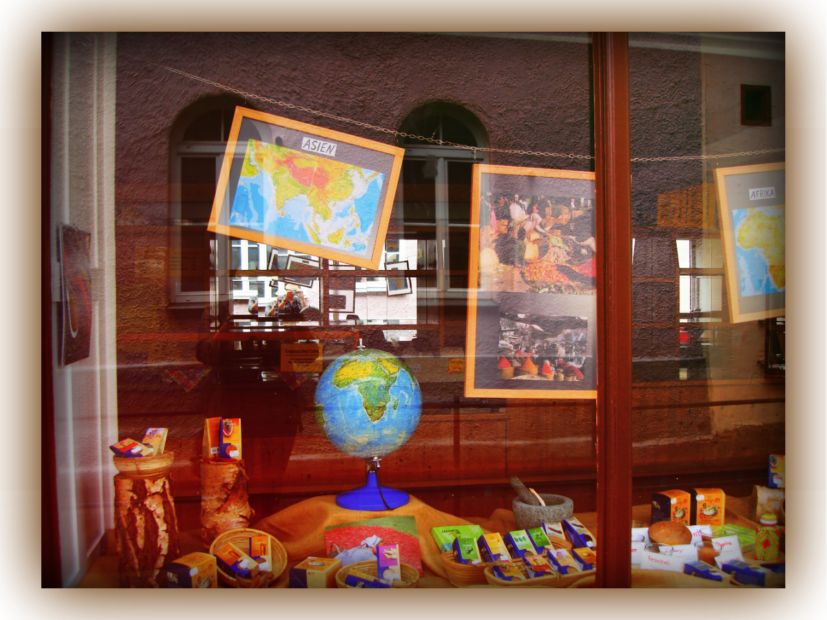
Photo of shopfront in Augsburg, Germany (by Stella Pierides)
I’ve always been fascinated by the concept of the Uncanny. Freud, the writer often associated with this concept, described the following uncanny experience when he came face to face with his own double. While travelling by train, Freud saw an elderly gentleman enter his sleeping compartment by mistake. Jumping up to let him know of his error, Freud realized it was his own image reflected in the mirror on the connecting door. He had found the appearance of what he thought was another man ‘thoroughly unpleasant.’ Without being frightened, he failed to recognise his ‘double.’ Or was the displeasure he felt, Freud wondered in the last note of his last chapter on “The Uncanny,” “perhaps a vestige of the archaic reaction to the ‘double’ as something uncanny?” He leaves us with a question, perhaps an encouragement to take this further ourselves.
Freud was not the first of course to link the concept of the ‘double’ with mirroring, the image in the mirror as well as the ‘other.’ Ever since Plato conceived of material reality as a poor representation of the true Forms, others have found man’s double in several contexts. In literature, for instance, Mary Shelley made the monster his creator’s ‘double’ and leaving him unnamed, led subsequent generations of readers to refer to him with the name of his creator: “Frankenstein.” Conrad, too, wrote the ‘double’ in his stories (e.g., in “The Secret Sharer”).
So what has this ‘uncanny’ and ‘double’ to do with haiku, and my theme of reader-oriented matters? If you read my previous posts, you may have noticed I like playing with ideas; though more thought games than thought experiments.
Let me throw this thought in the pot: Isn’t there in haiku a situation in which, when you come to the poem, you become slightly disoriented by the presentation of the two separate, juxtaposed ideas? (Remember the field of energy, in the previous post?) I think there is. The ‘cut’ and the pause in the juxtaposition of two ideas/images are device(s) which open up the extra perspective(s), depth, for the reader; they also create a sense of strangeness, a momentary, uncanny disorientation… until there is the spark of realization that transforms what was strange and uncanny into familiar and understood. Once resolved, the two initially puzzling parts of the poem appear to us the way Freud, relating that vignette, stood in front of his earlier self and its reflection; the way we stand in front of a Moore, a Hepworth, a Lucian Freud, or the narrator in Conrad’s novel and his secret sharer.
Are you with me? What do you make of the thought that the moment of insight or realization is preceded by the uncanny? That the uncanny in haiku involves being confronted by the juxtaposition of two on the surface unrelated – but on a deeper level related – ideas within a limited space? That the haiku moment does itself involve overcoming this sensation of the uncanny?
Finally, before I go, and in case you are interested, I’d like to mention a couple of places, amongst others, I like to visit for reading poetry, essays, information, learning, fun (in addition to “Haiku Matters“, haiku journals and the homepages of haiku societies!). Do let me know your favorites.
The The Haiku Foundation’s homepage and blog “Troutswirl.” On the same site, among many brilliant features, the THF “Haiku Registry,” the place to get a flavor of the work of haiku poets writing in various forms, from all over the world; the “Montage Archive,” the “Book of the Week,” the “Per Diem: Daily Haiku” panel, and “Per Diem Archive,” are my favorites (esp. since I help out with Per Diem!).
On this note, hopefully leaving you with more questions than answers, having raised smiles as well as eyebrows, I’d like to say a big thank you to Colin Stewart Jones, and goodbye to folks who found their way here, from both the writer and reader in me.
*
The Wikipedia on the Uncanny here Sigmund Freud, ‘The Uncanny’ in The Uncanny, ed. by Adam Phillips (London: Penguin Classics, 2003) p. 121-161. Conrad, Joseph, The Secret Sharer can be read here
After all this buzzing with insect haiku in January, February2013 is a quiet, reflective month.
This month’s guest editor, Matthew Paul’s selection is on the ever-present figure of the worker in haiku. Dentist, doctor, driver, gravedigger, barber, policeman, the solitary worker seen at work, engaged or not, lively or bored, cuts an impressive figure.
Visit the The Haiku Foundation site and see the workers at work. Every day, one haiku/senryu will appear in the Per Diem: Daily Haiku panel, at the right-hand corner, lower down the home page. Let the workers speak to you:
This coming Thursday, the 1st of November, is the first ever Mindful Writing Day, organised by Kaspa & Fiona at their blog ‘Writing Our Way Home.’
To join-in, simply slow down, pay attention to one thing and write down a few words from this experience (thus producing what is called a ‘small stone’).
Fiona and Kaspa claim that ‘small stones’ are easy to write, and that they will help you connect to the world. Once you’ve started, you might not want to stop… I concur! You might want to polish your little ones too, expand them into a longer poem, or shrink them, prune them and polish them into a micropoem or haiku. It is up to you!
As an additional bonus, if you visit ‘Writing Our Way Home’ on Thursday you’ll find out how to download your free kindle copy of the new anthology, ‘A Blackbird Sings: a book of short poems‘. This is a lovely, richly-textured book of poetry and prose by several contributors who have been writing small stones this year. Two of my own poems are included in this book.
If you do write, you can submit your small stone and see it published on the blog, and be entered into a competition to win one of five paperback copies of the book.
I will be taking part. In fact, taking part in the Facebook community NaHaiWriMo (National Haiku Writing Month) which is on-going all through the year, I have been writing ‘smalls stones’ every day, several of them haiku, and have been posting at least one a day every day. For me to do something different on this Mindful Writing Day, may amount to not writing at all! Just joking, I couldn’t stop, if I tried!
But if, say if, you do not feel like putting pen to paper, or fingertips to laptop keys, you might visit the blog anyway, and read what the others have written; or start visiting the site of the The Haiku Foundation, in order to read one haiku a day, every day, expertly chosen for you by monthly poetry editors. You will find this feature in the Per Diem: Daily Haiku panel, at the right hand lower corner of the Foundation Homepage. For the link click here
Whatever you decide to do, don’t forget to look at the sky. It is always there…
lost in thought –
his tongue caressing the crown
on his molar
NaHaiWriMo prompt: lost
Inspired by Lee Gurga’s THF Per Diem haiku ‘professional conference’!
For a day only, today, 22 October 2012, it will be available to read on the The Haiku Foundation website, in the Per Diem: Daily Haiku panel by clicking here
Ruth’s wonderfully touching, and humorous collection is “Hands-On.” Hands? Yes, hands. This is what she offers by way of an introduction:
“We are a species heavily dependent on our eyes, especially for connection with others and world around us. But our hands also connect, and that connection often reaches the heart. Right now my beloved mother-in-law, who doesn’t see well, is dying, and when you approach her, she reaches out her thin hand to connect. These haiku about hands touch emotion. They range from humor, as in Randy Brooks’ hand in the cookie jar, to sadness, as in Cherie Hunter Day feeling the weight and warmth of her dying dog’s collar. They include fear, as in John Stevenson’s shiver at a warm hand before diagnosis, sex, as in Sari Grandstaff’s total attention to the hand on her thigh, and even exasperation or anger, as in Kenneth Elba Carrier’s deaf man grabbing at the other’s hands.”
A new collection of poems starts today on The Haiku Foundation homepage. Kala Ramesh is the Per Diem: Daily Haiku editor for September 2012. She offers the following by way of an introduction to the collection:
“The Five Elements
The Hindus and the Buddhists believe that all Creation— including human beings— is composed of five essential elements. When death occurs, everything is transposed into these elements of nature, thus balancing the cycle of evolution.
The elements and their associated sense perceptions are:
This classification is woven into the fabric of our day-to-day activities, and widely used in all our art forms, including poetry, literature, dance, music and painting. The haiku poems showcased here might not appear in the order I had originally arranged them, but you could use your ingenuity and guesswork to ‘sense’ how many of these elements are present in the haiku, when you read them.”
I am looking forward to this daily treat for the whole month, and beyond… If you enjoy haiku, you’ll love this.
For a new poem each day on the Foundation homepage (lower right-hand corner) click here
You can also follow THF Per Diem on Twitter, @haikufound, for a daily Per Diem-related tweet, in addition to Foundation news and announcements.
The Haiku Foundation, a non-profit organization whose aim is “to preserve and archive the accomplishments of our first century of haiku in English, and to provide resources for its expansion in our next,” is the place to hang around if you are trying to make April, the National Poetry Month, last all year long!
There’s a lot to do there! There’s the Per Diem: Daily Haiku, in its box, on the Home page, bringing you specially selected haiku each and every single day of the year; the Haiku Registry, with over 400 poets and poems to browse through; archives of contest-winning poems, and awards, with judges’ commentaries; an exciting blog with thought-provoking posts and information; contest and event calendars, a digital library, and forums for any haiku-related questions you can come up with…
And now, there is going to be more! The Haiku Foundation plans to create
“the first collection of in-depth interviews documenting the development of 20th century haiku. Poets, translators, and scholars…will share their work and discuss their ideas. The resulting video and audio recordings will be available FREE of charge on the The Haiku Foundation (THF) website: http://www.thehaikufoundation.org …”
Now that’s a worthy cause!
The Foundation is asking for your help with this project. Running a Video Archive Campaign, it aims to collect through donations the $6,000 it needs to buy the audio and video equipment necessary. Will you help them reach their goal?
They say:
“Imagine if you could watch your favorite poets talk about their craft and lives and respond to questions you always wanted to ask them. While the technology wasn’t available during the lifetime of some of our favorite poets, today we have the opportunity to create a rich resource for our generation and those to come. As we move forward into the 21st century, many haiku poets who led the way in the 20th have already passed away. We need to start working immediately to preserve the voices of those who are still with us. Their stories deserve to be heard.”
I can well imagine…
“If a haiku has ever stirred your heart, pitch in! We will return your generosity with hours of enriching interviews, and you will help preserve a fast-fading history.”
Please follow this link here for a lot more information, including various gifts/perks you receive with your donation, tax free advice, gallery of gifts, comments etc.
Well, April, the cruelest month, is upon us! Thank God we have poetry to help us survive it. Poetry, Poetry, Poetry, Poetry!
The Haiku Foundation, the Poetry Foundation, Poets.org, brim with wonderful poetry to feed the soul – and the senses! Visit them and forget about April; or at least enjoy it! There is also Per Diem, the Daily haiku offered by The Haiku Foundation on their home page (bottom right-hand corner); Couplets, the multi-author poetry blog, coordinated by Joanne Merriam of Upper Rubber Boot Books, the Facebook pages of NaHaiWriMo, and numerous other projects, workshops, readings, and poetry-related events.
On this first day of Poetry Month, I am very happy to host Margaret Dornaus, ‘writer, a teacher, wife, traveler . . . as well as a haiku-doodler.’ Margaret says about herself, ‘I live in a beautiful woodland setting, surrounded by native oak forests, that inspires me to record haiku snapshots of luna moths and our resident roadrunner, and even an occasional black bear as it hightails it across the top of my road, my mongrel dog barking at its heels as I watch with wonder’.
In her post hosted here, Margaret kindly states, ‘I’m thrilled to exchange places with Stella for the day in observance of National Poetry Month and to have her wonderful work featured on my blog, Haiku-doodle (http://www.haikudoodle.wordpress.com).
Margaret herself chose to offer three poems (see below). This is how she reflects on her offering:
‘After we decided to share three of our poems on each other’s site, I contemplated whether I should contribute haiku or tanka. I began writing both about a year and a half ago, and, although I was already familiar with haiku, I knew nothing about tanka until I accidentally stumbled upon a call for submissions to Pamela A. Babusci’s journal Moonbathing. When I started studying this ancient lyrical form and reading the work of other tanka poets, I knew I’d found a home . . . . And so I’ve chosen three tanka to feature here today.’
you remind me
how it felt that night we met . . .
our universe
filled with possibilities
and the soft hum of tree frogs
.
Simply Haiku, vol. 9, no. 1, Spring 2011
.
years from now
I promise to remember
how you looked that night
alone on the verandah
holding moonlight in your hands
.
First place, Tanka Society of America
2011 International Tanka Contest
.
in darkness
we forget our anger . . .
suddenly
the sound of wild geese
piercing the starless night
.
Ribbons: Tanka Society of America Journal,
vol. 7, no. 1, Spring 2011
.
This blog post exchange is part of the Couplets project, a multi-author poetry blog tour coordinated by Joanne Merriam of Upper Rubber BootBooks “to help promote poetry and poets for National Poetry Month“.
April is not only the cruelest month. It is also National Poetry Month – for some of the world, anyway. Let’s not split hairs. We all want to celebrate poetry, so let’s do it. Poets, writers, publishers, readers, poetry lovers are planning get-togethers for poetry-related events: fests, readings, workshops, write-ins, stay-in-bed for poetry, day-dreaming…this kind of thing.
This is what I will be doing: I’ll be celebrating at ‘Couplets,’ a multi-author blog tour for April, to help promote poetry and poets for National Poetry Month. Co-ordinated by Joanne Merriam of Upper Rubber Boot Books it is going to be a fe(a)st. I am taking part and will be posting, besides my daily haiku, poetry-laden posts during the month. Come over to my web home and we’ll eat poetry words together!
Meanwhile, here are a few links to keep us going till then:
The Haiku Foundation: They say: “April 17, National Haiku Poetry Day, is a celebration of the genre of haiku, a kind of poetry whose origins date back a millennium in Japan; and more specifically, of English-language haiku, which has now been written for more than a century”. But you don’t have to wait till the 17th! You can explore this wonderful site, founded by Jim Kacian, and enjoy the best haiku and haiku poets in the world.
While visiting THF, check out their Per Diem: Daily Haiku series. In March they post my selection of haiku of the senses: haiku by some of the best poets highlighting the interconnectedness of sensory experience (Per Diem can be found on the front homepage of the Foundation, at the bottom right-hand corner). In April they post “Poems from Aotearoa, New Zealand haiku, featuring flora and fauna specific to those favored isles, and human activities, such as Anzac Day (April 25).” Editor: Sandra Simpson.
The Facebook page of National Haiku Poetry Month, or NaHaiWriMo, moderated by Michael Dylan Welch, has been running since February 2011. Although their haiku ‘month’ is February, they ‘haiku’ the whole year round. You can read or indeed “write at least one haiku a day, inspired by daily writing prompts”. The community is friendly and warm, encouraging…join them and surprise yourself! I have!
Poets.org has a page listing events and poetry resources here
Feel free to add/share any other events you may know of.
Literature, Art, and Life through the Lens of Haiku







 This coming Thursday, the 1st of November, is the first ever Mindful Writing Day, organised by Kaspa & Fiona at their blog ‘