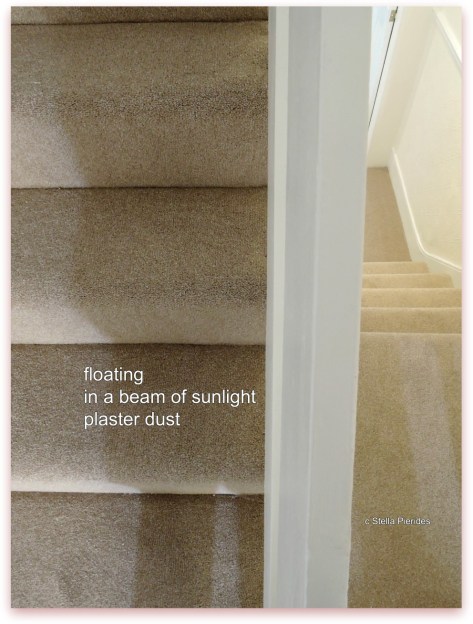
‘deep inside’

‘swelling buds’

sleepless
.
sleepless night formatting loneliness
.
In Bones – journal for contemporary haiku no. 9 March 15th 2016 p.22
‘east wind’
east wind
the moment
it drops
.
Haiku Journey (2015)
Haiku Journey is my entry to HaikuLife, The Haiku Foundation FilmFest 2015 (includes sound).
Alfred Wallis paintings by kind permission of Kettle’s Yard, University of Cambridge.
Haiku and Design: Stella Pierides
Editing: Rob Ward
“Joining the Dots” in Haibun Today
Joining the Dots
From the compensation for the demolition of his house to make way for a new road, he bought two tiny apartments, a four-poster bed, an amber komboloi, and a pendulum clock. As a child, I considered the wall-mounted, cherry wood, chiming clock to be my granddad’s most striking acquisition. I checked it continuously, comparing its time to the watch my dad had given me before going away to sea.
approaching wind knots matter
But it was the sound of it chiming the hour that stayed with me the longest. Half a century later, I can feel the deep resonance of that chime opening doors to the past.
let’s say the map shrinks afterwards
In Haibun Today, 10: 1, 2017
Pandora’s Box
Pandora’s Box
I step inside a second-hand store in downtown Athens. A musty odor envelops me. A yellow handbag, by the entrance, has pride of place. Plastic dolls of varying sizes, unclothed but for the price tag, line a shelf. Rows of scaffed shoes, and shoes never worn, line the skirting board. Shirts, trousers, blouses, and skirts hang from circular rails. Moths dance in the sunlight. I run my hand across the clothes and continue to the back of the shop, to the books: Fiction, Poetry, Classics, Biography, Bibles. I duck to avoid a doll in military dress.
A glass-topped drawer catches my eye. Sparkling pair after pair of earrings: pearl, gemstone, silver, gold, diamond. I didn’t expect such quality.
The owner, dressed in a beige cotton tunic, approaches. “The Junta General’s wife,” she tells me. “After the trials she could not wear them. Brought them here. In all these years, nobody will touch them, although they come and look.”
A shadow of suspicion crosses her face. She looks me up and down, then relaxes. “Pity. She loved poetry,” she says, fanning herself.
bitter olives . . .
sound of a key turning
in the lock
.
In Haibun Today vol.9, 4, 2015
‘winter wind’ in RHP 95
winter wind
the bird house filled
with emptiness
In Right Hand Pointing 95 The special Haiku Issue
guest-edited by Eric Burke.
‘typos’ in RHP 95
typos
in the book of the dead—-
water lilies
In Right Hand Pointing 95, the special, and wonderful, Haiku issue guest-edited by Eric Burke
 Interesting introduction by Dale Wisely, founder and editor of RHP, who refused to include haiku in the journal for twelve whole years! Well, at long last, Dale!
Read Dale Wisely’s introduction here
‘mild January’
mild January—
sprucing up his wife’s
grave
‘winter seclusion’
winter seclusion
practicing the warrior
pose
‘giving the walls’
giving the walls
a coat of sunlight—
egg tempera
.
yolk
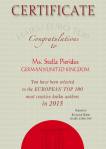
European top 100!
Pleased to hear that I have been included in Krzysztof Kokot’s list of creative European writers for the 5th year running! Krzysztof Kokot has published this year too his list of ”European top 100 haiku authors in 2015” Thank you for the honour, Krzysztof!
.

‘river tides’ on tinywords
My poem on tinywords yesterday:
river tides where have I been
.
(I almost missed it!)
Thanks to the tinywords team for the beautiful background image.
‘hung with lights’ and ‘dreaming’
Haiku for Gillena Cox’s Let’s Haiku a Christmas Carol, at Lunch Break,
*
hung with lights
the tree still sparkles…
year end sales
.
(Day 7)
*
dreaming
of a safe Christmas…
children’s refuge
.
(Day 6)
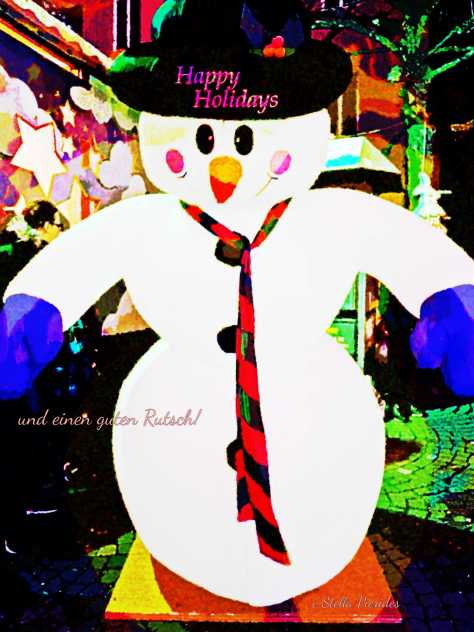
Happy Holidays!
Wishing all friends and blog visitors, Happy Holidays and a Happy New Year 2016!
Peace, Health, Love, and lots of Laughter
‘winter solstice’
Happy Solstice!

KYSO Flash Anthology of Haibun and Tanka Forms 2015
Clare MacQueen just announced the publication of the KYSO Flash Anthology, featuring prize-winning haibun and tanka. My own haibun “Time,” which received an Honorable Mention (in November 2015), is included.

This is how KYSO Flash describes the release:
We’re pleased to announce the release of a little book with a mouthful of a name: the KYSO Flash Anthology of Haibun and Tanka Forms 2015. Contributor copies are now on their way to folks.
This is an international collection of 25 poetic hybrid works by 14 authors (plus images by three artists). Works were judged by Roberta Beary, award-winning poet and haibun editor of Modern Haiku, for the first annual KYSO Flash “Best Of” contest. Cash prizes were awarded to seven artists for First, Second, and Third Place, and Honorable Mentions. The judge also selected 19 finalists to appear in this anthology.
The book is available from Amazon.com
‘Intertextuality’ in Sonic Boom 4
Pleased to see my ‘Intertextuality,’ a haibun diptych, in issue 4 of Sonic Boom, published under ‘Fiction.’
Issue 4, is an anniversary issue. Happy Birthday to Sonic Boom, many happy returns!
Intertexuality
(a diptych)
I
A reader asks for help with a patch of garlic plants forgotten and left to overgrow in their garden. Well, I say, dear reader, we are caught between a rock and a hard place. Garlic doesn’t like to be transplanted. And this text is not the right place to ask, or answer such a question. But I can’t resist. It is spring, after all, and I am stuck for ideas. So, to your garlic clump: Let it be. Let it grow, and when it is ripe and ready, when the tips of the green shoots start to brown, dig the plants out. They will be pungent, crisp, and juicy, the plant oils moistening your tongue. Then plant a few individual cloves for next year’s crop. Enjoy the rest.
writer’s block
the school of life
full of lessons
II
Spelt flour, baking powder, butter, milk, and salt. Mix, pat down, shape into rolls, and bake. Serve with olive oil, and garlic from another haibun to dip the bread into. Enjoy!
a frog jumps in—
intertextuality
for beginners

‘in search of’

‘bicycle thief—’ Honorable Mention
bicycle thief—
on her blouse
cherry blossom
.
2015 Haiku Invitational, International Sakura Awards Honorable Mention.
‘Pandora’s Box’ in Haibun Today
In time with the first snowfall…my haibun “Pandora’s Box” is now online at Haibun Today. A political haibun, looking back at the period of the Greek Junta and its aftermath.
The entire winter quarterly issue of Haibun Today can be found here
‘even when’
even when time stands still waiting

“Shoes” in Whirlwind #6
56. Münchner Bücherschau
From the Münchner Bücherschau: the German edition of Feeding the Doves, Taubenfuettern, on display, taking its place among my earlier Fruit Dove Press titles.

Afterlife
Do you sometimes wonder what happens after the gravediggers return to their workstations and the grieving relatives go home?  What is it of the self or soul that’s left inside the box or urn, or floating in the air? Do you think there may be life after death, a life after this life, an afterlife? Do you fret over reincarnation, heaven, or hell? Poets do.
resting in peace
her mobile phone
keeps ringing
Robert Epstein, a licensed psychologist, and haiku poet, has just edited Beyond The Grave: Contemporary Afterlife Haiku (Middle Island Press, 2015), an anthology of poets’ haiku on the life beyond. Thoughtful, sensitive, measured and moving, as well as studded with moments of humour, and brilliance, the anthology proves an invaluable companion for thinking about the limits (and beyond) of existence.
lilies the meaning of life after death
Leafing through poems on life after death, I let myself be led along lines of uncertainty, of hope, as well as humour, of the ineffable, of mysteries, without the certainties that dispose of thought.
afterlife
that turn of phrase
in her haiku
.
(Poems included in the anthology)
“Time” receives Hon. Mention in the “Best of Haibun and Tanka Forms” 2015, for the KF Anthology
I must be on a roll! Delighted to learn that my haibun “Time” received third honourable mention in the “Best of Haibun and Tanka Forms” 2015, for the KYSO Flash Anthology due out in December 2015.
Roberta Beary, award-winning poet and haibun editor of Modern Haiku, the judge of this contest, wrote:
Stella Pierides’ haibun shows how time, which is also the title, turned the narrator’s expectations of her life’s autumn upside-down. The haiku at the haibun’s end effectively juxtaposes the images and original word choice in lines 1 and 2, lulling the reader along until the surprise of line 3. At first glance the haiku does not seem relevant to the prose. A deeper reading shows that the haiku echoes and expands the feelings of surprise and mortality elicited by the prose, which is exactly what is supposed to happen in haibun.
You can find “Time” here
Light on a dark poem
Thrilled to have had a poem of mine discussed at re: Virals, The Haiku Foundation’s poem commentary feature. The poem is from my book In the Garden of Absence (Fruit Dove Press, 2012):
granny’s cushion
pulling the darkness out
pin by pin
It was chosen by Irish poet Marion Clarke, the previous week’s commentary winner. And right on Halloween, All Saints Day… which added extra layers of depth to my haiku. Thank you, Marion! And thank you too, to Garry Eaton and Beth McFarland for their insightful comments.
I love the re:Virals series, and look forward to reading the poems chosen and the commentaries written on them.
Would you like to take part? Anyone can participate. There is a new poem each Friday on the site (chosen by the previous week’s winning commentator) for you to comment on. Simply put your take in the Contact box by the following Tuesday midnight. . .and there you have it, good luck! The best commentary will be reproduced in its entirety on the site and kept permanently in the THF Archives.
‘mala fide’
mala fide—
taking another look
at the moon
Frogpond, 38:3 2015
