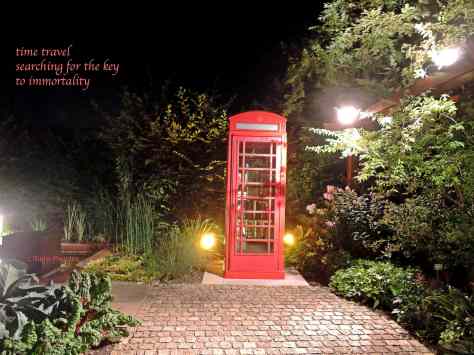
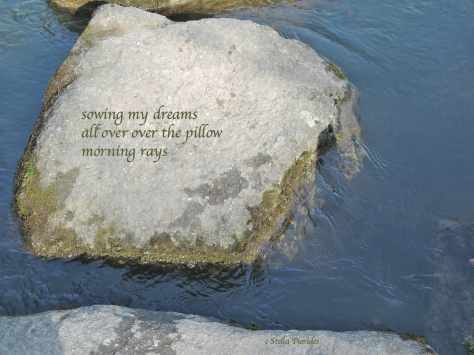
time travel
searching for the key
to immortality

time travel
searching for the key
to immortality

My poem ‘refugee child’ (paper boat) on ‘Neverending Story: Butterfly Dream,’ the First English-Chinese Bilingual Haiku and Tanka Blog, today, translated into Chinese! Honoured and grateful to the editor Chen-ou Liu.
Please visit the site to read the comments: Butterfly Dream
My monoku from New Resonance 10

it happens to the best of us ocean wave
featured in My Haiku Pond: ‘a peaceful community dedicated to the appreciation of English language haiku, haiku related Poetry and Art.’

Many thanks to My Haiku Pond editors Michael Smeer and Steve Smolak for featuring my work!
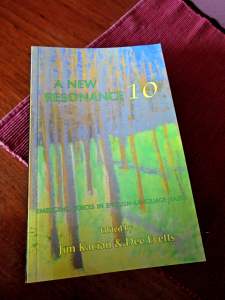
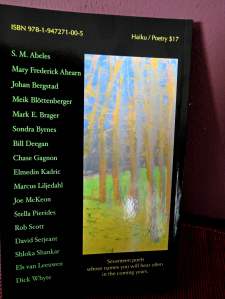
A New Resonance: Emerging Voices In English-Language Haiku, edited by Jim Kacian and Dee Evetts, now in its 10th edition
waiting room
how blossom turns
to fruit
article 50—
my long way home
grows longer
.
another spring
the knotted branch
in the shredder
.
Blithe Spirit, 2017, vol. 27:2
It’s been a few months since I shared the good news about New Resonance 10. Well, now it is out and I am in it!

Volume 10 of “A New Resonance 10: Emerging Voices in English-Language Haiku,” edited by Jim Kacian and Dee Evetts, a much-awarded series, is out and it includes my poems. along with those of 16 other contemporary poets!
It is truly an honour to be a part of this wonderful collection!

I received 25 copies of the anthology, and have several available to order.
Price per copy is $17, including shipping, as well as a postcard with a reproduction of a painting by Maria Pierides (www.mariapierides.co.uk). Please email me for your copy: stella (at)stellapierides.com

‘overall impression is Brilliant!’; ‘many a gem’; ‘words that weigh you down with the truth in them’; ‘I can confidently say that it has the navarasas (the nine emotions in Indian aesthetics)’.

mother’s day
the many colours
of gratitude
.
Incense Dreams journal issue 1, May 2017, p.49
Weitmannsee, near Augsburg. Where clouds go to admire themselves
on earth as it is in heaven

Sad news. A week today, Florian passed away. Heart failure. He was only six years old. He had lived the first few years of his life outside, in a garden; then he came to us. I’d like to think his last years were good years. Loving, intelligent, cuddly, stoic, playful, good companion, good friend to Emile. He inspired several of my poems. Sorely missed, he is now buried in a sheltered spot in our garden.
Rest in Peace, Florian.


The EarthRise Rolling Collaborative Haiku 2017, the world’s longest poem, on the theme of Reconciliation, is now collated and ready to treasure! You can find it in The Haiku Foundation site by clicking here
Many, many wonderful haiku.
I copy below my own contributions to the poem:
melting snow…
a pressing need
to confess
.
and who would hear
the sound of the sea…
reed ears
.
Passion Week—
letting the wild garlic
grow
.
daily grind
a stork pair picking
worms
.
revving up the engine
despite the rain
because of it
.
First appeared in Haibun Today Volume 11, Number 1, March 2017
.
refugee child–
folding and unfolding
his paper boat
.
First prize, Sharpening the Green Pencil, 2017
.
juggling
a pen and a feeding spoon –
the baby’s laughter
.
First appeared in Inner Voices, International Women’s Festival, 2017
.
The simulation hypothesis is not new. The idea that we are being held inside a complete, self-sustaining simulated biosphere, observed, and made to believe it is real has precedents in earlier times. Tweaking the basic idea here and there, we can trace it to Plato’s Allegory of the Cave: chained prisoners presented with mere shadows of the real world take them to be the real thing and refuse to believe otherwise. Plato sowed the seed of doubt in the world of experience. Can we ever go beyond the chains of our existence and into the light of the sun? And at what price? Is our existence woven with elements of both, sun and shadows, reason and fantasy, fact and fiction?
Millennia later, we are still wondering. But here, now, with the Church tower bell ringing the hours, sunlight throwing the olives on the table into relief, and grilled sardines scenting the air, the question whether this is the real world can wait.
silver leaves—
the ebb and flow
of time
.
KYSO Flash Issue 7: Spring 2017
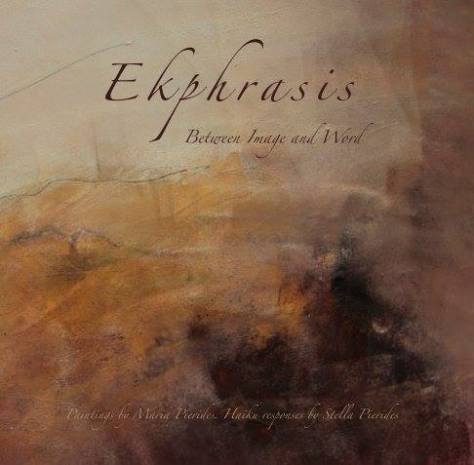
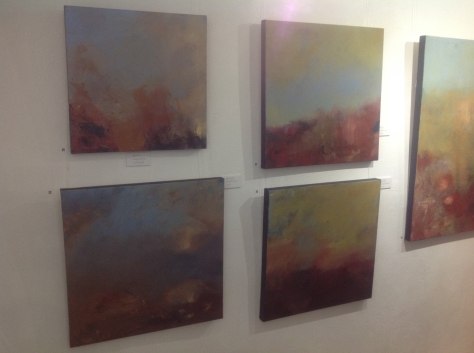
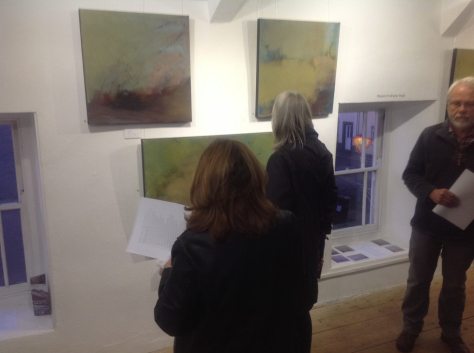
Good to see my haiku travelling to new and exciting places, accompanying Maria Pierides’s forthcoming exhibitions of her paintings in a number of venues in South Wales.
Maria has printed selected haiku responding to her paintings on cards for all occasions and will be taking them to her exhibitions of her paintings.
If you happen to be in Wales, you may wish to visit the marvellous exhibition ‘Art at the Hall’, Temperance Hall, Llangathen, South Wales, from the 14 to 23 of April; or Maria’s excellent forthcoming solo show at King Street Gallery, Carmarthen, 27 October to 16 November 2017.
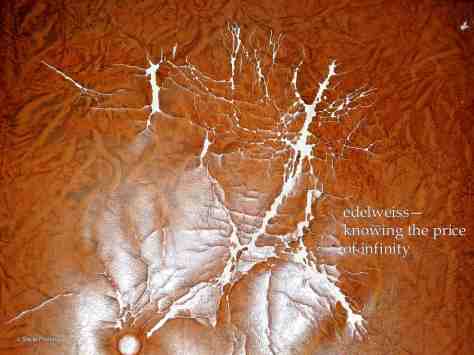
In addition to these exhibitions, Maria’s cards are available from King Street Gallery in Carmarthen or you can email her directly at pieridesmaria@me.com

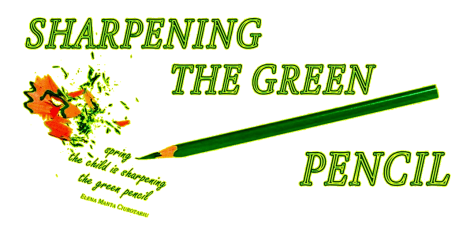
Delighted to learn that my poem “refugee child” received first prize in the Romanian contest “Sharpening the Green Pencil, 2017.”

Thank you to the judges, and especially Cezar Florin Ciobiza for his thoughtful commentary. And congrats to all participants!
refugee child–
folding and unfolding
his paper boat
A print book with all the poems entered is available from the contest organizers..
Please find the poem and commentary included in the (online) book of the contest, p. 13, here
What does it mean to wake up facing a fist pressing hard against your window?
How does one cope with such a threat, day in, day out?
The morning presses
its hot fist against the window:
the fight starts.
— Bart Mesotten, Haikoe-boek (self-published, 1986; translation by Max Verhart)
Pleased to share that my take on Bart Mesotten’s excellent poem is featured in this week’s re:Virals, The Haiku Foundation’s haiku commentary feature.
Take a look here
And try your hand at writing a commentary on the poem I chose (as this week’s winner) to be discussed next: LeRoy Gorman’s “the good soldier.”
A week ago, I mentioned in this blog a second paper, addressing the haiku community, Haiku and the Brain: an Exploratory Study, in Juxtapositions: The Journal of Haiku Research and Scholarship. Well, it is now online over at The Haiku Foundation. Do visit and check it out along with the other papers.
I am looking forward to reading the other contributions. And to receiving my own print copy of the Journal! Judging from the previous issues, it is a joy to hold and leaf through. And a collector’s item. You don’t want to miss it! More information on how to obtain a copy, see here
Meanwhile, here is the Abstract for this paper.
This paper presents the first results of an interdisciplinary project, bringing together haiku poets and neuro-/cognitive scientists, to investigate the reading of English-language haiku (ELH) as a potentially paradigmatic material for studying the reception of poetic texts. Our pilot study was based on the ‘eye-mind assumption’, that where and for how long we gaze at sections of text reflects processes of information harvesting for meaning construction. The results indicate that the interactive process between the poem and the reader gives rise to characteristic patterns of eye movements (saccades and fixations) across the text from which (i) the position of the cut (after line 1 vs. after line 2) and (ii) the type of haiku (context-action vs. juxtaposition) can be discerned. Finding (i) is of special importance: it provides evidence that the effect intended by the poet can indeed be traced in oculomotor behavior and that, thus, the cut is indeed a potent poetic/stylistic device with a specific effect in the reader. Moreover, readers’ recognition memory was found to be associated with more explicit, conscious-recollective experience of having read a particular haiku if the poem was self-rated to be understood. This suggests that the realization of the haiku’s ‘meaning gestalt’ in the reader’s mind, which may be associated with an ‘aha’ experience, is important for memory consolidation and remembering. Albeit tentative, these findings and conclusions open up interesting lines for future, interdisciplinary research.
Delighted to have two of my haiku: “juggling” and “hermit crab,” appear on Jennifer Hambrick‘s Inner Voices as part of the International Women’s Haiku Festival. And I love Jennifer’s commentary! Check it out here

.
Photo from the piece: Vanessa Pike-Russell/Creative Commons/Flickr
Christmas Day
the Home visitors
bearing gifts
.
steam room—
letting go of
my bones
.
In Blithe Spirit, Journal of The British Haiku Society, vol. 27, n.1, Feb. 2017
The relationship between poetry and science has been a long-standing fascination of mine. I am happy to report that for the last couple of years I have been involved in a study spanning the two, using haiku to understand how the brain receives, analyses, and constructs meaning. The first exploratory study has been written up and discussed in 3 papers, one of which can be found in the Journal of Eye Movement Research here

Mueller, H., Geyer, T., Günther, F., Kacian, J., & Pierides, S. (2017). Reading English-Language Haiku: Processes of Meaning Construction Revealed by Eye Movements. Journal Of Eye Movement Research, 10(1). doi:http://dx.doi.org/10.16910/10.1.4
This paper is the more detailed, scientifically oriented description of the exploratory study.

A more compact version of the same work, addressing the poetry community, is included in the forthcoming JUXTA 3.1: Pierides, S., Müller, H., Kacian, J., Günther, F., Geyer, T. (2017). Haiku and the brain: an exploratory study. Juxtapositions: A Journal of Haiku Research and Scholarship 3(1). Due out mid March 2017!
Out of This World

In the deepest of dark nights, the idea that we may be living in a computer simulation created by a higher intelligence appeals to me. I muse over the possibility that we may be simulated beings living in a ghost world without realising it!
What if the simulation hypothesis were true? What if we really lived in a version of Plato’s Cave: unable to see beyond the projections on the wall of our senses, we became captives of our perceptions. How would we ever be free? Would there be a way out? Even if a wise philosopher, daring scientist, or escaped prisoner were to tell us of the real world outside our cave generating the projections, we wouldn’t believe them.
Assuming there’d be some way out of the simulation, in those sleepless nights I think of possible glitches in the system, devise tests. This is my latest: try watching pools fill with rain, the noon slide towards evening, the inexhaustible torment of the sea: if you can bear their beauty, be well. If you can’t, you are sure to be out of this world.
revving up the engine
despite the rain
because of it
In Haibun Today Volume 11, Number 1, March 2017
poetic license—
returning to earth sunburnt
Laika
.
In right hand pointing winter haiku 2017
issue 107 low sky
Touching
Imagine your left hand is being made to feel a brief vibration and you’re being asked to estimate how long this vibration lasts. In one version of this scenario, you are holding a small ball in both hands; in another, your right hand is free. And in both versions, you see a safely suspended, potentially catchable ball moving towards you.
Would your estimate of the vibration duration be the same in both versions, or would it be different? Scientists tell us that we overestimate the duration of the vibration when our right hand is free.
Surprised? The scenario may sound unlikely, but all for a good reason: the investigation of the experience of tactile time. Perhaps unlike other bodily times, touch time appears as if time slowed. Your hand is free and ready to interact with the possibilities of a touchable object. The present moment gathers momentum: memories, anticipations, balance, co-ordination, visual cues… the time your father threw you a ball to catch, your sister’s expert throw, your playful nature entertaining the idea to catch the ball and surprise the scientists… Time slows for the possibilities; time slows with possibilities. The ‘touch’ body and the ‘touch’ mind ready themselves for the game.
infinity
a deer appears at the edge
of the woods
*
Bringing poetry and science together!
This haibun is from my new book Of This World (Red Moon Press, 2017) and appears on the LMU site MSense .
dust devils: The Red Moon Anthology of English-Language Haiku 2016, edited by Jim Kacian & the Red Moon Editorial Staff is now out and available to purchase.

From their website:
The Red Moon Anthology of English-Language Haiku enters its third decade of gathering the finest haiku and related forms published around the world in English into a single book, the longest run of any book dedicated to ELH. dust devils includes 173 poems (haiku & senryu), 8 linked forms (haibun, renku, rengay and sequences), and 5 critical pieces on the reading, writing and study of the genre.
Honoured to be included!
Don’t delay, order it and enjoy!
Serendipity! On the day I was informed that my haibun Touching —inspired by a scientific project carried out at LMU university Munich — would be featured on the LMU website, I came across an article in the New Statesman discussing the close relationship between poetry and science!
Take a look: the haibun Touching, included in my new book Of This World (Red Moon Press, 2017), at the LMU here and here and the New Statesman article here

OK, may be not so much serendipity, as I often check out writings about the relationship between poetry and science, and have even contributed to a couple of papers on precisely this matter. The papers are forthcoming, watch this space …
Each year around the 15th of January, Greek Dinner Around The World Day, I am reminded of The pre-Socratic Greek philosopher Thales of Miletus (624 – 546 BC), who is credited with the saying,
A sound mind in a sound body
How true! Research from many scientific disciplines has been confirming Thales’ saying ever since. Encouraging us to take up exercise of all sorts to keep the blood moving, arteries in good nick, and prevent harmful tangles from forming in the brain, scientists have gone out of their way to emphasise prevention. In this endeavour, the Mediterranean diet has been a major pillar, oiling the wheels of the temple to the mind!

In the context of this close relationship between physical exercise, bodily well-being, mental equilibrium, and the ability to enjoy life, you can imagine the enthusiasm with which I am taking part in this global event.
Admittedly, the main goal is wider: to celebrate Greek culture, Greek cuisine as it is known in every part of the globe, and promote the people, authors, chefs, travel and other businesses connected to Greece. Partners to this initiative host a dinner using Greek products and Greek dishes, share experiences and photos of their event, and tweet using the hashtags #GreekDinner, #GreekDinnerAroundTheWorld, and #EatGreek.
This year I took part by sharing a delicious Greek meal with friends and family. And books, of course. We met at an old favourite restaurant and I brought my latest book, Of This World (Red Moon Press, 2017) — a collection of haibun (prose with poetry) with several poems on Greek themes / settings — to the table.
The food was exceptionally good – the company excellent. The only problem was the usual problem: we all ate a little too much. Like every year, we were reminded that after a point, the amount of food, and drink, interfere with both body and mind! Once again we resolved to follow another Greek saying: the Aristotelian
Παν μέτρον άριστον, i.e., Everything in moderation
Many thanks to Keri Douglas for her tireless efforts in promoting this event.
και του χρονου
and if you are interested in a copy of my new book:
Amazon UK
Amazon Germany
Red Moon Press (USA)

Delighted to announce that Red Moon Press just released my haibun collection, Of This World
Stella Pierides has cultivated a terse, idiosyncratic style in her haibun that is instantly recognizable, and as a consequence is one of the shining lights of this burgeoning genre. Of This World certainly is, but it also takes us out of the world at large and into private spaces we feel privileged to witness. A unique and satisfying read.
Red Moon Press
Amazon Europe
Amazon UK
I am grateful for the generous comments:
This is how it’s done! Stella Pierides — in a hushed voice — takes me through what it is to be human — and part of the human history from the roots of Western culture in Diogenes’ tub to the ‘modern’ human — with all the questions and doubts, the uncertainties that come from that.
— Johannes S. H. Bjerg, Writer
Of This World’s marvelous, emotionally resonant haibun are steeped in the grace of the garden, rooted in a physical reality so sensuous that you can smell the fragrance of baking bread, of olives and garlic, of lemon and magnolia blossoms — and yet they also spiral on the updraft of metaphor as poet Stella Pierides ‘put[s] our hearts in the shoes of the hummingbird.’
— Clare MacQueen, Editor-in-Chief, KYSO Flash
A treasure trove of language and image. Pierides walks through dark streets of history, through alleyways of memory – emerging in shiny, unexpected places. Compact, urgent and closely observant, these minute offerings will captivate readers of both poetry and short fiction. An enormously engaging collection.
— Michelle Elvy, Writer and Editor
*
Of This World
ISBN: 978-1-936848-80-5
Pages: 124
Size: 6″ x 9″
Binding: perfect softbound