
winter seclusion
practicing the warrior
pose
Category Archives: Poems
‘giving the walls’
giving the walls
a coat of sunlight—
egg tempera
.
yolk

‘river tides’ on tinywords
My poem on tinywords yesterday:
river tides where have I been
.
(I almost missed it!)
Thanks to the tinywords team for the beautiful background image.
‘hung with lights’ and ‘dreaming’
Haiku for Gillena Cox’s Let’s Haiku a Christmas Carol, at Lunch Break,
*
hung with lights
the tree still sparkles…
year end sales
.
(Day 7)
*
dreaming
of a safe Christmas…
children’s refuge
.
(Day 6)
‘winter solstice’
Happy Solstice!

KYSO Flash Anthology of Haibun and Tanka Forms 2015
Clare MacQueen just announced the publication of the KYSO Flash Anthology, featuring prize-winning haibun and tanka. My own haibun “Time,” which received an Honorable Mention (in November 2015), is included.

This is how KYSO Flash describes the release:
We’re pleased to announce the release of a little book with a mouthful of a name: the KYSO Flash Anthology of Haibun and Tanka Forms 2015. Contributor copies are now on their way to folks.
This is an international collection of 25 poetic hybrid works by 14 authors (plus images by three artists). Works were judged by Roberta Beary, award-winning poet and haibun editor of Modern Haiku, for the first annual KYSO Flash “Best Of” contest. Cash prizes were awarded to seven artists for First, Second, and Third Place, and Honorable Mentions. The judge also selected 19 finalists to appear in this anthology.
The book is available from Amazon.com
‘Intertextuality’ in Sonic Boom 4
Pleased to see my ‘Intertextuality,’ a haibun diptych, in issue 4 of Sonic Boom, published under ‘Fiction.’
Issue 4, is an anniversary issue. Happy Birthday to Sonic Boom, many happy returns!
Intertexuality
(a diptych)
I
A reader asks for help with a patch of garlic plants forgotten and left to overgrow in their garden. Well, I say, dear reader, we are caught between a rock and a hard place. Garlic doesn’t like to be transplanted. And this text is not the right place to ask, or answer such a question. But I can’t resist. It is spring, after all, and I am stuck for ideas. So, to your garlic clump: Let it be. Let it grow, and when it is ripe and ready, when the tips of the green shoots start to brown, dig the plants out. They will be pungent, crisp, and juicy, the plant oils moistening your tongue. Then plant a few individual cloves for next year’s crop. Enjoy the rest.
writer’s block
the school of life
full of lessons
II
Spelt flour, baking powder, butter, milk, and salt. Mix, pat down, shape into rolls, and bake. Serve with olive oil, and garlic from another haibun to dip the bread into. Enjoy!
a frog jumps in—
intertextuality
for beginners

‘in search of’

‘bicycle thief—’ Honorable Mention
bicycle thief—
on her blouse
cherry blossom
.
2015 Haiku Invitational, International Sakura Awards Honorable Mention.
‘Pandora’s Box’ in Haibun Today
In time with the first snowfall…my haibun “Pandora’s Box” is now online at Haibun Today. A political haibun, looking back at the period of the Greek Junta and its aftermath.
The entire winter quarterly issue of Haibun Today can be found here
‘even when’
even when time stands still waiting

“Shoes” in Whirlwind #6
56. Münchner Bücherschau
From the Münchner Bücherschau: the German edition of Feeding the Doves, Taubenfuettern, on display, taking its place among my earlier Fruit Dove Press titles.

Afterlife
Do you sometimes wonder what happens after the gravediggers return to their workstations and the grieving relatives go home?  What is it of the self or soul that’s left inside the box or urn, or floating in the air? Do you think there may be life after death, a life after this life, an afterlife? Do you fret over reincarnation, heaven, or hell? Poets do.
resting in peace
her mobile phone
keeps ringing
Robert Epstein, a licensed psychologist, and haiku poet, has just edited Beyond The Grave: Contemporary Afterlife Haiku (Middle Island Press, 2015), an anthology of poets’ haiku on the life beyond. Thoughtful, sensitive, measured and moving, as well as studded with moments of humour, and brilliance, the anthology proves an invaluable companion for thinking about the limits (and beyond) of existence.
lilies the meaning of life after death
Leafing through poems on life after death, I let myself be led along lines of uncertainty, of hope, as well as humour, of the ineffable, of mysteries, without the certainties that dispose of thought.
afterlife
that turn of phrase
in her haiku
.
(Poems included in the anthology)
“Time” receives Hon. Mention in the “Best of Haibun and Tanka Forms” 2015, for the KF Anthology
I must be on a roll! Delighted to learn that my haibun “Time” received third honourable mention in the “Best of Haibun and Tanka Forms” 2015, for the KYSO Flash Anthology due out in December 2015.
Roberta Beary, award-winning poet and haibun editor of Modern Haiku, the judge of this contest, wrote:
Stella Pierides’ haibun shows how time, which is also the title, turned the narrator’s expectations of her life’s autumn upside-down. The haiku at the haibun’s end effectively juxtaposes the images and original word choice in lines 1 and 2, lulling the reader along until the surprise of line 3. At first glance the haiku does not seem relevant to the prose. A deeper reading shows that the haiku echoes and expands the feelings of surprise and mortality elicited by the prose, which is exactly what is supposed to happen in haibun.
You can find “Time” here
Light on a dark poem
Thrilled to have had a poem of mine discussed at re: Virals, The Haiku Foundation’s poem commentary feature. The poem is from my book In the Garden of Absence (Fruit Dove Press, 2012):
granny’s cushion
pulling the darkness out
pin by pin
It was chosen by Irish poet Marion Clarke, the previous week’s commentary winner. And right on Halloween, All Saints Day… which added extra layers of depth to my haiku. Thank you, Marion! And thank you too, to Garry Eaton and Beth McFarland for their insightful comments.
I love the re:Virals series, and look forward to reading the poems chosen and the commentaries written on them.
Would you like to take part? Anyone can participate. There is a new poem each Friday on the site (chosen by the previous week’s winning commentator) for you to comment on. Simply put your take in the Contact box by the following Tuesday midnight. . .and there you have it, good luck! The best commentary will be reproduced in its entirety on the site and kept permanently in the THF Archives.
‘mala fide’
mala fide—
taking another look
at the moon
Frogpond, 38:3 2015
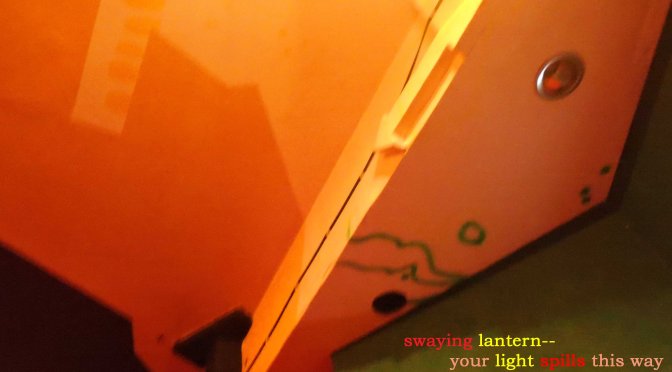
‘swaying lantern’

‘line after line’

‘light flows’

‘virtue’

‘failing light’
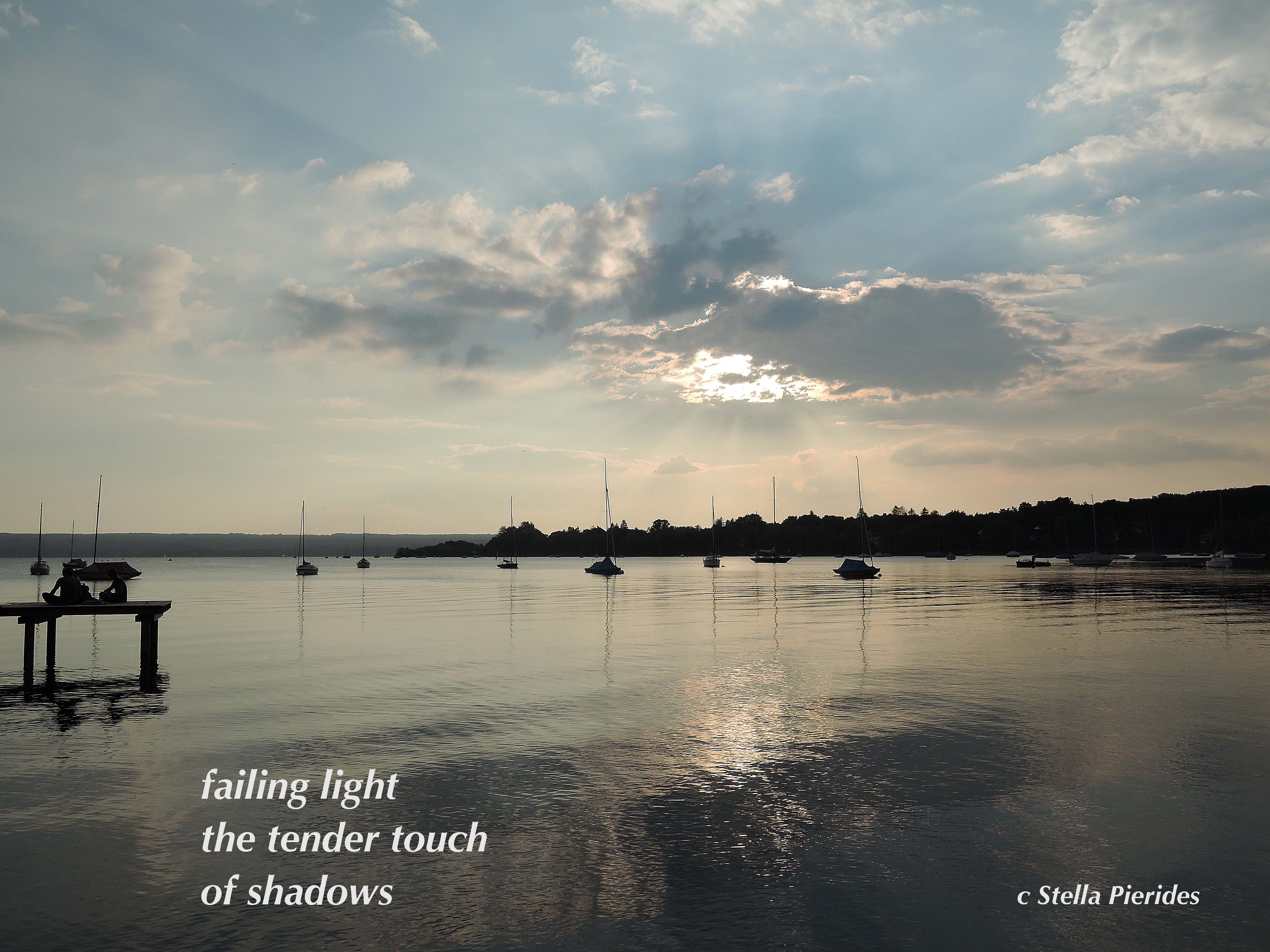
Photo: sunset, Ammersee, Bavaria.
‘thin clothes’ and ‘nine circles of hell’
thin clothes
an imperceptible smile
forming
.
nine circles of hell
positioning
my wickedness
Chrysanthemum 2015, Nr. 18. p. 34

‘Shut-eye’
Have you ever tried to fall asleep in Athens? I have, and I can tell you it is no mean feat. Car horns, car alarms, arguments, laughter, jovial “yia mas,” clinking glasses, people speaking in colourful accents and languages, young men selling flickering toys, women begging, babies crying, restless figures talking to themselves, dogs fighting; ambulances, police on motorcycles revving their engines… the Athenians never stop. There should be prizes for those managing to fall asleep in Athens.
So, when I read a story about disturbed sleep in Athens, I immediately sympathised. The character in the story could not sleep because neighbours had been digging in the pavement outside his window, chatting late into the night. No other sounds seemed to disturb his sleep. In the morning he found out what they had been up to. They had been planting a tree! Unfortunately, the author doesn’t tell us what kind of a tree. Was it an olive? A lemon? Or is he – for he must be a he, don’t you agree – withholding the information in case we start looking into symbols? Never mind, let’s not start obsessing.
on the pillow the night and its shadows
I can provide the tree for our purposes, no problem. But where is the story in the story? Several unspecified neighbours are planting an olive tree in the middle of the night, while as far as the story goes, teeming millions of people in this big city are asleep (how does the author account for the lack of noise in Athens? I don’t know). I can imagine people emerging bleary-eyed from their beds trying to make out what is going on. Asking questions, shaking their heads, crossing themselves, complaining; then what? Going back to sleep in a city that is at its loudest at night? Something does not fit, or rather is well-hidden in this story.
Unless, of course, it is a metaphorical sleep that is meant here. Sleeping as in keeping the peace, turning a blind eye. Wink, wink. Worse, someone turning a blind eye to the hope (planting of the tree, see?) that is being taking root.
Impossible? Let’s consider it. After the worst famine since World War II, after a huge increase in suicide rates, after the vicious psychological attacks on the country, against which, as a nation as well as an individual, it was difficult to defend oneself, the people of Athens, in their global origins and skin colours, in their Babelesque languages, are turning a corner. Things are being said. Planting is being done. The story writer, by ignoring the usual nocturnal noise, and foregrounding instead the hushed, whispering voices in the night, is drawing our attention to something inconspicuous: the barely audible voices of those just starting to communicate a desire to plant something that grows; a belief in survival, in continuity, in building once more a better life…
Planting trees in the dead of night: allusions to hope, to the future, putting down roots, seeds of hope in the dust of despair… see, even hope has to be dispensed in dribs and drabs. Still, whatever you do, don’t close your eyes; or ears.
silver leaves
the olive tree dripping
light
***
Blog Action Day 2015.
This haibun was written in response to the theme #RaiseYourVoice – in support of those who can’t.
Inspired by “Workers Disturb My Sleep in Beijing”
by Salvatore Attardo, published in Cha
.
#BAD2015 #Oct16 #blogactionday
‘Back to the river Ilissos’

‘way below’
way below
the chestnut’s inner skin
white sail
.

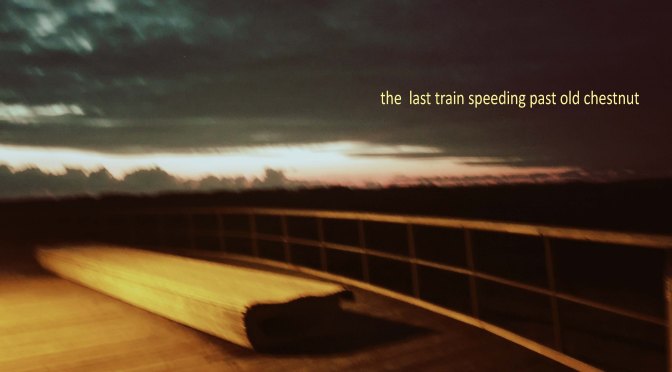
‘the last train’
the last train speeding past old chestnut
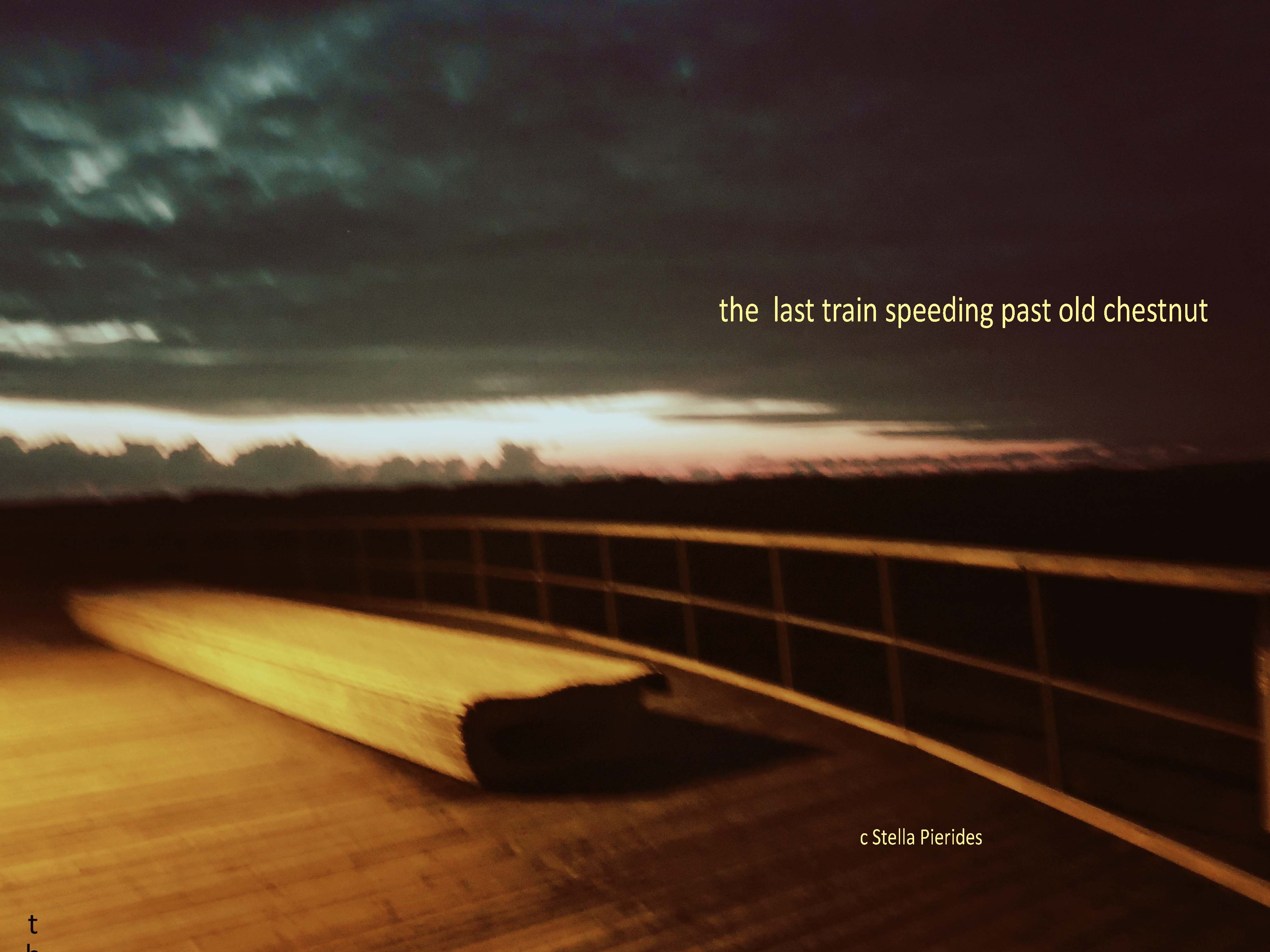
‘Shadows’
Shadows
I’m walking around the world without leaving home… How? By using a pedometer: it tracks my steps and lets me know weekly the distance I’ve covered. Occasionally, it congratulates me on earning a badge for achieving high step counts (per day) and distance milestones. The exuberant software emoticon that comes with the email makes my day. Earlier on this year, I celebrated walking the length of New Zealand: 1593 km long. A couple of weeks ago, I received a badge for walking the distance covered by the Great Barrier Reef, all 2574 km of it! Now of course I wish I had really been there. On the other hand . . . what is reality?
blood moon . . .
gliding in and out
of earth’s shadow
.
And here are my New Zealand and Great Barrier Reef Badges:


‘missing’
missing from the rainbow burnt umber
.
Prompt: umber
‘Dear Yannnis’
Delighted that my epistolary poem ‘Dear Yannis’ (Ritsos) is given another airing on RE / VERSE, the online journal.
‘Little Eagle Press presents poems previously published. Well worth another look, we think,’ they say. Thank you to Ralph Murre for giving my poem a second chance, and for the photo art image he created that accompanies the poem. Take a look by clicking here
