hiking —
for a moment the door
swings open
.
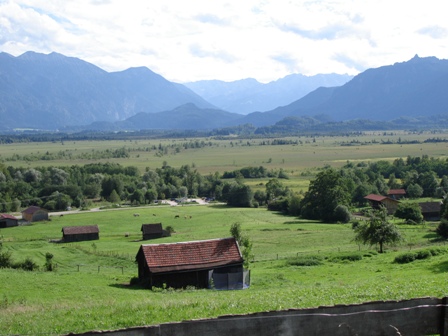
I took this photo on a walk round Lake Schliersee, in the Bavarian Alps. Beautiful lake!

hiking —
for a moment the door
swings open
.
I took this photo on a walk round Lake Schliersee, in the Bavarian Alps. Beautiful lake!
swollen river —
another deep
regret
.
apricot skies
taste of summer
in the fruit bowl
.
Blithe Spirit Vol 23 No. 4, p. 41
cold dew
why must I write
autumn poems?
.
#NaHaiWriMo prompt: sprinkle
fish-bowl…
sharing her cherry poem
on Facebook
.
nhwm: glass
What a “girl”! Initially published in Off the Coast in 2009 (Vol XV, Number 2), my “Girl” is now at Ralph Murre’s Little Eagle’s RE / VERSE. (19 December 2012)
I love the artwork by Ralph Murre!
Do take a look, but please be considerate! Click here
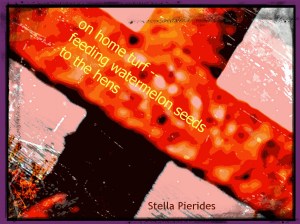
on home turf-
feeding watermelon seeds
to the hens
.
“On Home Turf,” Haiga, in “A Baker’s Dozen,” issue 4, 15 December 2012
…..
.
.
.
a fig is not a fig without your mouth
.
a pyromaniac’s dream on top of the world
.
In “Bones: Journal for Contemporary Haiku,” No 1, 15 December 2012
…..
at the bottom of the sea the bottom of the sea
.
raining stars
how the begging tin
sounds
.
in “Presence” #47, December 2012
…..
past her nails
a truth worth
holding on to
.
in Notes From The Gean, #14, p. 28, December 2012
…..
shooting star –
a baby slithers out
of the womb
.
frost bite
the winter bares its teeth
.
In “A Blackbird Sings: a small stone anthology”
edited by Fiona Robyn & Kaspalita Thompson, 2012
.
wordless poem sharing the silence of fallen leaves
.
NaHaiWriMo prompt: seeking solace
1
resting the needles –
a half-finished poem
hangs from my lips
2
resting the needles –
I search the mirror
for clues
.
Playing with Gabi Greve‘s kigo for the day: ‘resting the needles’! See the entry in the World Kigo Database
NaHaiWriMo prompt: mirror
.
quill scratching a poem where it hurts
.
NaHaiWriMo prompt: feather
Here is my own ‘smallstone’ of the day!

.
.
..
.
.
.
,
here is the now —
this smalls stone I hold
in my hand
.
.
This is the first ever Mindful Writing Day; it is organised by Kaspa & Fiona at their blog ‘Writing Our Way Home‘.
Visit them to read what the other ‘stoners’ are writing, and better still, email them your own stone!
Today, 29 September 2012, is the day when 100 Thousand Poets for Change gather online, in person, and in print to celebrate poetry, art and music, and to promote social, environmental, and political change.
If you happen to be in Munich today, drop by the Munich Readery, the largest and friendliest secondhand bookstore in Germany. They will be hosting an evening of readings and performances from 19:00 – 22:00.
In observance of today’s 100 Thousand Poets for Change, I offer the following prose poem: The Beach at Blakeney Point, first published in the North London Writers and Poets Anthology Gathering Diamonds from the Well, 2007.
The Beach at Blakeney Point
Hard as I try, I can’t recall the beach at Blakeney Point. Images blend and memories merge – this beach with that at Holkham, with Morston, Burnham Overy and Brancaster Staith.
I only see an expanse in my mental map, the horizon shimmer, Old Lifeboat House looking stern from afar. The salt marsh carpet, creeks, dunes and samphire. Now it is summer. Blue above and below, and the sharp pinpricks of the flying sand. Now it is winter. The saltings dim grey and dirty brown, freezing crystals on the scrub.
Hard as I try. My first walk to the Point fromCleyBeach. Before I knew about tide tables, I set off walking the deep shingle spit, bruising calves and blackening nails. I did reach the end, the sea and the tern’s nests. The feeling of space and the sense of infinity. The tide withdrew to sea while I rested, leaving casts of lugworms, deserts of sand behind. Buccinum and Hydrobia shells. Leaving the bottom of the sea to me. Its cruelty.
A baby seal washed up dead, lying in pools of water, alongside sparkling stones and Flustra fronds the colour of hope. Why, where is the…, what can I…? Too late. It was, I was, too late. I walked back barefoot, the seal receding with each step, ebbing away. The boom of the sea and the spray. The wind sculpted sounds, I licked salt off my lips.
Hard as I try. Sea holly, sandwort and sand sedge cling to shifting dunes. I can’t remember the beach at Blakeney Point. Only that seal, that wind, and my impotence.
.
76/100 Days of Summer
For Blakeny Point, see here
The Beach at Blakeney Point, in Gathering Diamonds from the Well, ed. Brian Docherty, Laurence Scott, and Katie Willis (London: New Gallery Books 2007)
.
whistling through a blade of grass poems I might write
.
NaHaiWriMo prompt: grass (Melissa Allen)
34/100 Days of Summer
Every year on the 21st of March UNESCO celebrates World Poetry Day. A decision to proclaim 21 March as World Poetry Day was adopted during the UNESCO’s 30th session held in Paris in 1999.
For UNESCO, “the main objective of this action is to support linguistic diversity through poetic expression and to offer endangered languages the opportunity to be heard within their communities. Moreover, this Day is meant to support poetry, return to the oral tradition of poetry recitals, promote teaching poetry, restore a dialogue between poetry and the other arts such as theatre, dance, music, painting and so on, support small publishers and create an attractive image of poetry in the media so that the art of poetry will no longer be considered an outdated form of art…” Link here
So, Happy World Poetry Day everyone!
.
telegraph wires –
swallows too are waiting
for your news
.
Nahaiwrimo extension 2011; prompt: migrating birds
.
as if the word for peace were war cloudy skies
.
cloudy lens –
looking without
seeing
.
NaHaiWriMo extension 2011; prompt: peace
All you ever wanted to know about dragonflies … in haiku…in Melissa Allen’s blog Red Dragonfly.
It is a dream of a post with amazing poems, images/artwork. (Don’t miss the video of the dying dragonfly.) The links to the poets and their sites/work is an extra bonus, and I know it is much appreciated.
So, go over there and read! (Delighted that two of my own haiku are included! Thank you, Melissa!)
I just watched a short youtube video trailer of a fantastic video poetry project, City Breath, bringing the poetry and art of South African cities to life! The link to this trailer is here
.
I was sent the following information about the City Breath project:
.
“Through their common city theme, these short video ‘gasps’ or ‘breaths’ of South African cities give voice to the private dreams and nightmares of local poets, dancers, performance artists and filmmakers. They interrogate, with or against rational logic, the way South Africans understand their cities and urban life. Rebellious in their nature, under 4 minutes each, the films represent a genre seldom seen in South African film and television.
“Inspiring, sometimes beautiful, sometimes challenging, and over-all very impressive.” (Trevor Steele-Taylor, Director of the National Arts Festival Film Programme)
The City Breath video poetry project was shown in several cities round the world – Johannesburg being the most recent, after Berlin, London, Cape Town, and Vancouver. Curator Kai Lossgott is looking for more venues and festivals around the world interested in showing the project. She can be contacted directly at info@kailossgott.com
Apart from selecting existing works, the CITY BREATH project has initiated and developed new collaborations in the areas of the video poem, screen dance and experimental film.”
For more information and a fab blog see http://www.citybreathproject.blogspot.com
I was impressed and inspired!
I happen to know the work of one of the poets quite well: the immensely talented Tanya van Schalkwyk’s work, fusing imagination with sensitive observation and dynamic expression.
But watching the trailer (a few times!) made me want to see the whole thing!
Tania’s contribution to the video project is her poem “The Electrician” included in her book Hyphen. It can be seen here

The Festival of the Trees is “a periodical collection of links to blog posts and other online sites, hosted each month on a different blog.” Bloggers, poets, writers with an interest in arboreal matters post related material on their own blogs and submit the links to the host of each month’s co-coordinator. This month’s host was Arati, of the Bangalore-based blog Trees, Plants and More.
My own contribution to this month’s Festival of the Trees, I wrote some time ago. In “If Trees, then Olive Trees,” I use the olive tree, a precious, almost sacred tree in the Mediterranean, western Asia, and northern Africa countries; a symbol of peace and hope, connecting to the “olive branch,” and the sighting of land after the biblical flood.
Short, gnarled and twisted, the olive tree even looks appropriately old. It is said to live for hundreds of years, as its roots are capable of regeneration even if the trunk above ground is destroyed. Radiocarbon dating has confirmed 2000 year old trees in several countries! A tree known to be situated in the grounds of Plato’s Academy, in Athens, lived till the 1970s. An olive believed to have been planted by Peisistratus, the tyrant of Athens in the 6th century BC, is still to be found in Athens. Even older trees have been found in Israel and Arab lands, dating from 3000 and 4000 years ago. The trees of the Garden of Gethsemane are said to be dating from the time of Jesus.
In literature too, we know of several millenary trees: Homer featured olive trees in his poetry. Remember Odysseus bed?
My own poem is about putting down roots, both literally and metaphorically. You can read it here.
My novel “Alexandrias 40: In the Shade of the Lemon Tree” is also set around a tree, and it includes a number of surprising uses for its fruit. Not long now till the book is out. Watch this space.
For instructions on how to submit to the next Festival of Trees here.
.
Seferis’ Houses
.
The houses he had owned
they took away from him..
.
Seferis carried his home
on his back like a tortoise.
Iron beds in empty hotel rooms
rang through his lines,
and the sounds of loneliness–
the silent screams of souls
left to themselves
in the dark.
.
The houses he had owned they
took away from him.
.
He used his poetry,
he strung words from the stars
stared at them from afar.
Flowers of Agapanthus
he nailed on his lines,
and crickets, beating time
for the machine.
.
Only briefly did he go back to Smyrni.
.
For he knew. Seferis knew. He knew
you have to talk to the dead.
Hades is full of whispers–
the house is always watching.
And waiting.
.
A version of this poem appeared in the “Word for Word” anthology Gathering Diamonds from the Well, London: New Gallery Books, 2007.
George Seferis (1900-1971), Greek poet, originally from Smyrni (now Izmir) in western Turkey, winner of the Nobel Prize for literature 1963.
20 October 2010
The poet Constantine P. Cavafy, or Konstantinos Petrou Kavafis, one of my favorite poets, wrote the following about his origins:
.
“I am from Constantinople by descent, but I was born in Alexandria—at a house on Seriph Street; I left very young, and spent much of my childhood in England. Subsequently I visited this country as an adult, but for a short period of time. I have also lived in France. During my adolescence I lived over two years in Constantinople. It has been many years since I last visited Greece. My last employment was as a clerk at a government office under the Ministry of Public Works of Egypt.”
.
I have pasted his poem Ithaca below – he knew what he was talking about. For more of his poetry and resources on the web, see the Cavafy Archive
The poem, quotation, and Wikipedia url can be found here
Ithaca
English Translation
When you set sail for Ithaca,
wish for the road to be long,
full of adventures, full of knowledge.
The Lestrygonians and the Cyclops,
an angry Poseidon — do not fear.
You will never find such on your path,
if your thoughts remain lofty, and your spirit
and body are touched by a fine emotion.
The Lestrygonians and the Cyclops,
a savage Poseidon you will not encounter,
if you do not carry them within your spirit,
if your spirit does not place them before you.
.
Wish for the road to be long.
Many the summer mornings to be which with
pleasure, with joy
you will enter ports seen for the first time;
stop at Phoenician markets,
and purchase the fine goods,
nacre and coral, amber and ebony,
and exquisite perfumes of all sorts,
the most delicate fragances you can find,
to many Egyptian cities you must go,
to learn and learn from the cultivated.
.
Always keep Ithaca in your mind.
To arrive there is your final destination.
But do not hurry the voyage at all.
It is better for it to last many years,
and when old to rest in the island,
rich with all you have gained on the way,
not expecting Ithaca to offer you wealth.
.
Ithaca has given you the beautiful journey.
Without her you would not have set out on the road.
Nothing more has she got to give you.
.
And if you find her threadbare, Ithaca has not deceived you.
Wise as you have become, with so much experience,
you must already have understood what Ithacas mean.
.
For more of his work see the Cavafy Archive and here
I am delighted and honored! My micro-poem They send light to Earth was chosen to be the first piece to be published by new e-zine @textofiction.
Brand new, “Textofiction is an online literary publication dedicated to bringing the best writing in under 140 characters.”
Read my micro-poem and think, it packs a lot in. Better still, let me know your thoughts about it! Read it here
Date of publication: 29 August 2010
Big, tough fella
loud, racy lass
timid Cinderella
prodigy, alas
blow your vuvuzela
if you must.
See also my post: Whatever you think about football
This poem is a suicide note addressed to a number of unusual addressees, leaving the content of the note to the reader’s imagination. It puzzled and haunted me for the last few weeks: its exquisite, lyrical tone, its mysteries and the ways it brings nature alive through its lines.
A Critical analysis by Tammy Ho Laiming and Jarno Jakonen appeared recently in A Cup of Fine Cha. I thoroughly enjoyed reading both, poem and analysis, and kept them with me for weeks, chewing on words, mulling over the subtle allusions.
Tammy Ho Laiming and Jarno Jakonen’s analysis of the poem, as well as the comments, provide a beautiful and multi-faceted context to the poem. There is whole list of addressees in this “Suicide Note”: “frog, cicadas, rain clouds, gardens, worms, grass, deer, curtains, noise, lights, glass trails, heart, hands, ink, bruises, rivers, summers, monsoons and thunderbolts,” which the analysis and the comments fully and thoroughly explore.
I have nothing to add, except one question: Where are the people? Where are the relationships with people? The nature described in the poem is giving, generous – though providing what is usually offered by humans: warmth is offered by glow worms, for instance. And as if to emphasize the point, neighbours and strangers appear only impersonally as in “the shining lights of the neighbours and their last ashen cigarettes.”
So, for me, there is so much loneliness and sadness in the persona pouring out every time nature stands in for the human touch: friends, family, acquaintances, colleagues, or even kind strangers. What could be more indicative of sadness, and indeed despair, than the need to use “broken glass trails that will show the way to strangers”?
From this perspective, what if, in a well-encrypted way, we are led to ask: does the poem take the line of praising nature instead of criticizing fatal failings of the human heart?
Still Life, in Poets Online, Archive, Found Poems, February 2010
[poem] http://www.poetsonline.orgI wrote this poem in response to the painting titled Woman by Robert Campin. The painting can be found in the National Gallery, London. Here is the link: http://www.nationalgallery.org.uk/paintings/robert-campin-a-woman
My poem, Girl, can be found in the print Journal Off the Coast, International/Translation Issue, Spring 2009.
Girl
after ‘Woman’ by Robert Campin, 1378-1444, National Gallery
She rarely smiles. A thick, white veil
frames her face, stops her innocence
from straying too far;
remembering the world outside.
Here she lives, here she is
and here she stays: four walls,
bench, Bible, rosary, Cross,
pair of clogs, glass, pebble,
compass, chair, table.
She would be lost, but
for her little pleasure:
a bowl of coconut ice
refectory Sister leaves
on her windowsill.

Here I collect notes, poems, articles, pictures, news I find interesting, exciting, thought-provoking – without necessarily agreeing with them.
New Poetry Book, Hyphen, by Tania van Schalkwyk
A wonderful meditation on origins, place and the spaces in between. Tania has the gift of writing poems that refresh the soul. Here is a link to her book:
http://www.uctwriters.co.za/hyphen
Gabriel Josipovici, ‘Borges and the Plain Sense of Things’ in readysteadyblog. A great read:
http://www.readysteadybook.com/Article.aspx?page=josipovicionborges
Carol Ann Duffy’s poem 12 Days of Christmas makes my day, everyday. What an alive, current, all-encompassing ode to reality! Thank you Carol Ann Duffy!
http://www.radiotimes.com/content/features/carol-ann-duffy-the-twelve-days-of-christmas/ and article
http://www.guardian.co.uk/uk/2009/dec/06/poet-laureate-duffy-christmas-poem


