.
watermelon seed
the root
of everything
.
NaHaiWriMo prompt: root(s)
.
watermelon seed
the root
of everything
.
NaHaiWriMo prompt: root(s)
.
sun and showers
a line of cars stop and go
stop and go
.
NaHaiWriMo
.
spring first light
the history of the world
in bird song
.
NaHaiWriMo prompt
.
balmy breeze
one more stone
for my cairn
.
NaHaiWriMo prompt: one kigo
.
pine
a line of breadcrumbs
climbs the trunk
.
NaHaiWriMo prompt: tree
In the continuing celebrations of National Poetry Month I am thrilled to host
Mary Alexandra Agner, whose wonderful poetry I have been recently savoring.
She can be found online at: www.pantoum.org
Mary writes:
Female Science Professor (FSP) posted an article last month entitled “The
Hate Stage of Writing“. She discusses the ups and downs of attachment to your
work while writing scientific papers, including a brightly-colored graph showing her
attachment to the papers she’s written (ranging from hate to love) as a function of
the writing lifetime of the paper. I was struck by the similarities and differences
between her commentary and that in Diane Lockward’s thoughtful
discussion of when a poem is finished.
FSP’s article explores the idea that you know the paper is finished when you hate
it. And while Diane’s article doesn’t address that directly, her advice about
letting the poem sit while you “get uninvolved with it” is, to me, a similar stance.
Anger can make you objective. (It can also make you completely subjective, so
apply it to your writing process with caution.) Anger can give you a distance like
the one Diane is discussing but I’m intrigued that I don’t see poets blogging about
hating a poem and knowing it’s ready to go out, while a scientist does. Undoubtedly
my sampling technique needs improvement.
It is the graph in FSP’s post that catches at me. I would like to see similar ones
for poems, especially some that include the impact of the publishing process on our
attachment to our own work. We should all take to heart FSP’s comment that she
“certainly [doesn’t] submit or finish any of [her] papers in the hate stage.”
Diane, perhaps, might add that we shouldn’t submit our poems in the love stage
either, when you are too close to the work to be objective.
It should not surprise you, this many words into my own commentary, that I enjoy
crossing the boundaries between science and literature, two cultures that have never
seemed that different to me, even after all the energy expended to display how far
apart they are. All the poems in my newest book, The
Scientific Method, came to me as a guilty pleasure, bridging that gap and making
art out of what I was told was not possible. And the majority of them finished the
revision process with a resounding thump, excepting “Jump the Chromosome”
which I fear I revised away into too little, mostly based on some kind commentary by
an editor (who did not publish the poem). My graph, for the book as a whole, was one
flat line up between “like” and “love”. The only thing that kept my spirits up,
waiting to hear back from publishers, was that the poems continued to ring true for
me year after year. And that, rather than the objectivity of hate, is what allows
me to keep offering poems to editors for publication.
.
You can read a really scientific poem of Mary’s here
.
This post is part of the multi-author poetry blog tour Couplets, the brain-child of Joanne Merriam, of Upper Rubber Boot Books.
.
Anzac Day –
adding those who died
of a broken heart
.
This poem appears in the entry for Anzac Day, see Gabi Greve’s World Kigo Database here.
.
jasmine rice Jasminreis
the tongue twists into a new Zungenbrecher in einer neuen
language Sprache
.
In Bregengemme / Chrysanthemum Vol. 11.1, 2011
(With many thanks to the editors for the translation into German)
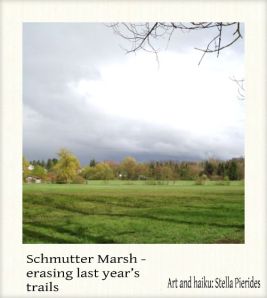
In November last year, I moved to a place near the river Schmutter, in the Greater Augsburg area. Some of you may remember my posts, and pictures, on ‘Leaving Ammersee’ from last year. Given the spectacular Ammersee lake and those sunsets – those sunsets! – it was difficult to imagine then how I would take to my new surroundings. Indeed, it has taken time for me to settle – still many unpacked boxes in the cellar! – but at least I have started going out for walks in the vicinity.
Almost next door, there are the Schmutter meadows: a nature reserve marshland by the river Schmutter (a tributary to the Danube), which is flooded several times each year. The soil is enriched by the flooding, and meadows become home to numerous rare plants, birds, and other animals.
And here, in the local marshland, its grassy paths, sludgy mud, numerous water channels, sluices, and flooded pools, the river itself twisting and turning, I have found beauty, again! This is a beauty I can neither own nor grasp in one go, i.e., in one picture, in one season, or one year. It is a beauty that develops, changes; a fragile, weather-beaten, marshland eco-system that I can only experience piecemeal on my walks through it.
If you have the time, take a look at this picture and haiku, imagine walking by the Schmutter. I will be posting more pictures from this area and writing haiku responding to my walks in the future. Am I trying to make this area ‘mine?’ Perhaps I am! You can come along for the experience.
Better still, choose an area near your own home, observe it, write about or take pictures of it, and turn it into your ‘most beautiful thing.’
This post is written in response to Fiona Robyn’s call for writers to write (and blog) about what they consider to be their most beautiful thing: a ‘blogsplash’ . In the context of her launching her new novel ‘The Most beautiful Thing,’ Fiona is making the novel available for free on the 24th and 25th of April 2012. Visit her blog for details here

.
marshland storks –
this year too paths emerge
along the Schmutter
.
NaHaiWriMo prompt: local season

Aubrie Cox’s PDF collection of poetry on the theme of Fox Dreams is now ready and up on her blog, yaywords, to be downloaded, shared and above all, enjoyed.
My own poem is on page 10, together with a number of really great haiku. To read them all, click here
.
stealing away
from my yard again, little fox!
first blossoms
.
.
earth day —
the darkness inside
leaf veins
.
NaHaiWriMo prompt: earth day
Can be found on Gabi Greve’s World Kigo Database, under Earth Day (2012)
I am pleased to report here that Cara Holman, in her blog Prose Posies, celebrated April the 17th, National Haiku Poetry Day, by hosting a virtual haiku poetry reading event. Several poets, including myself, were given the space to ‘read’ their haiku at this event.
Thank you, Cara, for organizing this wonderful space, and for including my haiku. In such good company!
The link, which makes the poetry reading accessible to those interested is here
.
light rain –
I leave the cherry blossom
to the birds
.
NaHaiWriMo promt: observation (3)
.
moonless night
a pair of gumboots
inside the door
.
In Gabi Greve’s World Kigo Database: Gumboots, Saijiki for Kenya and Tropical Regions, here (scroll down)
.
spring sky
on my screen
tag clouds
.
NaHaiWriMo prompt: observation
.
spring night
the lit spire across
the valley
.
NaHaiWriMo prompt: description/observation
.
searching your face
for my childhood friend
Welsh onion heads
.
NaHaiWriMo prompt: cool/warm spring
For ‘Welsh onion head’ see Gabi Greve‘s World Kigo Database here
.
after the picnic
and the drive home
cool air
.
NaHaiWriMo prompt: cool, autumn
Happy National Haiku Poetry Month, everyone!
Tomorrow, April 17, is National Haiku Poetry Day, a day dedicated to celebrating haiku – locally in the United States and globally in the hearts of all those loving this genre. The Haiku Foundation has organized a number of events all around the country. You can see the schedule of events here
If you live outside the US, there’s still lots to do. Explore the website of the Foundation, taste the Per Diem: Daily Haiku straight from its box, write haiku, spread the word…
Whatever you do, Happy National Haiku Poetry Day!
National Poetry Month 2012 – Update. Taking part in Couplets, the multi-author poetry blog organized by Joanne Merriam of Upper Rubber Boot Books, I was honoured to be featured:
On the 1st of April 2012 at Margaret Dornaus’ wonderful blog ‘haiku-doodle’
On the 6th of April 2012, at Angie Werren’s great blog for micropoetry ‘feathers’
In the same project, Couplets, 1st of April, I hosted the exquisite poetry of Margaret Dornaus on my own blog. Margaret offered three of her excellent tanka poems.
I also had the pleasure of hosting Lisa Cihlar, whose poetry I love. Lisa wrote a fascinating article about the creation of one of her characters, ‘Swampy Woman.’
There is more to come in the second half of the month. And there are so many good poets taking part in this project! Visit the Couplets site and enjoy! And don’t forget to come back!
.
toll house
the groundless optimism
of daisies
.
NaHaiWriMo prompt: tax
.
shimmering heat –
pine-scented water
over glowing stones
.
NaHaiWriMo prompt: shimmering heat
.
no longer entire-
his shrinking world
.
Micropoem on the NaHaiWriMo prompt: cats
My kitten Emile’s operation is coming up soon and this is also about taking his point of view, in advance…
.
rest-home yard
a garden swing
creaks
.
NaHaiWriMo prompt: swing
.
spring tide
flocks of waders rise
and fall
.
NaHaiWriMo prompt: water/earth/spring
.
Easter light
a seed
splits open
.
NaHaiWriMo prompt: religious observance
.
the stillness between
this day and the next-
paschal lily
.
NaHaiWriMo prompt: religious observance
.
April full moon –
instead of herself
her shadow
.
NaHaiWriMo prompt: moon +