Category Archives: Archive

A Bum’s Demise

Papa Osmubal’s poem “A Bum’s Demise,” published in Asian Cha, is nominated for a Pushcart. You can read the poem here. A very perceptive and thorough analysis of this poem is also published by Asia Cha, in their section A Cup of Fine Cha, here

I felt both moved and haunted by this poem; compelled to comment on it. It kept me thinking. It is a powerful poem, with many levels and even more twists of meaning. Verlaine is implicated. His liver also, though I was more interested in the state of his heart. Read my own comment in the comments section of A Cup of Fine Cha. You can also find it copied in my own Scrapbook.

19 October 2010

Tweet

Memory Loops

Memory Loops

Researching my novel When the Colors Sing, I came across information about a new memorial to the victims of National Socialism that has opened in Munich. It is a virtual memorial, with personal accounts of the victims being read out from the specific locations where the events described occurred across the city.

Michaela Melian, artist, musician, professor for time-based media in Hamburg, won the first prize for this audio art work in the competition “Victims of National Socialism: New forms of remembering and remembrance” held by the city of Munich in 2008. She was awarded the city’s art prize in 2010.

Melian collected material from newspapers and Holocaust archives, interviewed survivors herself and put together a sensitive and remarkable collection. The individual accounts, read out by actors, are indicated by blue circles superimposed on a digital map of the city, and people can click on them to hear the stories.

The digital memorial can be accessed from across the globe, especially by the younger generation more interested in digital forms of communication. In Munich, some museums are lending their mp3 players to those wishing to tour the places where the events described took place. Bayerischer Rundfunk supports the project, broadcasting narratives in special programmes. The Munich Department of Arts and Culture is also offering its support.

Incidentally, the visual image of Memory Loops reminds me of Anselm Kiefer paintings: “the dark light falling from the stars” for instance. Here is the link to Memory Loops, by artist Michaela Melian.

See also here

Tweet

18 October 2010

The Acropolis and the violence

The Acropolis and the violence

Giorgos Seferis, the Greek poet and Nobel laureate, 1900-1971 (born in Smyrni, lived everywhere else, almost), wrote:

I woke with this marble head in my hands;
It exhausts my elbows and I don’t know where to put it down.
It was falling into the dream as I was coming out of the dream.
So our life became one and it will be very difficult for it to separate again.

(From “Mythistorima,” quote: Wikipedia; read the whole poem here)

Seferis was expressing an important element in the Greek identity, an element which weighs heavily on the Greek psyche. But while this has been written about, there are other “marble in the hands” issues in modern Greece. Take the recent “reporting” on the demonstrations, discontent, and rioting that has been taking place in Athens in the last year. The last event to make the news was the one that took place on the Acropolis.

The Persians sacked the Parthenon while it was still being built on the Acropolis of Athens, along with the rest of the city in 480BC. The Athenians raised it to the ground – I should say: rock – and then rebuilt it. There had been temples on the site earlier, and more were added later. It served as a mosque after the Ottomans took Athens in the 15th century. The Acropolis survived millennia of attacks and war damage, including being bombarded by the “Venetian Army” when it was used as a weapons arsenal by the Ottomans. Only last year, 2009, the new museum was opened at the foot of the Acropolis. And now, the Acropolis is being used as a place of protest. Culture Ministry employees, protesting about working for 22 months without pay, barricaded themselves inside, not allowing the tourists in until their demands were met.

A sad story, for the tourists were reported to have been unimpressed by the protest. They had travelled a long way to see the ancient site and were understandably disappointed. Sad for those Athenian workers too, those seeing no other way of exercising their legitimate right to protest and no other venue. Perhaps they thought this was going to make the world sympathize with their plight: after all, what would you do if you hadn’t been paid your salary for twenty two months? Sad, also, that the violence continues.

And yet, the people of Athens, and of Greece must be equally disappointed that their social, political, and financial predicament is not being put in the context of the unique Greek experience and history, but is instead too readily compared with ‘that of Western European countries. Brendan O’Neill, in an interesting article in Spiked, writing about the riots at the time of the killing of the Greek teenager, argued that the Greek problems were not simply due to the credit crunch (the pet idea of the Press) but stemmed from a historical crisis of legitimacy. Without necessarily agreeing with all the points O’Neill makes in this article, one might say that by putting the situation in a wider, complex historical perspective, O’Neill went beyond the usual media fascination with violence and money. Sad that this kind of writing is not found more often in the media. Because absence of interest in what lies beneath the “news” is a form of violence too.

16 October 2010

Tweet

Ithaca

The poet Constantine P. Cavafy, or Konstantinos Petrou Kavafis, one of my favorite poets, wrote the following about his origins:

.

I am from Constantinople by descent, but I was born in Alexandria—at a house on Seriph Street; I left very young, and spent much of my childhood in England. Subsequently I visited this country as an adult, but for a short period of time. I have also lived in France. During my adolescence I lived over two years in Constantinople. It has been many years since I last visited Greece. My last employment was as a clerk at a government office under the Ministry of Public Works of Egypt.

.

I have pasted his poem Ithaca below – he knew what he was talking about. For more of his poetry and resources on the web, see the Cavafy Archive

The poem, quotation, and Wikipedia url can be found here

Ithaca

English Translation

When you set sail for Ithaca,
wish for the road to be long,
full of adventures, full of knowledge.
The Lestrygonians and the Cyclops,
an angry Poseidon — do not fear.
You will never find such on your path,
if your thoughts remain lofty, and your spirit
and body are touched by a fine emotion.
The Lestrygonians and the Cyclops,
a savage Poseidon you will not encounter,
if you do not carry them within your spirit,
if your spirit does not place them before you.

.

Wish for the road to be long.
Many the summer mornings to be which with
pleasure, with joy
you will enter ports seen for the first time;
stop at Phoenician markets,
and purchase the fine goods,
nacre and coral, amber and ebony,
and exquisite perfumes of all sorts,
the most delicate fragances you can find,
to many Egyptian cities you must go,
to learn and learn from the cultivated.

.

Always keep Ithaca in your mind.
To arrive there is your final destination.
But do not hurry the voyage at all.
It is better for it to last many years,
and when old to rest in the island,
rich with all you have gained on the way,
not expecting Ithaca to offer you wealth.

.

Ithaca has given you the beautiful journey.
Without her you would not have set out on the road.
Nothing more has she got to give you.

.

And if you find her threadbare, Ithaca has not deceived you.
Wise as you have become, with so much experience,
you must already have understood what Ithacas mean.

.

For more of his work see the Cavafy Archive and here

National Poetry Day 2010 UK

Thursday, 7 October 2010 is National Poetry Day in the UK.

“Poetry helps us to revive, heal or endure” and the official website for this day provides a number of resources to help celebrate this poetry day 2010.  There is a small selection of poems on this year’s theme of Home here

Andy Jackson, of North Carr Light, “A newsy blog for creative writers in Dundee, Perth & Angus” set out to create a

Patchwork Poem for National Poetry Day 2010

Poets of all shapes, ages and sizes sent in work; 43 of them “from established Scottish poets such as Sheila Templeton and Eleanor Livingstone to a group of schoolchildren from Aberdeenshire and attendees at an Adult Learning Centre on the West Coast…to south of the border and as far away as Germany…” Andy Jackson, who edits the North Carr Light blog, writes. (Indeed, myself included!)

Using a line from each poet’s contribution he produced a wonderful  poem:
x
x
“It was certainly a challenge, but ultimately an enjoyable one,” writes Andy Jackson.
x
The poem is also available to download from North Carr Light.

The poem itself can be read online  here

The list of contributors is included with the poem.

Happy Poetry Day!

After the Passion

Black Horse
After the Passion

In Oberammergau they waited for ten years – they prepared for several. And finally, this year, 2010, they performed the Passion Play all summer. For those new to his event, it is laid on by the villagers of Oberammergau once every ten years, to fulfil a vow made by their ancestors in 1633. They had pledged to stage the Passion of Christ in exchange for protection from the devastating plague, wars, and poverty that had been raging in the area in the 17th century.

Now, the last performance of this decade’s Passion Play, the 109th of  the season, has taken place; more than half a million people from all over the world attended this year’s production.

The costumes have already been mothballed for the next set of performances in 2020! The performers have been allowed to have their hair cut (after a year of growing it long in order to appear “authentic”), and the village to relax for the time being.

There is cause for celebration and merriment. The village has done well in this climate of global depression and economic unease. The performance was excellent and the hospitality unique.

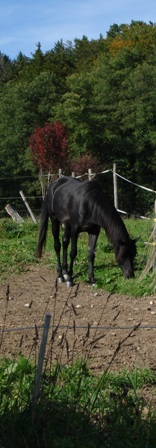
A sad note, however, must not be left unheard. The animals that took part in the performances will be returning to their usual, mundane jobs. This would be unremarkable if it did not involve a heart-breaking separation. According to the Sueddeutsche Zeitung, the camels (Campari and Opi) and the black horse (Garko) – who starred in and enriched various scenes of the play, strutting their stuff nonchalantly on stage day after day – became infatuated with each other. Now however, they must go their separate ways: Campari and Opi to their home farm in Schwabmuenchen, and Garko back to his job of pulling coach-loads of tourists around Oberammergau.

Date: 5 October 2010

See also here and here

Tweet

Bremen Town Musicians

A few days ago I visited Bremen, Northern Germany, and was fascinated by the
number of statues, photographs, and references to the Grimm brothers’ fairy tale The Bremen Town Musicians.

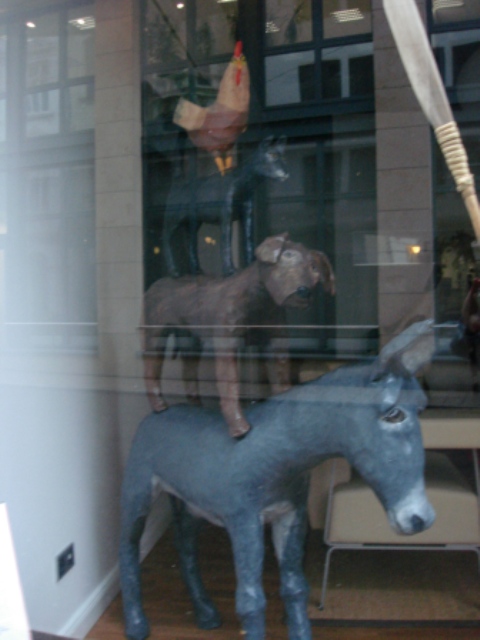
The Four Bremen Town Musicians
Bremen Musicians

In this tale, four animals: a donkey, a dog, a cat and a cock, having worked hard for their human owners, but getting on in years, are facing redundancy, abandonment, abuse, and slaughter. This unsavoury predicament brings them together and they decide to set off for the town of Bremen to find work as official musicians there.

Before reaching the town, however, they come across a house in the forest, as one does in fairy tales, and agree to try to scare away a gang of robbers feasting inside it. The dog stands on top of the donkey, the cat on top of the dog, the rooster on top of the cat, and each making its own, unique cry – their concerted braying, barking, meowing, and crowing – they crash through the window inside the house and scare the robbers off. In this remarkable way of co-operation, the four animals repel an attack by the robbers during the subsequent night, and settle to live there for the rest of their lives.

The Four Bremen Town Musicians
Bremen Town Musicians

(I took a picture of this sculpture from the street; it is made of papier mache by Gaby Bertram of scrap-pap.de)

I wonder why this fairy tale has become so important to the city. Might it have to do with a wish for all kinds of people, of all backgrounds, ages, ethnic origins to live together happily, like those seemingly incompatible animals did in the story? I hope so anyway.

Readers of this blog will know about my novel Alexandrias 40: In the Shade of the Lemon Tree, and my interest in the ways people (in this novel, mainly Greeks and Turks) come together – or not. It seems that having a sense of shared humanity and a common purpose, and project helps: this Grimm tale shows us how.

In any case, I had fun walking around and finding depictions of the animals to photograph.

How Time Dilates…

How Time Dilates…

atomic clock
Atomic Clock USNO

I just read that Einstein’s Theory of Relativity was shown to apply to altitude differences as small as 33 centimeters. Scientists at the US National Institute of Standards and Technology in Boulder, Colorado, using the latest and most accurate atomic clocks, found that the higher you are above sea level, the faster time runs for you.

In addition, as Einstein had also suggested, the scientists found that travel through space influences clock speed. A stationary clock ticks slower than a moving one. So, if your clock is moving rather than stationary and, in addition, you live high up, then you might start thinking about botox, moving to sea-level, or buying a bungalow!
x

The time differences at these small distances are minuscule, but now measurable.
x

This demonstration of time dilation leads me on to another, though I believe related, track. Einstein conceived of his Relativity Theory more than one hundred years ago, and yet we are only now able to confirm its predictions on our, human level! Atomic theory, stating that matter is composed of discrete units called atoms, according to Wikipedia, “began as a philosophical concept in ancient Greece and India” and only entered scientific thinking in the early nineteenth century. Thus, “time” is also relative, depending on the prevailing culture, socio-political conditions, etc., when it comes to the interval between ideas being born and their progressing to proof and acceptance. Just think of the effect of certain periods of the Middle Ages on the progression of ideas!
x

Moving on to a more experiential level: In my forthcoming novel Alexandrias 40: In the Shade of the Lemon Tree, a little girl is obsessed with time. She fears changes of plan, the adults changing their mind, things happening unexpectedly – “Can you do that?” she wants to know. If you change your plans, then time becomes unpredictable. She keeps comparing the time on her watch with that of other family members, to reassure herself of the stability of her world. Like most of us, she confuses the subjective timeline of our lives, and its curves, ambits, u-turns and roundabouts, with the instrument of its measurement, her watch.
x

On the other hand, shrinking or speeding up time, for instance through time-lapse photography, can provide us with a new, marvelous perspective on the world. The BBC has a great video on this, “Timelapse: Speeding up life” Watch it; I added it to my previous post.
x

For musings and poetry on Time, read Asian Cha’s Random musings on Time: “Pray, my dear, quoth my mother, have you not forgot to wind up the clock?” They claim their clock does not tick. Not even tock?
x

Perhaps this, the dilation of time, the arrhythmia of time, where the interval between “tick” and “tock” is unpredictable, or different to what our current understanding would lead us to expect, is a major, crucial point where the arts and the sciences intersect – where the subjective and objective meet. Let us stay with this thought for a minute. Stop all the clocks!

Murnau (Moor)

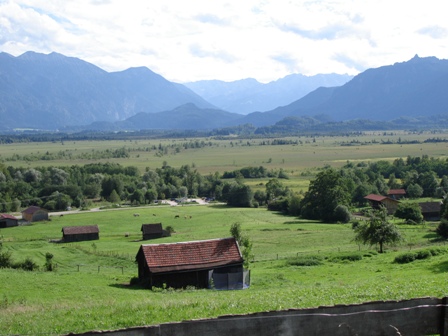
Murnau is a small market town in the foothills of the Bavarian Alps. It is the place where Gabriele Münter, Wassily Kandinsky, and Franz Marc, inspired by the landscape, created The Blue Rider movement.

This is how the tourism office describes Murnau:

In Murnau nature, art and culture form a special bond. World-renowned artists like Kandinsky, Münter and Horváth lived here and found inspiration in the picturesque landscape at the foothills of the Bavarian Alps with its romantic lakes and unique moorlands.

The moor, Murnauer Moos as it is called in German, right next to the town of Murnau, is an enormous nature reserve, the largest in Central Europe and, surrounded by the Bavarian Alps, benefits from a micro-climate that supports an extraordinary range of animals and vegetation.

Meadows, marshes and mires; bog and creeks invite and nourish butterflies, insects, and rare birds. The light is translucent, the air uplifting, and the colors of the wild orchids, irises, grasses, and innumerable other plant varieties are thought to “sing.” Painters, photographers, art, nature, and bird-lovers make their pilgrimage to the moor to hear these songs.

Whenever I can, I go for walks there. My poem Murnau, published in escarp.org on the 8th of August 2010 is a twitter-sized attempt to condense the experience of walking on the moor without losing sight of some of the cultural associations of the area.

Nolde Question

Colour Clouds
Nolde Question

While working on my novel When the Colors Sing, about The Blue Rider (Der blaue Reiter) movement, especially Kandinsky, Münter and Marc, I came across the work of Emil Nolde and his struggles with the development of his art. Readers of this blog will know I recently visited his house – now a museum – in Seebüll, North Frisia, to get a better feeling of his surroundings and the areas where he liked to work.

Having dipped a bit deeper in Nolde’s bio, I came back with more questions than I went with; which is something I appreciate. For instance, I kept thinking, how did Emil Nolde hold the tension between his art and his craft; between his personal, conservative philosophy and his experimental and liberating work; between his roots in the farming community and artistically, in a German tradition of painting, and freedom of expression in his own artistic explorations of landscape, nature and humans. In other words, how did Nolde carry his own, individual cross to produce such work of great depth, intensity, and appeal?

Continue reading Nolde Question

They send light to Earth

Murnau Moor
Murnau Moor

I am delighted and  honored! My micro-poem They send light to Earth was chosen to be the first piece to be published by new e-zine @textofiction.

Brand new, “Textofiction is an online literary publication dedicated to bringing the best writing in under 140 characters.”

Read my micro-poem and think, it packs a lot in. Better still, let me know your thoughts about it! Read it here

Date of publication: 29 August 2010


David vs Goliath

Niyamgiri Victory
David vs Goliath

A tribe in India has won a stunning victory over one of the world’s biggest mining companies. The Dongria Kondh, a tribe of 8000 people, with the help of Survival International and others, has won a victory over a multibillion company which proposed to mine bauxite on the sacred hills of the tribe. The Dongria Kondh’s struggle had a happier ending than that of the film Avatar, in which a tribe was pitted against a ruthless mining company. The Dongria Kondh’s perseverance, courage, and victory will encourage indigenous tribes everywhere.

Well done to Dongria Kondh, their supporters, and to Survival!

One Sound, One World

Handmade Football 1

Photo credit: Jessica Hilltout

I wrote this poem during the 2010 World Cup, when everyone was talking about vuvuzelas. It appeared in escarp: ” a text-message-based review of super-brief literature,” 17 June 2010.
xxxxx

Big, tough fella

loud, racy lass

timid Cinderella

prodigy, alas

blow your vuvuzela

if you must.

See also my post: Whatever you think about football

Nolde’s Garden

Nolde's Garden

Having seen an exhibition of Emile Nolde’s “unpainted pictures” in the Berlin branch of the Nolde Foundation earlier on this year, I came to visit his house in Seebüll, North Friesland, Germany, where he lived and worked.

The house is built on higher ground – this used to be a tidal area – providing a panoramic view of the garden below and the surrounding flatlands. The “unpainted pictures” refer to the small-scale watercolors Nolde produced from 1941 onwards, after he was formally forbidden to paint by the Nazi regime. Even before that, the Nazis considered his work to be “un-Germanic” and “degenerate.”

In order to continue working, Nolde used watercolors since they do not emit the typical smell of oil paint and turpentine that would have been easily detectable by the Gestapo during unannounced inspections. Nolde considered the watercolors of this period “unpainted,” because he had planned to render them in oil after the fall of the regime.

Some of the “unpainted pictures” are of flowers, with vibrant colors that overflow the boundaries set by the line and spill over. Perhaps this is one expression of Nolde – like Kandinsky – seeing music in color: his color notes blending across space in the way musical notes blend in time.

Nolde found ample inspiration for these motives in his own garden, which abounds with joyous color and diversity of form illuminated by the immense skies of North Friesland.

“ArTherapy” in Gazi

"ArTherapy" in Gazi

At this year’s (2010) Munich Film Festival I watched Nikos Perakis’ new film “ArTherapy”.  I found it an intelligent, exciting and enjoyable film, mixing documentary with fiction.

The protagonists, young students of the National Theatre School of Drama, mostly middle-class, politically conscious and wholly devoted to their art, work tirelessly in the face of adversity in the Athenian capital. The portrayal of the young, the intensity and aliveness of Athenian life, the wonderful development of the culture centre in the centre of historic and multicultural Athens, aptly named Technopolis, made me feel proud of my Greek roots. And yet, however much I enjoyed the movie, I felt there was something missing: something about the context, the place, the area was lacking. There were interviews with a few locals, but overall, I was left wondering who was the art therapy for, who is in need of it and why? An unfair question, perhaps, or even an irrelevant one. And yet.

Of course one answer to this question might be that it is the young generation addressed in the film that needs it, the generation of Greeks facing high unemployment, debt and deficit, of a politically traumatized youth, but this too did not seem enough to help understand my unease. In addition, a more complete answer might be that the fans need the art therapy too: “There is no better time to offer your fans an artistic therapy against the period of an economic crisis and fear from the forthcoming social shock. Told in the style of Fame Story…” the GR reporter wrote about the film. Of course…and perhaps!

I followed my usual pattern when in doubt: I googled Gazi. Taking its name from the Public Gas Works, which existed there for over a century, Gazi was, for most of its existence a poor area, where poverty, prostitution and immigration went hand in hand. And then I came across an article in Balkanologie about the people of Gazi.

The author of the paper, Dimitris Antoniou, wrote about the late immigrants to the area who arrived from the 1980ies and 1990ies onwards: Muslims from Northern Greece, from the Western Thrace migrating internally to Athens. Influenced by the Treaty of Lausanne, as well as the Greco-Turkish volatile relations and tit-for-tat policies, these people had found it hard to settle in Western Thrace, with scores migrating to Turkey, other countries, as well as to Athens, whenever possible. Antoniou followed their settlement patterns in the capital, their struggle for survival from earning a living through establishing cultural and religious associations to working out a distinct identity as a group.

Five years after the publication of this paper, I cannot find any further information about the people described and how they fared in the face of the massive redevelopment of the area.

Given the importance of this area as migration destination of Muslim Thracians, I now wonder what impact development has already had or might have on this group of people. Would it lead to the complete demise of this community in the name of progress, or might there be a new way of helping to engage and support the community in its search for and expression of its social and cultural identity? Would there be a way that the arts and crafts flourishing in the Gazi Technopolis might aid the survival of this community? That could also be a form of art therapy!

(Picture credit: http://en.wikipedia.org/wiki/File:Gazi_Technopolis.jpg)

The Garden of Eden

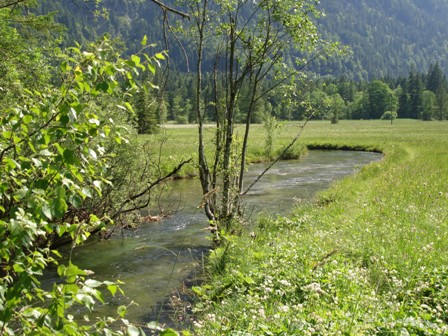
Garden of EdenDoes the Garden of Eden look like this?

A steady flowing river, whispering reeds and listening fish;  a flowering meadow,  a gentle mountain breeze, green to delight the eye, colorful mosaic of insects. It certainly felt like the Garden of Eden.

If not, what does the Garden of Eden look like?

Perhaps my twitter poem earlier in the Spring caught something of this quality, though the Cornmill Meadows are in the outskirts of London while the landscape in this picture is in the valley of the river Ammer near Ettal and Oberammergau.

At the Cornmill Meadows

dragonflies rest on nettles

comfrey, buttercups

and the smooth stones

of the shallow stream.

(Published in Escarp, a “review of super-brief literature”)

Photo Credit: Attentive Eye

Pascale Petit, Frida Kahlo and the Mirror

Dividing my time between England and Germany means I miss a lot of events I would have liked to attend. I would certainly have gone to a reading by Pascale Petit from her new book What the Water Gave Me. As it is, I rely on reviews such as
Ruth Padel’s “What the Water Gave Me by Pascale Petit” in The Guardian, or
blog posts such as Kathleen Jones’ “Pascale Petit and the paintings of Frida Kahlo” in her blog A Writer’s Life; and
Adele Ward’s “From Pain to Paint to Poetry: Pascale Petit” in Adele Ward the poet at the Bus Stop – well written and thoughtful reviews.

I love Pascale Petit’s work. She has an imagination bubbling with creative and often electrifying ways of seeing the world. What Les Murray said about a “powerful mythic imagination” in her poetry is certainly true, though for me, while she draws from the whole gamut and history of art and culture, she fizzles with new ideas of her own. As a result, on reading her poems you acquire a new set of eyes, different with every single poem.

This is what makes it even more remarkable for me, namely, that she is able to put herself into another person’s perspective so well, with sensitivity and humility. Her poem “War Horse,” from The Treekeeper’s Tale, an earlier collection, inspired by Franz Marc’s letter to his wife Maria, is a beautiful instance of this. Writing to his wife from the slaughter fields of World War I, at night, he speaks through Petit over the distance of space, time, and culture to us as individual human beings.

It seems that Frida Kahlo is given the same treatment. I have not read the whole book yet, but from the poems and the reviews I have read, it seems that Pascale Petit is putting her remarkable imagination and empathy to excellent use. Taking her lead from a painting titled “What the Water Gave Me,” in which images from Kahlo’s life float in the bath water of her painting, Petit gives voice to this remarkable woman.

Kahlo became internationally known late in the twentieth century, long after her suffering polio, then catastrophic injuries from an accident in her teenage years, and her tumultuous relationship with Diego Rivera. Kahlo wove the strands of life, pain and art in her work: she used her injuries to inspire and fire her art, and her art to cope with her injuries and pain. The details of her injuries and private life have had a powerful effect on generations of women in particular, and have been written about extensively. It is a pity that a large number of her fans are said to be more fascinated with Kahlo’s tragic life than with the greatness of her art: the way she used life, pain and paint to speak in a unique language of painting. It is a unique “language” which conveys in colour, form, and Mexican folklore what it is like for a courageous intellect such as Kahlo’s to be looking at herself in the mirror.

One wonders what might have happened had Kahlo herself written poetry instead, or in addition to, her painting. Might she have coped in a different way, perhaps better than she did in her life? We will never know. Now, however, through Petit’s book, we can hear her voice.

While there is a plethora of writing about Kahlo, not many have managed the task of letting her speak for herself. Petit transforms the paint into poem in the same way that Kahlo transformed pain into paint. Unafraid of death, anger, blood, ugliness, loneliness, of the monkey and the other animals in Kahlo’s portraits, of Diego Rivera, and other disturbing realities in Kahlo’s life, Petit empowers Kahlo to speak and the reader to hear her.

The Voice of (the) God (particle)

The Voice of God

Poets, writers, artists, and composers have always tried to listen to God. Through words, paints, colours, notes, they have often succeeded, as is attested by the quality of literature, art, and music in the treasure-chest of humanity.

Now, scientists are getting nearer to hearing God. Or rather, nearer to the sound of the Higgs Boson particle, nicknamed God Particle. Using a process termed sonification, they are converting scientific data collected though the LHC at Cern, into sounds.

You can listen to the sounds produced so far: http://bit.ly/b0zMG2.  I personally prefer Bach – or at least Mozart’s interpretations of the voice of God!

Photo credit: Maria Pierides /p>

The day after Refugee Day

The 1951 Refugee Convention establishing the United Nations refugee agency declares: a refugee is someone who “owing to a well-founded fear of being persecuted for reasons of race, religion, nationality, membership of a particular social group or political opinion, is outside the country of his nationality, and is unable to, or owing to such fear, is unwilling to avail himself of the protection of that country.” http://bit.ly/aix15K

Refugee Day (20th June 2010) has come and gone. Refugee week too. Congratulations to the people taking part and above all, to those organizing the events, the publicity, the media, those attracting attention to displaced persons fleeing persecution as well as those celebrating the achievements of refugees.

But what now? What comes the day after? And the day after that? Will our attention be drawn somewhere else, to another, no doubt, worthy cause? The refugees are still here, many under the skies, lacking water, food, warmth, traumatized. Let us not wait for next year’s refugee day to remember them. Let refugee awareness become part of our everyday consciousness and conscience. Part of our lives.

Here are some pointers to organizations that help:

Facts about refugees: see information http://www.refugeeweek.org.uk/InfoCentre/Facts

Though the 2010 refugee week has come and gone, the information on this site is valid and useful:  http://www.refugeeweek.org.uk/Events

For the best resource,  see the United Nations Refugee Agency website: http://www.unhcr.org/cgi-bin/texis/vtx/home

Highlighting the plight of tens of thousands of refused asylum seekers who are destitute, homeless and not allowed to work in the UK: http://stillhumanstillhere.wordpress.com/

“The largest refugee organization in the UK providing advice and assistance to asylum seekers and refugees”http://www.refugeecouncil.org.uk/

The Hungry Tide: Language and Silence

The Hungry Tide

I just read The Hungry Tide, a novel by Amitav Ghosh, published in 2004. It has taken me a long time to find out about it, as well as its author, but, as they say, better late than never.
Such a well-written, well-researched, good read! But the added reason I bring it here is that it includes, among a number of other topics, the story of a Bengali refugee group, settled on Morichjhanpi island of the Sundarbans, forced to flee by the newly elected government of West Bengal, and the massacre of 1978-79. I have an interest in refugee groups, their experiences, itineraries and development – a refugee group appears in my forthcoming novel, Alexandrias’ 40: In the Shade of the Lemon Tree, as well as the one I am currently working on – and Ghosh’s story describes one such group, in a different part of the world, in a sensitive and engaging manner. In such a manner, in fact, that one might say that the refugees find a home and a voice in Ghosh’s novel. While they flee one way, and then the other, like the ebb and flow of the tide, they are given a presence, a ‘stable’ place in history by Ghosh.
He writes in English, weaving fact and fiction into a wonderfully clear, informed and at the same time enchanting tale.
While the refugee group is an important pivot to the story, the ebb and flow of the tides in the Sundarban islands off the easternmost coast of India, and the ebb and flow of language and silence, are the true stars of the novel. The main characters, an American Indian female researcher, an Indian male translator and an Indian male illiterate fisherman, carry the tidal shifts and currents between language and the areas around it, those places which inhabit the heart and the elemental areas of the psyche shared by all humans. This shared humanity provides the ground for the – unfortunately often undervalued – capacity to communicate with one another. “…Words are just air,” a character says, “When the wind blows on the water, you see ripples and waves, but the real river lies beneath, unseen and unheard.” (see also my comment:  http://bit.ly/aGNY1P)

Ghosh’s achievement in this novel is to illustrate this ability through the relationships between these three characters and someone who, through his diary, is telling the tale of the refugees, using political, philosophical, and religious themes linked with passages from Rilke. In this novel, history, politics, poetry, biography, religion and myth are brought together in their varying forms of narrative language and yes, narrative silence, to tell a seamless story of incredible beauty.
More than that, however, the novel – through its metaphorical and symbolic richness and its assumption of the perspective of the American Indian scientist and the Indian translator, while contrasting them with the different qualities of the Indian fisherman’s discourse, and its unfortunate reception – reaches further into the colonial and post-colonial waters and invites critical reflection.
I cannot recommend this book highly enough, especially for the outstanding achievement of bringing together so many strands, including the horrific tale of the refugee group, loss, history and a love story with so much humanity and humility.

A Tale of Two Passions
A Tale of  Two Passions

It is often said that life is stranger than fiction. Fair enough, I wouldn’t argue with this. Here I wish to point out two cases where fiction, narrative, or stories influence life. Admittedly, this is not any story, but the story based on the Passion.

Kazantzakis, perhaps best known for having written that other passionate character, Zorba the Greek, published his version of the Passion, Christ Recrucified, in 1948. It is a novel set in a Greek village in Asia Minor during the Ottoman Empire. The villagers are given a free hand in the running of their village affairs as long as they keep quiet, and the Agha (the local Ottoman governor), who likes to enjoy life’s little pleasures, happy.

Trouble, and the plot, comes to the village with the sudden arrival of a group of refugees led by their priest – their village was destroyed by the Turks in the fermenting tensions between Greece and the crumbling Empire. The locals don’t want the refugees in their village, but turn a blind eye, initially, to their camping on a barren mountainside just outside the village.

It is Easter Week approaching, and the village elders are preoccupied with allocating the roles of the Passion story to the locals: who will be “Judas,” “Christ,” or “Mary Magdalene?” Once the preparations for the Holy Week are underway, the chosen actors begin to identify with their allocated characters; they become more saintly, with the exception of “Judas” who becomes treacherous. The novel then takes off, with the actors coming in between the newly arrived refugees and their needs for food and shelter, and the resenting and increasingly intolerant locals. It has a terrific climax, wonderful psychological portraits both of individuals and social groups; it is one of my favourite Greek novels.

Well, in the Bavarian village of Oberammergau, in the foothills of the Alps, another Passion Play has been performed for centuries. In the year 1633, the village suffering from the plague, struck a deal with God: they would perform the Passion Play every ten years if God, in return, kept them free from the plague. Both sides seem to have kept their bargain – though the villagers did not hold the metaphorical plague of the World War II against God – and the play goes on. This year, 2010, sees the 41st performance.

The village performs the Play wholeheartedly, with villagers living and growing up with the preparations and performances all through their lives. Their aspirations, dreams and competition for the main roles achieve the status of basic needs. However, only those born and bred there, or those who have lived for at least twenty years in the village, are allowed to take part. Over two thousand locals (half the village) are involved in the performances that last the whole summer, from May to October, performing to an audience of over four thousand people daily! The rest are involved in the catering for and accommodating of the thousands of visitors in a small village.

Now the reason I brought these two together here, the novel by Kazantzakis and the performances of the Passion Play in real life Oberammergau, is more than that they share the same basic story; more important than the fact (and my need to brag about it) that I will be going to see the Play this year; more than the influence that Kazantzakis’ novel had on the background to my own novel, Alexandria’s 40: In the Shade of the Lemon Tree. It is how in both, Kazantzakis’ novel and the village of the Passion Play, a similar psychological phenomenon seems to be taking place. The actors tend to become more like the characters of the Passion story. The villages tend to show similarities with the folk of the original story.

In Oberammergau, one of the locals cast as Virgin Mary, I read, refused to marry afterwards; one of the “Jesuses” kept ‘blessing people’ long after the performance was over. One of the actors playing this year’s “Jesus” is reportedly tempted to defer to the actors who played previously “Jesus” and let them mount the donkey entering Jerusalem. There is also the story of King Ludwig II, making presents of silver spoons to the actors of the performance he attended, with the exception of “Judas,” to whom he gave a tin spoon. As for the village politics, they are reported to be tinged with the sometimes polarizing passions of the original story.

In the Kazantzakis novel, a similar but more pronounced process seems to be taking place. The main characters of the Play take on the qualities of those they portray. The actor Judas behaves like “Judas,” the local prostitute starts behaving like “Mary Magdalene,” similarly “apostle Peter” and “Christ.” The villagers and the mob equally seem to become caught in a web that almost dictates a necessity of action that follows the Passion. It is as if a need arises for the Play to become embodied and concretely played out in the village of the novel.

It is this unsettling echo between the two depictions I wish to highlight. Even on the side of the spectator, newspaper articles about the Oberammergau Play, inchluding the Spiegel online,  attract our attention by reporting that one of this year’s chosen inhabitants to portray “Jesus” is a psychologist; “Mary Magdalene” a Lufthansa flight attendant. This points to an expectation in ourselves to weld together the roles in the Passion Play with the Oberammergau locals playing them. When they do not fit – after all who would have thought of Christ been played by a psychologist? – a sense of discrepancy, perhaps a sense of the Uncanny arises.

An interesting analogy may be found in the discrepancy between what one wants to say and the way one expresses it through language, which is smaller in one’s native language than in a second/adopted language. While in the first case the metaphor of “bathing in language” is appropriate, in the second – when the gap between what one wishes to say and the way it is said is too wide – the expression “like bathing in a ski-suit” has been used by Tammy Ho Lai-Ming. A shift from the latter, uncanny experience to the more comfortable one of having the appropriate linguistic tools (the “bathing suit”) to express oneself is accomplishable through practice. In real-life Oberammergau, the endless rehearsals, revisions and reworking of the text, the advice sought and given, ensure that the fit between the Passion and its performance improves with each passing decade.

Kazantzakis’ novel, of course, has the advantage of setting this theme of the actor, the role and reality on a fictional stage. On this stage, the actors no longer simply perform but rather re-enact – as if the role fitted them like a glove. Better still, as if there were no distance between the narrative of the Play, the specific role, and the self. Or, as if: “World and dream are one,” as a boy in the novel sings to the Agha.

But then perhaps I am making too much of this: after all, one of the Oberammergau inhabitants who played Christ in the year 2000 performance is now, in the year 2010, playing Judas!

Dragonflies

I went for a walk to the Dragonfly Sanctuary in the Lee Valley Park,  near Waltham Abbey, in the outskirts of London. Peaceful and dreamy, idyllic… though a different note entered my mind when I read the information provided about dragonflies: the lower lip technique of the dragonfly nymphs catching their prey, the cannibalism as a way of regulating population…
Reflecting on my experience, I wrote this poem which can be read both as a perfect idyll, with the dragonflies resting within a sssssh soundscape of silence; and as the calm before the next rush of the dragonfly for its prey.

The poem was published in escarp,  a text-message-based review of super-brief literature (www.escarp.org).

Comment on “Suicide Note”

Anuradha Vijayakrishnan’s poem “Suicide Note” was published in Cha: An Asian Literary Journal

This poem is a suicide note addressed to a number of unusual addressees, leaving the content of the note to the reader’s imagination. It puzzled and haunted me for the last few weeks: its exquisite, lyrical tone, its mysteries and the ways it brings nature alive through its lines.

A Critical analysis by Tammy Ho Laiming and Jarno Jakonen appeared recently in A Cup of Fine Cha. I thoroughly enjoyed reading both, poem and analysis, and kept them with me for weeks, chewing on words, mulling over the subtle allusions.

Tammy Ho Laiming and Jarno Jakonen’s analysis of the poem, as well as the comments, provide a beautiful and multi-faceted context to the poem. There is whole list of addressees in this “Suicide Note”: “frog, cicadas, rain clouds, gardens, worms, grass, deer, curtains, noise, lights, glass trails, heart, hands, ink, bruises, rivers, summers, monsoons and thunderbolts,” which the analysis and the comments fully and thoroughly explore.

I have nothing to add, except one question: Where are the people? Where are the relationships with people? The nature described in the poem is giving, generous – though providing what is usually offered by humans: warmth is offered by glow worms, for instance. And as if to emphasize the point, neighbours and strangers appear only impersonally as in “the shining lights of the neighbours and their last ashen cigarettes.”

So, for me, there is so much loneliness and sadness in the persona pouring out every time nature stands in for the human touch: friends, family, acquaintances, colleagues, or even kind strangers. What could be more indicative of sadness, and indeed despair, than the need to use “broken glass trails that will show the way to strangers”?

From this perspective, what if, in a well-encrypted way, we are led to ask: does the poem take the line of praising nature instead of criticizing fatal failings of the human heart?

On “Where were you last night?”

In this beautiful and haunting poem, Tammy Ho offers interesting answers to this question. The poem is part of a project in which she writes poems on demand. She asks that those interested email her something about themselves – an incident, a piece of information, a photograph – and she will then write a poem dedicated to them, inspired by the material they sent.

The poem “Where were you last night?” was written for a photographer friend; his photograph of a pair of bedroom slippers with the words “Her bedroom sippers,” used for inspiration.

The poet rose to the occasion, a difficult one, since it does not simply involve writing in response to a photograph, but a picture by a photographer and friend. How close is the friendship, one wants to ask, how much information is one not privy to, why bedroom slippers, what is the artist’s intention? And yet, on reading the poem, these questions lose their urgency, as we enter, or rather are led into, a world we feel we know, which however appears magical at the same time. From a book launch, to fairy tales, to Moscow, to Chelsea, to hotels and linguistic stops, we are taken round the world and back into the poet’s arms.

There are so many things I like about this poem that to single out one thing would do injustice to the rest. Nevertheless, I will pick out a theme which resonates particularly strongly with me.

The first stanza gives a clue that serves as an entry point. The narrator might be asking herself the question “Where were you …?” The book launch she attended was a boring event, too many writers’ egos, neat piles of books and lots of wine on an empty stomach! But we know you can’t judge a book by its cover. This leads the narrator to crack open the book pile, and the stories, fairy tales, metaphors, characters come tumbling out in the subsequent stanzas. The writer is never bored, or alone… and the reader is certainly entertained and amused, but also puzzled.

At the same time, a sense of longing and loneliness comes across in the poem. “Where were you last night?” might also be a question asked of the “you” in the poem – as if the narrator wished the “you” had been with her. The repeated question suggests feeling excluded, or left; and all that within the context of closer intimacy claimed by the words in the photograph “Her bedroom slippers.” In asking the “where were you” question, the narrator implies “you” could have been with her, “at home,” in her own arms, with her wearing “her bedroom slippers.” Perhaps, the fact that “you” were not is just as well, as one might imagine that, had that “you” been at home with her, the poem might not have been written!

In this sense, for me, this poem also explores the source(s) of creativity: is the feeling of a lack, of longing and of loss an essential ingredient of creative work? What other ingredients are there? And why is inspiration and creative effort so often experienced as capricious, and fragile, needing to be nursed and safeguarded? There is a powerful hint in the poem at our anxieties about the fragility of the creative process: one snowflake and we can be blinded for ever… There is a display of poetic force in this poem which transcends and transforms the longing into a poetic journey well worth embarking on.

Eleanor Ross Taylor

Disappearing Act, Eleanor Ross Taylor’s poem can be read in The Guardian by clicking http://bit.ly/c98Rhi

It is a brilliant self-reflective poem, based on experiencing the human body as a thinking as well as a feeling person.

Winner of the 2010 Poetry Foundation’s Ruth Lilly award, she made the news at a time when she was almost forgotten.  Poetry magazine editor Christian Wiman, commented on her “sober and clear-eyed serenity,”  and her strong reserve. “We live in a time when poetic styles seem to become more antic and frantic by the day, and Taylor’s voice has been muted from the start,” The Guardian reported.  Others, commenting on her award, made strong references to her age.

Her poetry, though, speaks for her talent and originality; her making us see the world anew – in this case, our own body.

Hope in a Changing Climate

Two lakes inside old volcano, Africa. on Twitpic

Creative Climate is a media and research project about climate and the environment run jointly by the OU and the BBC.

The Creative Climate website is full of interesting information from experts around the world: videos and articles to take your breath away – though not literally! On the contrary, there is a lot of hope in the contributions.

The documentary Hope in a Changing Climate drawing on success stories from China, Ethiopia and Rwanda, demonstrates how barren and decimated land that was thought to be beyond redemption could be brought back to life by local residents. Planting trees and selected vegetation in patterns that encourage the soil to retain water, they managed to transform within five years the arid plateaus to lush, fertile and life-sustaining land. The film of the work carried out by the locals in the Loess  Plateau in China, is both beautiful and inspiring.

Restoration of the environment is possible; the process of decimation is not irreversible. As if proof were needed that it is a matter of belief, determination, and dissemination of knowledge… all to do with the climate of opinion influencing the climate!

For lack of pictures of these areas to show what has been achieved, I include the photograph of Two Lakes in a Volcano taken from space and tweeted live from the international Space Station by Soichi Noguchi http://twitpic.com/1exv5i Thank you Soichi Noguchi for this gem of a picture! It also attests to what can be achieved through co-operation, ingenuity and determination.