Grateful to be included in ‘Echoes 2,’ the yearbook of the New Resonance Community and its 170 poets, celebrating the 20th anniversary of the New Resonance series!
Today I came across a beautiful meditation on death and dying: Debiprasad Mukherjee & Gabriel Rosenstock’s lyrical and soulful collaboration: Last Stop Before Salvation
This is how their work is presented by the Culturium:
In this week’s guest post for The Culturium, Debiprasadoffers us a window on the private world of those in the final days of their life ensconced in a hospice on the banks of the Ganges river. Coupled with Gabriel’s beautiful haiku, their collaborative offering is a moving and deeply profound meditation on the soul’s journey from this life to the next.
Debiprasad Mukherjee, Last Stop Before Salvation – The Culturium
I took this photo during a recent visit to Wuerzburg. It is the Großer Sitzende (Big Seated), north side of Wuerzburg Cathedral, a work by Maria Lehnen.
My video ‘Lake Constance,’ filmed on location, with haiku by yours truly, and edited byRob Ward, is now featured as part of The Haiku Foundation HaikuLifeFilmFest 2018! (with the sound of waves and wind)
gut bacteria
the strange call
of the wild
9/100 Astonishing news from the BBC makes my #100daysnewthings!
More than half of our body is not human, claim scientists.
‘Human cells make up only 43% of the body’s total cell count.’ The rest are microscopic colonists: bacteria, viruses, fungi and other organisms. ‘The greatest concentration of this microscopic life is in the dark murky depths of our oxygen-deprived bowels.’ http://www.bbc.com/news/health-43674270
Image copied from the #BBC website #The100DayProject#100daysnewthings#poetsofinstagram #followme#poetry#poems#haiku#stories#dailycreativity
Watermill am Brunnenlech is my 1/100 #100daysnewthings
city of water
floating on your
Roman past
Augsburg is applying to be included in the UNESCO World Heritage list, aiming to secure its unique water management system for the future and make it visible to the whole world.
It says, “Canal landscapes and water towers, waterworks and water power characterize Augsburg. In the interplay of innovative spirit and technical mastery, the city had a system of water management unique in Europe for 500 years. Artistically designed magnificent wells and buildings of world renown to this day of the appreciation of Augsburg water art.”
Having read Dorothee Lang’s blog post on the #The100DayProject, I am tempted to take part. I will have to choose a theme and create something daily, for 100 days on it, posting the result on Instagram.
A couple of problems: I didn’t want to join yet another social media channel, and have only a few days to find a theme to focus on for the project starting on the 3 of April. And how could I possibly find the time? For these reasons, and many more, I decided to . . . give it a go.
I am settling on 100 days of finding new, to me, things. Of opening up to new ideas, other ways of thinking, other people; expanding my horizons! And I’ve just signed up on #Instagram. I will be using my iPad to post. Daily hashtags: #The100DayProject #100daysnewthings #poetsofinstagram
Each day, I’ll be searching for, finding and posting something new to me. It may not be new to you, but to me, it may be an epiphany. ‘It’ may be an interesting quotation, a piece of information, a discovery or re-discovery, a haiku or other poem or text I discover in me, a photo of something I hadn’t noticed before…you get the gist.
Thank you Dorothee for the inspiration and encouragement!
It’s at its loudest in the early morning hours. Before light dissolves darkness, before the neighbour leaves for work, before the birds start singing, his laboured breathing comes over the baby monitor whispering, gurgling, rattling, spluttering…
I lie awake listening to the crack of thunder, the roaring waterfall, the sounds of the sea emitted from his chest. A car starting, the exhaust backfiring, the train leaving station. The boat reversing in the harbour. Light rain. A soft mieow. His breathing renders a whole world. In this soundscape, I make out the stories he told me when years ago he put me to bed.
Soon, light dispels the apparitions, and his breath comes over the monitor soft, steady, regular, lulling me to sleep.
I am honoured to have been asked to serve as a judge in the ‘Ken and Noragh Jones Haibun Awards.’ And very much enjoyed reading all the wonderful entries.
The results and reports by all sections’ judges can be viewed at the Society’s website (for haibun, please scroll down), and will also be published in BlitheSpirit, the Society’s Journal.
A big thank you to the Society for entrusting me with this task, and to all those who sent in their entries.
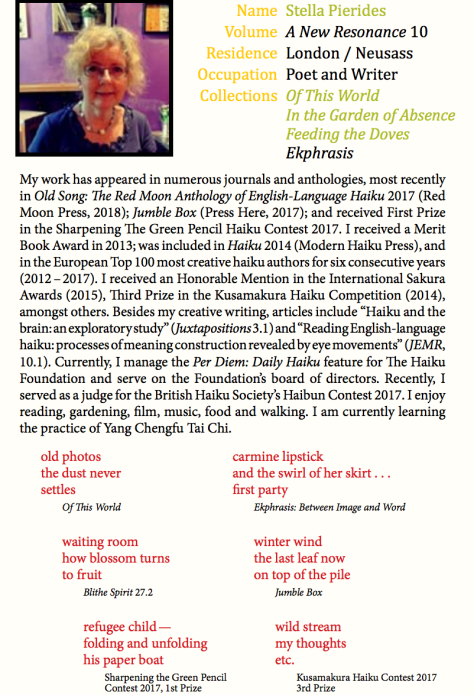
The Red Moon Anthology of English-Language Haiku assembles each year the finest haiku and related forms published around the world in English into a single book. old song, the twenty-second volume in the most honored series in the history of English-Language haiku, includes 151 poems (haiku & senryu), 17 linked forms (haibun, renku, rengay and sequences), and 5 critical pieces on the reading, writing and study of the genre.
refugee child—
folding and unfolding
his paper boat
p.54
(This poem had received First Prize in the Sharpening The Green Pencil Haiku Contest 2017)
Delighted to have two poems featured on Jennifer Hambrick’s blog Inner Voices, for a second year hosting the International Women’s Haiku Festival 2018! This is how Jennifer introduces them in her blog:
Two laser-sharp senryu by poet Stella Pierides explore women’s age dynamics and the eternal question of women’s dress and sexuality.
dressed to kill
she asks
if I’m retired
Jennifer says:
Well. Why not just ask about her final wishes? The picture is this senryu is crystal clear: a younger woman, in full heat of professional and/or personal ambition and wearing the clothes to prove it, asks the poetic speaker, whom I read to be an older woman, if she’s retired – read: no longer competition, no longer someone to be concerned with. To be charitable, maybe it’s just an observation: the older woman looks older, looks perhaps comfortable in her own skin, and the younger woman just doesn’t get a) that retired doesn’t equal out to pasture, and b) that remarking, even obliquely, on someone’s age is at best insensitive. And what if the poetic speaker actually is retired? Picasso said it best: “It takes a very long time to become young.”
and:
knee-length skirt
the extent
of her rebellion
.
Jennifer writes:
This little senryu is situated perfectly between the rock and the hard place that, eventually, every woman encounters. Look sexy, be sexy, the world instructs. But not too sexy. In this poem, rebellion against the social expectations that a girl or woman be prim and proper results in a shorter skirt. But rebellion against social expectations doesn’t necessarily eliminate the expectations. There is potentially a price to pay – the demise of one’s reputation – for breaking the rules, hence the “extent of her rebellion” is defined by the knees. It could be fear from social pressure that keeps everything north of the knees covered, or it could just be the poem subject’s authentic assessment of her own comfort.
Many thanks to Jennifer Hambrick for including my poems!
I am very much looking forward to reading and enjoying the rest of the month’s contributions with Jennifer’s insightful commentaries.
Literature, Art, and Life through the Lens of Haiku