Category Archives: Publications

‘Touching’ bringing poetry & science together

Touching

Imagine your left hand is being made to feel a brief vibration and you’re being asked to estimate how long this vibration lasts. In one version of this scenario, you are holding a small ball in both hands; in another, your right hand is free. And in both versions, you see a safely suspended, potentially catchable ball moving towards you.

Would your estimate of the vibration duration be the same in both versions, or would it be different? Scientists tell us that we overestimate the duration of the vibration when our right hand is free.
Of This WorldSurprised? The scenario may sound unlikely, but all for a good reason: the investigation of the experience of tactile time. Perhaps unlike other bodily times, touch time appears as if time slowed. Your hand is free and ready to interact with the possibilities of a touchable object. The present moment gathers momentum: memories, anticipations, balance, co-ordination, visual cues… the time your father threw you a ball to catch, your sister’s expert throw, your playful nature entertaining the idea to catch the ball and surprise the scientists… Time slows for the possibilities; time slows with possibilities. The ‘touch’ body and the ‘touch’ mind ready themselves for the game.

infinity
a deer appears at the edge
of the woods
*

Bringing poetry and science together!

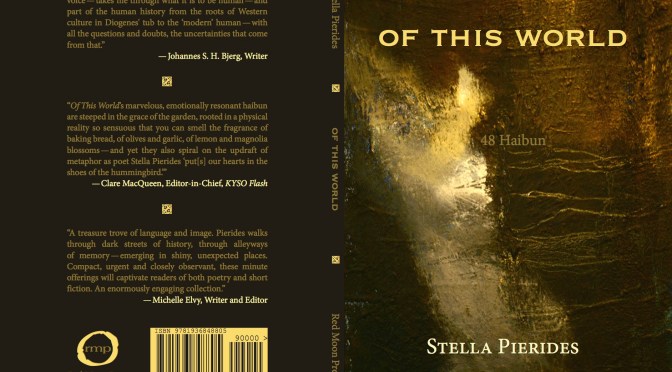
This haibun is from my new book Of This World (Red Moon Press, 2017) and appears on the LMU site MSense .
Of This World is also available @ Amazon  Germany and the UK

‘dust devils’

dust devils: The Red Moon Anthology of English-Language Haiku 2016, edited by Jim Kacian & the Red Moon Editorial Staff is now out and available to purchase.

dust devils,haiku,anthology,
From their website:

The Red Moon Anthology of English-Language Haiku enters its third decade of gathering the finest haiku and related forms published around the world in English into a single book, the longest run of any book dedicated to ELH. dust devils includes 173 poems (haiku & senryu), 8 linked forms (haibun, renku, rengay and sequences), and 5 critical pieces on the reading, writing and study of the genre.

Honoured to be included!

Don’t delay, order it and enjoy!


‘Of This World,’ released by Red Moon Press!

Delighted to announce that Red Moon Press just released my haibun collection, Of This World

Of This World

Stella Pierides has cultivated a terse, idiosyncratic style in her haibun that is instantly recognizable, and as a consequence is one of the shining lights of this burgeoning genre. Of This World certainly is, but it also takes us out of the world at large and into private spaces we feel privileged to witness. A unique and satisfying read.


Red Moon Press
Amazon Europe
Amazon UK

I am grateful for the generous comments:

This is how it’s done! Stella Pierides — in a hushed voice — takes me through what it is to be human — and part of the human history from the roots of Western culture in Diogenes’ tub to the ‘modern’ human — with all the questions and doubts, the uncertainties that come from that.

— Johannes S. H. Bjerg, Writer

Of This World’s marvelous, emotionally resonant haibun are steeped in the grace of the garden, rooted in a physical reality so sensuous that you can smell the fragrance of baking bread, of olives and garlic, of lemon and magnolia blossoms — and yet they also spiral on the updraft of metaphor as poet Stella Pierides ‘put[s] our hearts in the shoes of the hummingbird.’

— Clare MacQueen, Editor-in-Chief, KYSO Flash

A treasure trove of language and image. Pierides walks through dark streets of history, through alleyways of memory – emerging in shiny, unexpected places. Compact, urgent and closely observant, these minute offerings will captivate readers of both poetry and short fiction. An enormously engaging collection.

— Michelle Elvy, Writer and Editor

*
Of This World
ISBN: 978-1-936848-80-5
Pages: 124
Size: 6″ x 9″
Binding: perfect softbound

In A New Resonance 10!

I am delighted to share that my work will be included in A New Resonance 10: Emerging Voices in English-Language Haiku, along with the work of 16 other wonderful poets.

A New Resonance is a much valued and award-winning series, sensitively appreciating each featured poet’s work. The New Resonance Poets community, numbering more than a hundred-fifty poets, is a virtual who’s who of English-language haiku poets. I am honoured to be included in this group.

Thank you to the editors Jim Kacian and Dee Evetts and also a big thank you to the New Resonance community for nominating me!

The book (by Red Moon Press) will be available in May 2017.

‘Being Remembered’ in Haibun Today

Being Remembered

Salting is one of the oldest methods of preserving food. Fish, meats, cheeses, cabbage, olives have been cured, brined, pickled to protect them from fungi, bacteria, and other harmful organisms, and thus keep them fresh for longer. Still, it comes as a surprise to read of one more entity to be preserved in salt: memory.

A project titled Memory of Mankind aims to preserve humankind’s most precious milestones by engraving them on special ceramic tablets, and then storing them in salt-lined vaults deep in the Austrian mountains. Small tokens engraved with a map pointing to the archive’s location, and other information helping our descendants decipher the tablets, will be strategically buried around the globe. And what will future generations find to define us? The article suggests sacred texts, treatises, classics, scientific articles, images of buildings, paintings, musical scores. And individual histories, family albums, recipes.

My list would include my daughters’ photos and paintings, multiple drafts of a haibun, favorite poems, a pin cushion and thimble, an amber komboloi, an oil lamp, a pot of basil; my grandmother’s piece of the Holy Cross, the sound of the sea . . ..

family supper
the same joke for
the umpteenth time

.

In Haibun Today Volume 10, Number 4, December 2016

Memory of Mankind website


The Path

The Path

Painting,The Path,haibun,Maria Pierides,haiku,Port Isaac,Amorgos,


At the top of the stairway snaking up the hill, a white-washed chapel and an olive tree. Blinding sunlight. Some way to go yet. The stony stairs are narrow, a couple of hands-width before the cliff falls steeply into the sea.

Slow down, there’s no hurry. Take a deep breath. Feel the rough warmth of the rock. The wind beating against it raises the fragrance of sage, of thyme and marjoram to the skies, erases the silence.

marble wings—
in the distance
windmill ruins

Feel the salt on your lips, the urgent wind tussling your hair.

This history book under your arm, so well-thumbed, leave it here, against that rock, someone coming after you might linger, take a look.

pillars of salt—
propping her foot
on a stone

And the pebble from Amorgos you kept in your pocket all those years, add it to the cairn over there, where the path widens. Let it go. The trail is moments like this, following the light, teetering on the edge of your desires, of your sorrows.

That bench at the top, see it now, under the olive tree? This is your goal. You can rest there. Wise, gentle Persephone will hold your hand.

embalming my tongue
I rest in the shadow
of the silver-leaved olive

Author’s commentary:

stella-pieridesHaving left Greece in my youth, I keep returning to it in my writing, visiting and revisiting the landmarks and landscapes of the country.

Time has a different texture in and about Greece. Sculptures solidifying the past appear at every corner, at every museum: looming, teasing, reminding. Accompanying us into the future. There’s no escaping the sculptures, the poets know it:

“… I woke with this marble head in my hands;
it exhausts my elbow and I don’t know where to put it down.”

Seferis, Mythistorema 

and

Ritsos approaches the sculptures from different, mythical angles, turning the people and landscape into eternal presences:

“…Nowadays, we don’t think much
about Theseus, the Minotaur, Ariadne on the beach
at Naxos, staring out at the coming years.
But people still dance that dance: just common folk,
those criss-cross steps that no one had to teach,
at weddings and wakes, in bars or parks,
as if hope and heart could meet, as if they might
even now, somehow, dance themselves out of the dark.”

Ritsos, The Crane Dance

In The Path, honoring these roots, I try to present this aspect of my Greek inheritance. I fail, of course, but proud to be trying.

Painting “Golden Light, Port Isaac” by Maria Pierides

In Blue Fifth Review, Broadside #44 Fall 2016

Machine Phenomena and Light Bulbs

A few years ago, in a paper titled ‘Machine Phenomena’, I explored situations in which the metaphor of the machine is understood and used concretely to express positive or negative, idealised or denigrated experiences — ranging from, for example, the use of innocuous expressions like ‘I need to charge my batteries’ to experiencing being controlled by an influencing machine. This article became a chapter in the book ‘Even Paranoids Have Enemies: New Perspectives on Paranoia and Persecution’  (ed. Berke, Pierides, Sabbadini, Schneider), published in 1998 initially by what was then Routledge.
even paranoids have enemies,machine phenomena,Since then, from time to time, I check whether, and where the concept of ‘machine phenomena’ is being used and to what effect. So it was with pleasure I came across an interesting article, by Grace Halden, titled ‘Incandescent: Light Bulbs and Conspiracies’, in Dandelion: postgraduate arts journal and research network, v.5, no 2, Spring 2015.

In my reading, Grace Halden (2015) illustrates how light, in the form of a lightbulb, became what can be seen as a machine phenomenon (Pierides, 1998), becoming entrenched in concrete fantasies of benevolence and evil. She points out

through examining general technology (such as machines), anxieties surrounding ‘modification, transformation and replacement’ emerge despite the technology being traditionally associated with protection and assistance.

Halden uses the texts of The Light Bulb Conspiracy (2010), The X-Files (1993-2002), and Thomas Pynchon’s Gravity’s Rainbow (1973) to explore how this innocuous, commonplace object, with an enormous beneficial impact in the modern world,

has been used to symbolise the malevolence of individuals and groups, and the very essence of technological development itself.

Interesting stuff. Check it out!

The Haiku Foundation re:Virals 31 and my Commentary

This week, a terrific haiku by Melissa Allen was up for discussion at The Haiku Foundation  re:Virals. Interesting commentaries looking at the poem from different perspectives. You can read the whole post with the poem and all the commentaries  here. I am pleased to say mine was this week’s winner. I copy it below:
.
Melissa’s poem:

radiation leak moonlight on the fuel rods

          — Melissa Allen, Haiku in English: The First Hundred Years (2013)

And my take:

In current usage, the word leak refers to a variety of situations: from leaking a document and bringing into the light a secret, to taking a leak, to a wasteful dripping of water, to seepage of radiation. This poem, with its radiation leak, immediately opens up a danger zone. Step in at your peril into an image that gives rise to paralyzing fears, to the dead zones of Chernobyl, Fukushima; to the forbidden zones. Anything could happen here.

From a leak to a fireball, from the atom to the apocalyptic mushroom cloud, you could be walking into a minefield of the results of unbridled ambition and unscrupulous greed, a Faustian deal . . . Whether the leak is from a technological or scientific project, where man sees himself tirelessly bent on expanding knowledge and power over nature, finding solutions to the human problems of illness, poverty, and environmental degradation; whether hubris or dedication to the common good, here is a consequence: the spewing of poisonous material, the fall into a dark, man-made Hell.

But now the poet brings moonlight on the scene. Like a benevolent, all-seeing Eye of God, moonlight bathes the fuel rods in light we associate with understanding, with cool logic, in forgiveness. I am reminded of the Greek poet Yiannis Ritsos’ Moonlight Sonata, where moonlight hides smaller-scale follies such as showing white hair as golden, at the same time relentlessly intensifying shadows. In Allen’s poem too, moonlight is both kind and cooling, as well as relentless and permanent, not allowing the fuel rods to hide in the shadows. An image burned into the mind.

Note that the fuel rods are not spent. The young man in Ritsos’ poem too, is present all through the poem, at the end leaving full of energy, bursting into laughter as he walks away. Life continues in its boundless energy, in its perpetual flow, beyond leaks, beyond the night, beyond our human follies, beyond life itself.


‘reed ears’

The book of the Fifth Haiku Contest, Sharpening the Green Pencil, is out. An awe-inspiring two hundred and fifty poets from forty five countries took part. Great contributions. Congratulations to the winners!

I am honoured that my own haiku,  translated into Romanian by Ana Drobot, was featured in the book (p.191).

reed ears —
not hearing what the doctor
tells me


“Joining the Dots” in Haibun Today

Joining the Dots

From the compensation for the demolition of his house to make way for a new road, he bought two tiny apartments, a four-poster bed, an amber komboloi, and a pendulum clock. As a child, I considered the wall-mounted, cherry wood, chiming clock to be my granddad’s most striking acquisition. I checked it continuously, comparing its time to the watch my dad had given me before going away to sea.

approaching wind knots matter

But it was the sound of it chiming the hour that stayed with me the longest. Half a century later, I can feel the deep resonance of that chime opening doors to the past.

let’s say the map shrinks afterwards

In Haibun Today, 10: 1, 2017

Pandora’s Box

Pandora’s Box

I step inside a second-hand store in downtown Athens. A musty odor envelops me. A yellow handbag, by the entrance, has pride of place. Plastic dolls of varying sizes, unclothed but for the price tag, line a shelf. Rows of scaffed shoes, and shoes never worn, line the skirting board. Shirts, trousers, blouses, and skirts hang from circular rails. Moths dance in the sunlight. I run my hand across the clothes and continue to the back of the shop, to the books: Fiction, Poetry, Classics, Biography, Bibles. I duck to avoid a doll in military dress.
A glass-topped drawer catches my eye. Sparkling pair after pair of earrings: pearl, gemstone, silver, gold, diamond. I didn’t expect such quality.
The owner, dressed in a beige cotton tunic, approaches. “The Junta General’s wife,” she tells me. “After the trials she could not wear them. Brought them here. In all these years, nobody will touch them, although they come and look.”
A shadow of suspicion crosses her face. She looks me up and down, then relaxes. “Pity. She loved poetry,” she says, fanning herself.

bitter olives . . .
sound of a key turning
in the lock
.

In Haibun Today vol.9, 4, 2015

‘typos’ in RHP 95

typos
in the book of the dead—-
water lilies

In Right Hand Pointing 95, the special, and wonderful, Haiku issue  guest-edited by Eric Burke

RHP, Right Hand Pointing Interesting introduction by Dale Wisely, founder and editor of RHP, who refused to include haiku in the journal for twelve whole years! Well, at long last, Dale!

Read Dale Wisely’s introduction here

KYSO Flash Anthology of Haibun and Tanka Forms 2015

Clare MacQueen just announced the publication of the KYSO Flash Anthology, featuring prize-winning haibun and tanka. My own haibun “Time,” which received an Honorable Mention (in November 2015), is included.

KYSO Flash 2015

This is how KYSO Flash describes the release:

We’re pleased to announce the release of a little book with a mouthful of a name: the KYSO Flash Anthology of Haibun and Tanka Forms 2015. Contributor copies are now on their way to folks.

This is an international collection of 25 poetic hybrid works by 14 authors (plus images by three artists). Works were judged by Roberta Beary, award-winning poet and haibun editor of Modern Haiku, for the first annual KYSO Flash “Best Of” contest. Cash prizes were awarded to seven artists for First, Second, and Third Place, and Honorable Mentions. The judge also selected 19 finalists to appear in this anthology.

The book is available from Amazon.com

‘Intertextuality’ in Sonic Boom 4

Pleased to see my ‘Intertextuality,’ a haibun diptych, in issue 4 of Sonic Boom, published under ‘Fiction.’

Issue 4, is an anniversary issue. Happy Birthday to Sonic Boom, many happy returns!

Intertexuality
(a diptych)
I
A reader asks for help with a patch of garlic plants forgotten and left to overgrow in their garden. Well, I say, dear reader, we are caught between a rock and a hard place. Garlic doesn’t like to be transplanted. And this text is not the right place to ask, or answer such a question. But I can’t resist. It is spring, after all, and I am stuck for ideas. So, to your garlic clump: Let it be. Let it grow, and when it is ripe and ready, when the tips of the green shoots start to brown, dig the plants out. They will be pungent, crisp, and juicy, the plant oils moistening your tongue. Then plant a few individual cloves for next year’s crop. Enjoy the rest.

writer’s block
the school of life
full of lessons

II

Spelt flour, baking powder, butter, milk, and salt. Mix, pat down, shape into rolls, and bake. Serve with olive oil, and garlic from another haibun to dip the bread into. Enjoy!

a frog jumps in—
intertextuality
for beginners

diptych, haibun,