Category Archives: featured

Lemon Tree Magic

lemon tree
Lemon Tree Magic

This month’s theme of the Festival of the Trees is “The Magic of Faerie Trees.”  Hosted by Salix of Windy Willow, it is an interesting if bewitching topic. If you are into magic and fairies, fine. If you are not, what can you say about mystery or magic in a tree?

On the other hand, how is it that the olive tree is capable of living thousands of years? Is there magic involved? With its strong roots surviving underground, even when the trunk looks dead, the olive tree can make a claim to magic – though less so to mystery, if the strong roots explain its longevity! Then there is its outstanding beauty: its silvery foliage, almost like a whispering cloud, fused with its ragged, gnarled, twisted trunk, providing a unique image. This tree has so many associations for me that I decided to find a space for it in my second novel, When the Colours Sing.  An olive tree in pre-alpine Bavaria! We’ll see how this strand is going to develop. But first things first.

There is the lemon tree (for which I made space in my first novel, Alexandrias 40: In the Shade of the Lemon Tree) to talk about. Glossy foliage, waxy, white-purple flowers, divine fragrance, fruit to grace any table, book or poem!

Lemon trees are said to have originated in Asia and spread in the Mediterranean regions after Alexander the Great’s soldiers brought them back from India. They are treasured trees in the Mediterranean lands. They are as important as olive trees and vines. They are vital to the health and well-being of the people living in those lands, as they have numerous medicinal, hygienic, cooking and culinary uses. From the abundant vitamin C, to the taste-enhancing addition to salads, soups, and various dishes, to decorative and aesthetic uses, to the perfume industry, lemons are most versatile.

In Northern Europe and America, there are additional associations which emphasize the lemon’s bitter taste, as in the expression “when life gives you lemons,” or the “lemon car,” referring to a defective, multi-flaw car. In a painting by Paolo Morando, The Virgin and Child, Saint John the Baptists and an Angel, Christ as a child is being offered a lemon, an act frequently associated with learning a variety of tastes and therefore being weaned off baby food.

In this sense, the lemon bridges opposites in taste (bitter-sweet), between cultural perceptions, and generations (weaning the baby off baby food). Is that a clue for interpreting the Italian, unknown artist’s painting Man and Wife, in the National Gallery of London, which has a lemon tree as a background?  

Readers’ Digest lists 34 uses for the lemon. In Alexandrias 40: In the Shade of the Lemon Tree,  there is a whole number of other uses – some surprising ones – for the lemon.  But please note: try them at your own risk!

(Forthcoming:  Alexandrias 40: In the Shade of the Lemon Tree: www.voxhumana-books.com)

18 November 2010
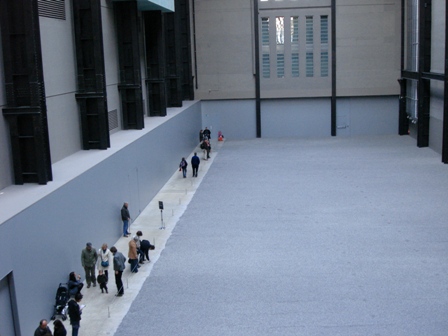
Tate Seeds: close contact

tatesunflowerseeds
Tate Sunflower Seeds

Following the enormous disappointment at the Tate’s stopping the public from walking on  Ai Weiwei’s seed landscape, Tate Modern had a better idea: for all those wishing to at least touch the seeds, there is now a narrow corridor to the side of the sunflower seed installation. Now, we can walk on the edge, and we can touch.

Thank you Tate!

Guardian article about the Tate rethink (and the guards offering seeds in mugs for people to feel!), here

My own post on the Sunflower Seeds show, here

27 October 2010

Bremen Town Musicians

A few days ago I visited Bremen, Northern Germany, and was fascinated by the
number of statues, photographs, and references to the Grimm brothers’ fairy tale The Bremen Town Musicians.

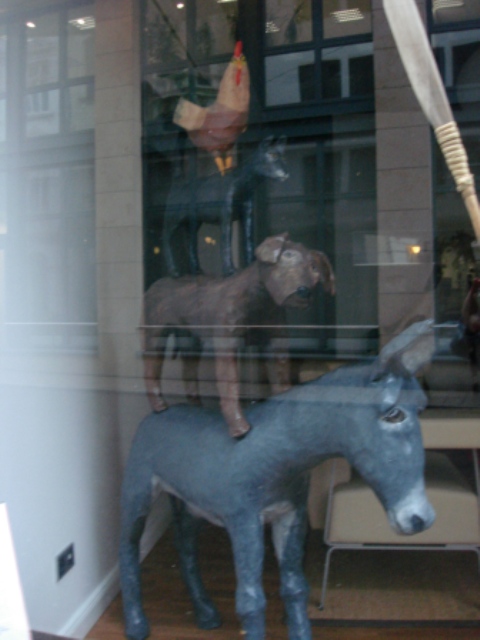
The Four Bremen Town Musicians
Bremen Musicians

In this tale, four animals: a donkey, a dog, a cat and a cock, having worked hard for their human owners, but getting on in years, are facing redundancy, abandonment, abuse, and slaughter. This unsavoury predicament brings them together and they decide to set off for the town of Bremen to find work as official musicians there.

Before reaching the town, however, they come across a house in the forest, as one does in fairy tales, and agree to try to scare away a gang of robbers feasting inside it. The dog stands on top of the donkey, the cat on top of the dog, the rooster on top of the cat, and each making its own, unique cry – their concerted braying, barking, meowing, and crowing – they crash through the window inside the house and scare the robbers off. In this remarkable way of co-operation, the four animals repel an attack by the robbers during the subsequent night, and settle to live there for the rest of their lives.

The Four Bremen Town Musicians
Bremen Town Musicians

(I took a picture of this sculpture from the street; it is made of papier mache by Gaby Bertram of scrap-pap.de)

I wonder why this fairy tale has become so important to the city. Might it have to do with a wish for all kinds of people, of all backgrounds, ages, ethnic origins to live together happily, like those seemingly incompatible animals did in the story? I hope so anyway.

Readers of this blog will know about my novel Alexandrias 40: In the Shade of the Lemon Tree, and my interest in the ways people (in this novel, mainly Greeks and Turks) come together – or not. It seems that having a sense of shared humanity and a common purpose, and project helps: this Grimm tale shows us how.

In any case, I had fun walking around and finding depictions of the animals to photograph.

How Time Dilates…

How Time Dilates…

atomic clock
Atomic Clock USNO

I just read that Einstein’s Theory of Relativity was shown to apply to altitude differences as small as 33 centimeters. Scientists at the US National Institute of Standards and Technology in Boulder, Colorado, using the latest and most accurate atomic clocks, found that the higher you are above sea level, the faster time runs for you.

In addition, as Einstein had also suggested, the scientists found that travel through space influences clock speed. A stationary clock ticks slower than a moving one. So, if your clock is moving rather than stationary and, in addition, you live high up, then you might start thinking about botox, moving to sea-level, or buying a bungalow!
x

The time differences at these small distances are minuscule, but now measurable.
x

This demonstration of time dilation leads me on to another, though I believe related, track. Einstein conceived of his Relativity Theory more than one hundred years ago, and yet we are only now able to confirm its predictions on our, human level! Atomic theory, stating that matter is composed of discrete units called atoms, according to Wikipedia, “began as a philosophical concept in ancient Greece and India” and only entered scientific thinking in the early nineteenth century. Thus, “time” is also relative, depending on the prevailing culture, socio-political conditions, etc., when it comes to the interval between ideas being born and their progressing to proof and acceptance. Just think of the effect of certain periods of the Middle Ages on the progression of ideas!
x

Moving on to a more experiential level: In my forthcoming novel Alexandrias 40: In the Shade of the Lemon Tree, a little girl is obsessed with time. She fears changes of plan, the adults changing their mind, things happening unexpectedly – “Can you do that?” she wants to know. If you change your plans, then time becomes unpredictable. She keeps comparing the time on her watch with that of other family members, to reassure herself of the stability of her world. Like most of us, she confuses the subjective timeline of our lives, and its curves, ambits, u-turns and roundabouts, with the instrument of its measurement, her watch.
x

On the other hand, shrinking or speeding up time, for instance through time-lapse photography, can provide us with a new, marvelous perspective on the world. The BBC has a great video on this, “Timelapse: Speeding up life” Watch it; I added it to my previous post.
x

For musings and poetry on Time, read Asian Cha’s Random musings on Time: “Pray, my dear, quoth my mother, have you not forgot to wind up the clock?” They claim their clock does not tick. Not even tock?
x

Perhaps this, the dilation of time, the arrhythmia of time, where the interval between “tick” and “tock” is unpredictable, or different to what our current understanding would lead us to expect, is a major, crucial point where the arts and the sciences intersect – where the subjective and objective meet. Let us stay with this thought for a minute. Stop all the clocks!

Nolde Question

Colour Clouds
Nolde Question

While working on my novel When the Colors Sing, about The Blue Rider (Der blaue Reiter) movement, especially Kandinsky, Münter and Marc, I came across the work of Emil Nolde and his struggles with the development of his art. Readers of this blog will know I recently visited his house – now a museum – in Seebüll, North Frisia, to get a better feeling of his surroundings and the areas where he liked to work.

Having dipped a bit deeper in Nolde’s bio, I came back with more questions than I went with; which is something I appreciate. For instance, I kept thinking, how did Emil Nolde hold the tension between his art and his craft; between his personal, conservative philosophy and his experimental and liberating work; between his roots in the farming community and artistically, in a German tradition of painting, and freedom of expression in his own artistic explorations of landscape, nature and humans. In other words, how did Nolde carry his own, individual cross to produce such work of great depth, intensity, and appeal?

Continue reading Nolde Question

They send light to Earth

Murnau Moor
Murnau Moor

I am delighted and  honored! My micro-poem They send light to Earth was chosen to be the first piece to be published by new e-zine @textofiction.

Brand new, “Textofiction is an online literary publication dedicated to bringing the best writing in under 140 characters.”

Read my micro-poem and think, it packs a lot in. Better still, let me know your thoughts about it! Read it here

Date of publication: 29 August 2010


David vs Goliath

Niyamgiri Victory
David vs Goliath

A tribe in India has won a stunning victory over one of the world’s biggest mining companies. The Dongria Kondh, a tribe of 8000 people, with the help of Survival International and others, has won a victory over a multibillion company which proposed to mine bauxite on the sacred hills of the tribe. The Dongria Kondh’s struggle had a happier ending than that of the film Avatar, in which a tribe was pitted against a ruthless mining company. The Dongria Kondh’s perseverance, courage, and victory will encourage indigenous tribes everywhere.

Well done to Dongria Kondh, their supporters, and to Survival!

Sugar Cube Horror

Yesterday, I tweeted the “11 of the most craziest things about the universe,” a short photo essay by Marcus Chown, science writer. Chown alerted us to the fact that “if you squeezed all the empty space out of all the atoms in all the people in the world, you could fit the entire human race in the volume of a sugar cube.” He explained that this is because matter is “empty.” An atom, the most basic element of matter, orbited by electrons, is an incredibly empty thing with immense distances, relatively speaking, between the electrons and the central nucleus.

I was reminded of Sartres “Hell is other people.” Not the way he meant it – which was that if our relationship with a particular person is  bad, then our being with them becomes hell;  but the way it is usually understood, namely, that all other people are, and our relating with them is, torture.

I wonder what Sartre would have made of the idea that all humankind could theoretically be squeezed into a sugar cube! Horror of horrors! He might well have been a bit more appreciative of the already existing space inside and in-between other people’s atoms.

Now that’s a thought (for a short story).

I see that the ideas in the photo essay are explored in Chown’s “The Matchbox That Ate A Forty-Ton Truck: What everyday things tell us about the universe.” Well then, I am off to get this book…

For an essay on the quote “Hell is other people” see: http://legacy.lclark.edu/~clayton/commentaries/hell.html

Also, for the real thing:  http://www.sartre.org/

No Exit, the play from which the quotation arises http://en.wikipedia.org/wiki/No_Exit

http://www.huffingtonpost.com/marcus-chown/11-of-the-craziest-things_b_628481.html#s107477

Photo credit:  Constantina Pierides