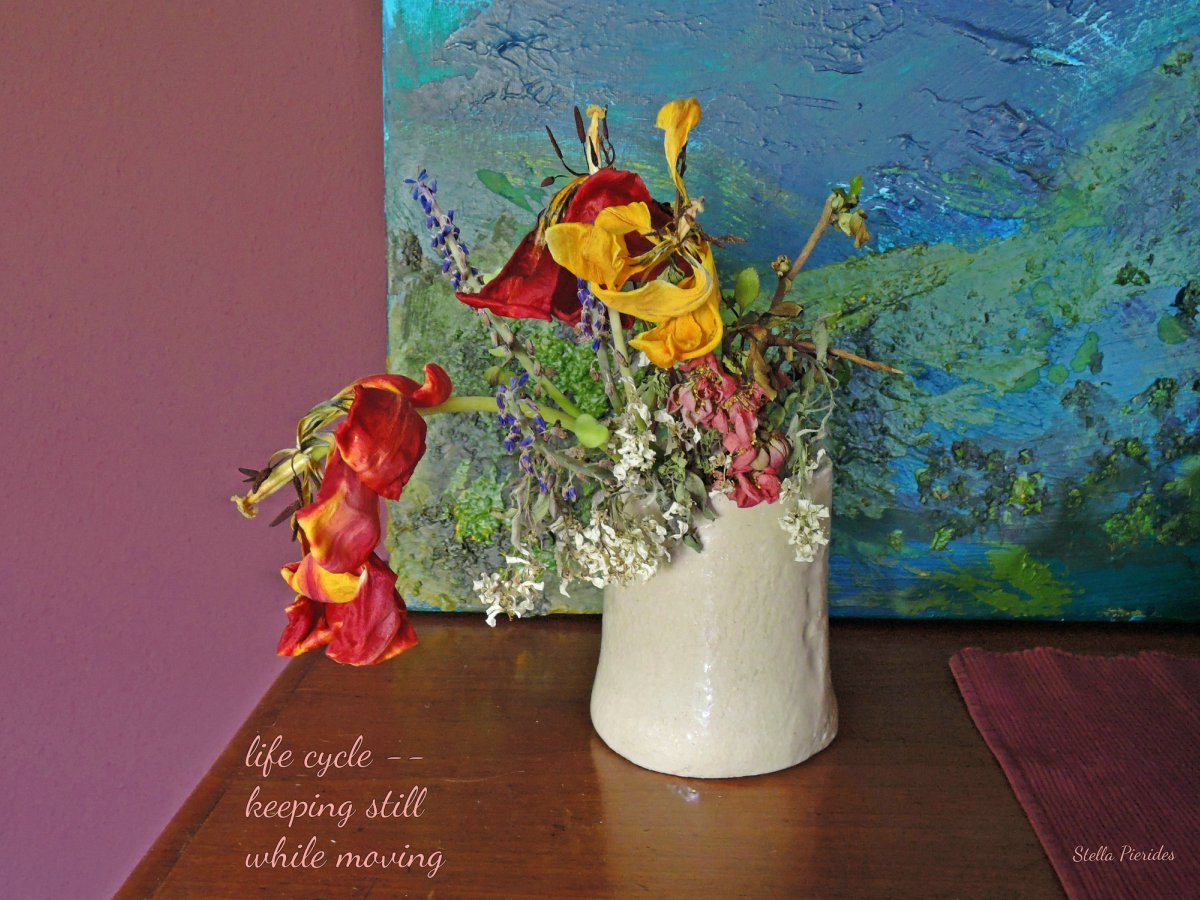
life cycle—
keeping still
while moving
.
In the background, painting by Maria Pierides, slightly altered in the process of making this haiga.

life cycle—
keeping still
while moving
.
In the background, painting by Maria Pierides, slightly altered in the process of making this haiga.
catching
the last rays. . .
buttercups
 *
*
From my walk along the Schmutter
Photo of bridge over the Schmutter, Neusaess
*
that look on her face . . .
a feather stuck
to the egg
.
Prompt: question
.
Nepal quake fluttering prayer flags
.
Nepal quake
resin seeping from
the pine
.
Prompt: quake
swaying branch
the hummingbird here
and not here
.
moment of stillness
just before the light
changes
 From In the Garden of Absence (Fruit Dove Press, 2012), my book of haiku and micro poetry.
The ‘hummingbird’ poem is also included in my film presentation for HaikuLife ‘Haiku Journey‘ organised by The Haiku Foundation and shown together with several other entries to the event on International Haiku Poetry Day, April 17, 2015. The event was an enormous heart-warming, global literary celebration of haiku, and if you missed it, you can catch up through the blog posts on the THF site and the links here
in light of
wild violets…
nightcap
в светлината
на дивите теменужки…
нощна шапчица
*
dawn chorus
the night shift spills out
into the street
утринен хор
нощната смяна се изсипва
на улицата
*
These two haiku, first posted to THF EarthRise, the IHPD rolling haiku collaboration 2015, were translated into Bulgarian for Wild Lilacs, a blog of Bulgarian poets: Thank you Maya Lyubenova, Tzetzka Ilieva, Vessislava Savova!
At the beginning of this year, I wrote about my visit to Kettle’s Yard, University of Cambridge, to view their collection of paintings by Alfred Wallis. At that time, I was inspired to put together a presentation for the HaikuLife FilmFest, organised by The Haiku Foundation. The presentation, Haiku Journey, was shown on International Haiku Poetry Day, April 17, 2015, together with a good number of other films. It is now archived on the site here.
Poetry and arrangement: Stella Pierides; film editing: Rob Ward
Images: by kind permission of Kettle’s Yard, University of Cambridge
Enjoy!
In 2015, The Haiku Foundation celebrates haiku on a global scale, encompassing the work and achievements of haiku poets from around the world. From this year on, International Haiku Poetry Day (IHPD), replacing the THF’s National Haiku Poetry Day, becomes the biggest celebration of haiku poetry word wide. On April 17 each year, haiku poets, haiku poetry fans, and organisations will be getting together under the auspices of the THF in order to honour the depth, reach, creativity, and joy of the genre we have come to love.
For this year, the Foundation has organised a series of events, from local haiku readings and celebrations, over HaikuLife, a FilmFest showcasing work submitted by individuals and organisations, to EarthRise, a rolling collaborative poem.
On April 17th, 2015, from 12:01 A.M. at the International Date Line, a wave of haiku contributions begins and rolls throughout the day, with poets offering their haiku at dawn their local time. The finished collaboration, on the theme of Light, will be permanently archived on the THF site.
I am very much looking forward to the day, and the many exciting contributions from poets around the globe. I will be setting my alarm, and posting my own haiku to the inaugural EarthRise.
I am also delighted that the FilmFest, HaikuLife, features a short film of my haiku together with paintings by Alfred Wallis (from the excellent Kettle’s Yard, University of Cambridge, collection). I created this film with the (much appreciated) support of Rob Ward, After-Effects Artist and Animator. Besides my presentation, there are at least 12 other contributions by haiku poets and organisations, amounting to almost 90 minutes of film.
I hope you will be able to join in the fun on IHPD.
For times, url, and other information about HaikuLife and EarthRise, as well as the local (to the US) readings, please visit the Troutswirl blog at The Haiku Foundation site.
Update April17, 2015
Happy International Haiku Poetry Day, folks! Contribute your poems to EarthRise, watch the HaikuLife films, go to the readings, enjoy the day!
My short film, Haiku Journey, is shown today — together with a number of other films — and will be permanently archived on the Haiku Foundation site. Please see here
For an introduction to the Foundation HaikuLife project, and the list of all projects shown, please click
skull MRI
butterfly eggs readying
to hatch
.
Prompt: a Rorschach test image (Gabi Greve)
World Kigo Database, Haiku topics, Theory and Keywords: Rorschach
See more poems here
re: falling leaves
he says he still
loves her
.
In Frogpond, 2015, Vol. 38:1, p. 10
waiting room
how iron rust
grows
walking on ice …
my full attention
to the moment
.
A Hundred Gourds 4:2 March 2015, p. 15
ash wednesday
the oud workshop closed
during the war
.
.
you and I this winter ellipsis
.
Modern Haiku vol. 46.1 winter-Spring 2015
Continuing with the science fiction/weird science theme:
angel dust
a seagull drone readies
to sweep

creature comforts
I pack a haiku
for Mars
olive press
in the Cretan mountains
liquid gold
.
Prompt: oil
the sum total
of experience…
blood orange
I took this photo a few months ago, in 2014, during a visit to the Duveen Galleries, Tate Britain. The photo is of a small part of Phyllida Barlow’s installation, ‘dock’. You can read an account of my reaction to her work here.

still life
a gull breaks
the silence

This is a photo I took of Konstanz harbour, on Lake Constance, or Bodensee, as it is also known in Germany.
wikipedia entry for Lake Constance:
http://en.wikipedia.org/wiki/Lake_Constance
pinpricks of icy rain…
how damp wood spits
.
In Blithe Spirit, 25:1, p. 4.
Blithe Spirit is the Journal of the British Haiku Society
event horizon
another stage
of the journey

how to be…
eating the prickly pear
blossoms

nature’s numbers
the infinite sweetness
of cup-shaped blooms
What do Pattern, Poetry, and Polemics have in common? The Arts and Crafts Movement’s poet, novelist, publisher, translator, architect, designer, craftsman, retailer, environmentalist, and social activist William Morris! I was delighted to be able to visit the William Morris Gallery, in Walthamstow, which tells the story of William Morris and his multiple achievements: the elaborate, detailed, inspirational designs and their manufacture/production/application; the poetry and prose; the perfectly hand-crafted books; the politics, speeches and support for the Victorian poor… Morris applied himself with awe-inspiring energy and dedication to an astonishing array of disciplines.
There’s an organic unity in his work, each piece containing seeds from whatever he’d been working on, in whatever field. Despite this connectivity and continuation in his work, Morris has often been strongly and unfortunately linked with mere wallpaper design. I found this contradiction interesting in itself, as if the critics and the viewers, the consumers of his work, could not cope with someone different to themselves, someone excelling in many fields, rather than just one, if at that. It is not the only contradiction. The critical assessment of his work rests on this ground of contradictory perception, for example, when it is pointed out that Morris decorated the houses of the rich while campaigning for the rights of the poor.
Yet, Morris himself was aware of the connections between disciplines and the depth achieved when we become conscious of them. Lecturing on design, in 1881, he claimed,
‘any decoration is futile … when it does not remind you of something beyond itself’.
Beyond Morris’ decorations, patterns, and wallpapers lie references to the medieval world, history and myth, nature and society, beauty, and above all the assertion that we are all made of the same stuff. Although referring back to a pre-industrial age, his is a utopian vision of humans fulfilling their creativity, and themselves, in self-determined, non-alienated work, within an egalitarian society that supports them in this endeavour. In those terms, in addition to his role in the Arts and Crafts movement, he comes across as a social thinker and moral visionary working towards a better world.
tenements
the heart of a soft
berry
Here is a link to the amazing William Morris Gallery collection
The wikipedia link here
neo-classical
the delicate beauty
of snowdrops
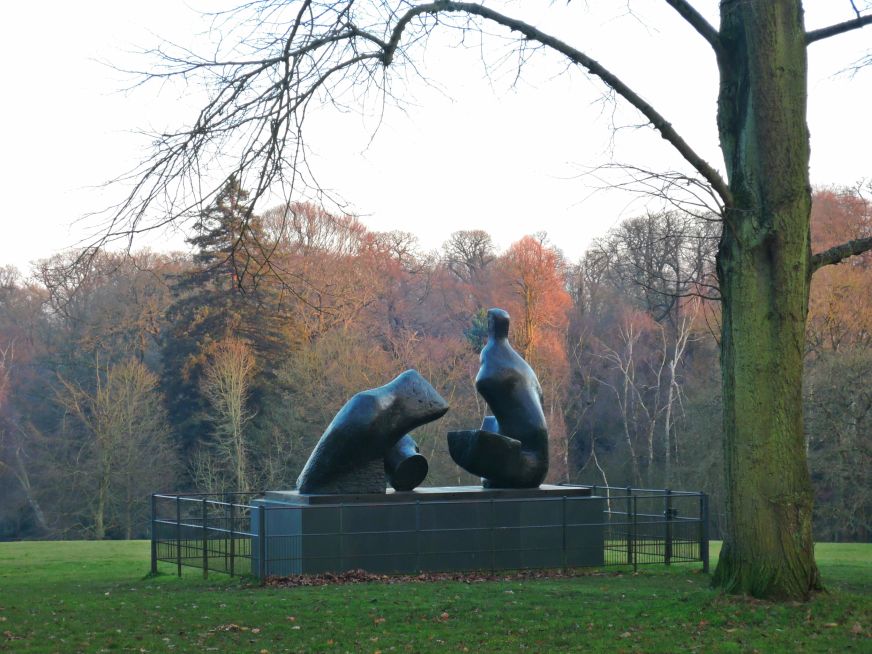
Photo: of a Henry Moore sculpture on Hampstead Heath
Between 1958 and 1973 Kettle’s Yard was the place Jim and Helen Ede called home. In 1966, while still living there, they gave it to Cambridge University. It is now a living museum and gallery, showing the Edes’ collection as arranged by them. Artworks alongside furniture, glass, ceramics and natural objects such as pebbles and wood, with the aim of creating a harmonious whole. Jim Ede’s vision was of a space that should not be
an art gallery or museum, nor … simply a collection of works of art reflecting my taste or the taste of a given period. It is, rather, a continuing way of life from these last fifty years, in which stray objects, stones, glass, pictures, sculpture, in light and in space, have been used to make manifest the underlying stability.
Today each afternoon (apart from Mondays) visitors can ring the bell and ask to look around (there is no entry fee). The house is said to be a work of art in itself. Warm, generous, and well-informed guides are available to help visitors ’see’ and understand the spirit and history of the house.
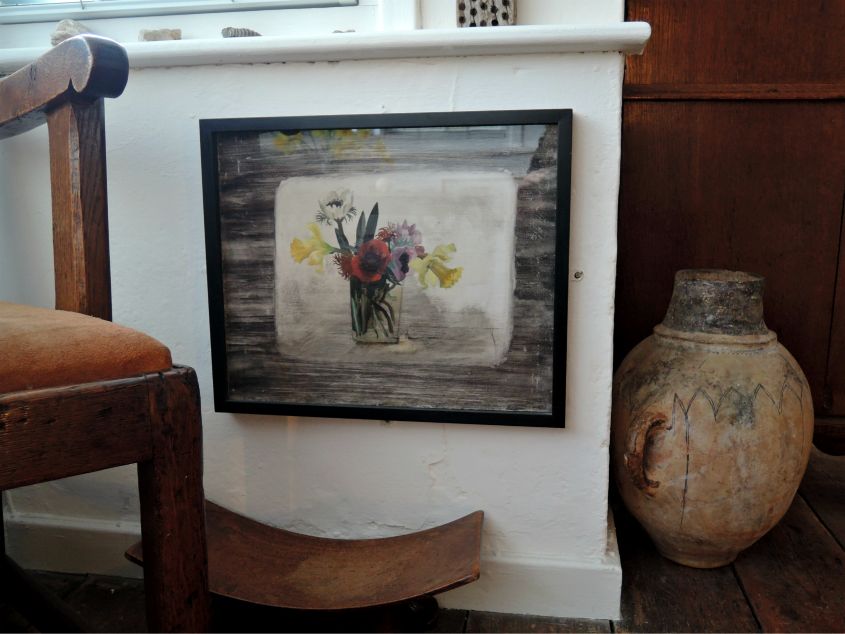
Christopher Wood, Flowers, 1930
A wonderful slideshow with Wood’s paintings can be found here
More paintings: Kettle’s Yard
across the years
the quiet breathing
of anemones
.
(And yes, in case you are wondering, I did visit again)!
after the rain…
squelching across
winter lawns

Photo from my walk in Hampstead Heath.
machine song
the plug-in maker’s
baritone voice
.
#scifaiku #sciencepoetry
regardless
of sunrise or sunset
day moon
.
Prompt: seize the poem: day moon
marmelada
my tongue savours
the word
.
Prompt: marmalade