Scheherazade
and the Emperor…
where do we go
from here


Scheherazade
and the Emperor…
where do we go
from here
herb garden
the bench by the rosemary
occupied
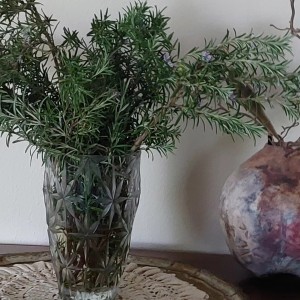
On the fascinating question about the role rosemary plays in memory.
Happy to see the new “Haiku for Parkinson’s” blog post on The Haiku Foundation site: using haiku to reflect on, and gain a sense of control over, the ups and downs of mood in Parkinson’s. Read it here: https://thehaikufoundation.org/haiku-for-parkinsons-mood…/
#haiku4parkinsons#h4p#Parkinsons#ParkinsonsDisease#haikufound#livingwithparkinsons#MovementDisorder#Parkinson’s
The new project of The Haiku Foundation, Haiku for Parkinson’s was launched on the 17th of December 2023! I very much look forward to seeing it develop along the various themes and issues arising from Parkinson’s. The Introduction to the feature can be read by clicking here
I have copied it on this site too, see below.
Haiku for Parkinson’s is a feature of The Haiku Foundation, introducing haiku as a tool in the Parkinson’s toolbox, helping negotiate the challenges of the disease and improve quality of life. And, introducing Parkinson’s Disease (PD) to people living with haiku.

What is Parkinson’s Disease?
Parkinson’s Disease has mainly been attributed to the deterioration and eventual death of brain cells producing dopamine, important for organizing movement. This has been addressed by dopamine replacement therapy. Over the last few years, the role of dopamine and its involvement in the production of other brain chemicals has come to be understood better, leading to improved treatment of the many symptoms increasingly recognized to be part of the disease – over 40 and counting. Besides shaking, stiffness, difficulties with swallowing, problems with walking, balance, and coordination, there are also many ‘non-motor’ symptoms, including anxiety, depression, fatigue, apathy, insomnia, visual hallucinations. Moreover, several of the body’s autonomic functions, such as heart rate, blood pressure, temperature, breathing, and digestion become compromised.
thud!
a bird flies into
a closed window
— Catherine Mair
While this is a formidable list, and at present there is no cure, several programs have been developed amounting to what is often referred to as the Parkinson’s toolbox. Creative therapies are becoming available, offering considerable benefits, including lifting mood, increasing energy and motivation, as well as adding to the paradoxical phenomenon of increased creativity reported by (some) people living with the disease (see Parkinson’s Europe, Parkinson’s Creativity).
Haiku for Parkinson’s (H4P)
Haiku poetry is being used by some people living with PD to support life with this condition. Its qualities include:
Brevity: Haiku can be written or read in a single sitting, enabling feelings of completeness and accomplishment.
Concentration: Concentrating on the moment and our embodied being, haiku anchors us in the world, providing a counterweight to ‘Parkinson’s moments’ – when one feels stuck or caught in acts such as buttoning a shirt or trying to turn over in bed.
Exercise of the mind: Crafting a haiku, in the effort of finding the images and rendering them in words that best convey the experience, exercises brain and mind.
dreaming of birdsong
I wake to a wolf shaking me—
tremors again!
— Tim Roberts
Connectedness: Writing and reading haiku involves attending to the relationship or interaction between writer and reader, and nature – restoring our connection to the world and so becoming a healing force.
Identity: haiku helps enable exploration of the self by overcoming the embarrassment and stigma of the disease, and coming to terms with the constant challenges faced …
Parkinson’s
losing the power
to be myself
— Catherine Mair
while making the various symptoms and the uncertain future manageable.
the last page missing
from the library book—
late autumn evening
— Stella Pierides
In the coming posts, we will hear more about the qualities, and practice, of haiku in supporting people living with PD. And we will be venturing into the realm of haiku’s partner, haibun: the marriage of haiku with prose.
Coming up next: British poet Tim Roberts, living in New Zealand, will be telling us about his haiku practice and how it helps him manage the condition.
References and Bios
“Thud!” and “Parkinson’s” in Catherine Mair, keeping my head above water, 2015. This chapbook is available from The Haiku Foundation Digital Library.
Catherine Mair was born on a winter’s night in the family’s farmhouse in 1938. She has been published widely locally and internationally. In later years she has gravitated to the Japanese forms of Haiku, Tanka, etc. She has grandchildren and great-grandchildren, and the family has grown.
“dreaming of birdsong” in Tim Roberts, Haiku and Parkinson’s Disease: A Practice, in New Zealand Poetry Society Archives, 2020.
Tim Roberts was diagnosed with Parkinson’s Disease at 49 and has found freedom and joy in writing haiku and other Japanese-style short-form poems. He enjoys foraging for experiences and inspiration with his dog and lives a life that, he hopes, makes poetry inevitable. His book Busted! (Red Moon Press, 2023) is haiku and micro-poetry about his experience as a British police officer. Tim lives in New Zealand and is in awe of the scenery, wildlife, and southern stars. His favorite Maori phrase is ‘Kia kaha’, which means ‘stay strong’.
“the last page missing” in Stella Pierides, Frogpond 41.2 Spring/Summer 2018, p. 27
Parkinson’s Toolbox in Stella Pierides, Parkinson’s Toolbox: The Case for Haiku, 2022. Available from The Haiku Foundation Digital Library
Stella Pierides, who lives with Parkinson’s herself, is a writer and poet. Her books include Of This World (2017) and In the Garden of Absence (2012), both HSA Merit Book Award recipients. Her article “Parkinson’s Toolbox: The Case for Haiku” appeared in Juxtapositions: A Journal of Research and Scholarship in Haiku, issue 8, 2022.
mourning dove—
I think I know
who I am
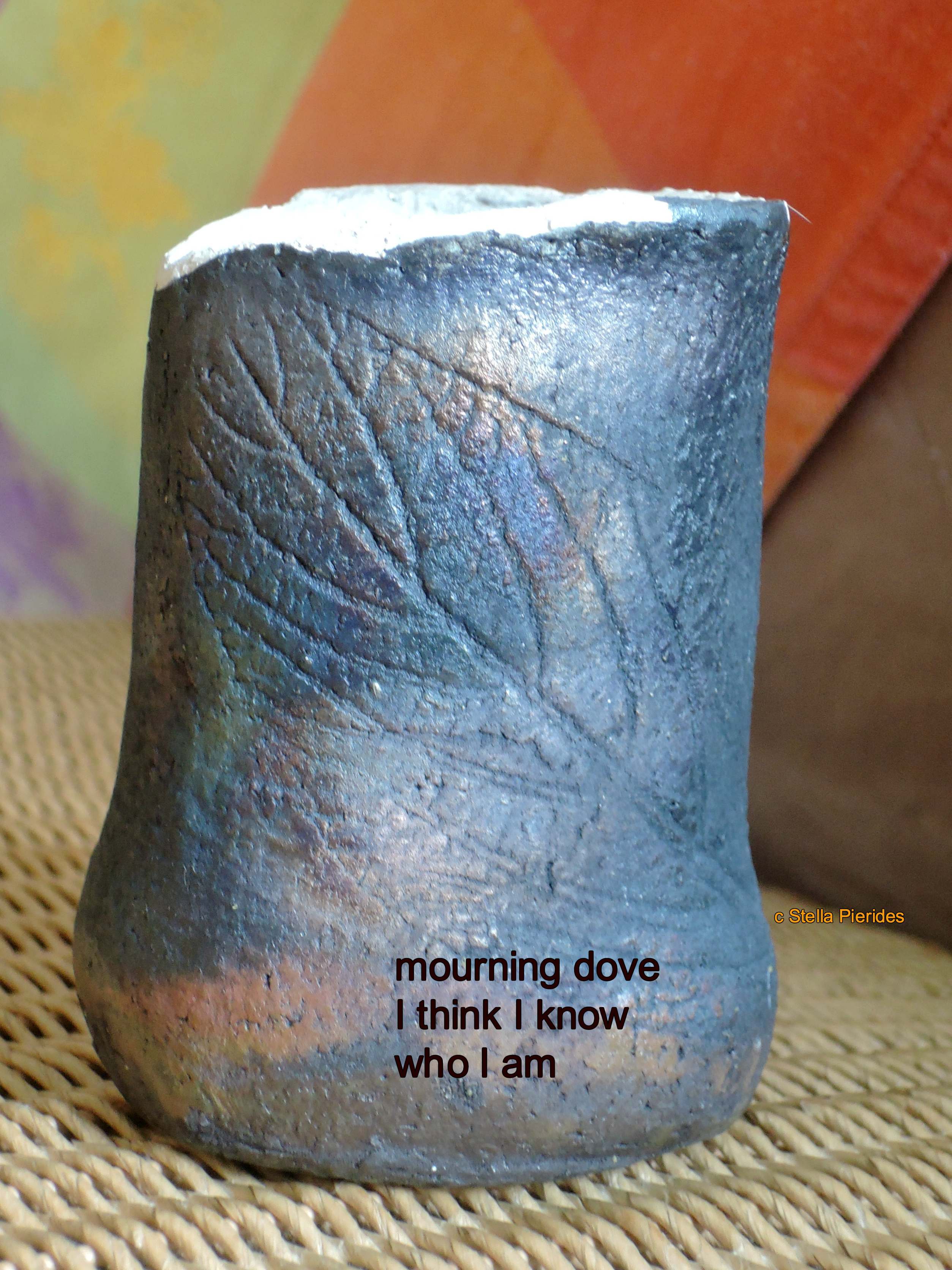
88/100 #The100DayProject #100daysnewthings
Every year, thousands of people try to enter Europe without permission. The last two years the numbers have increased. War, civil war, terrorism, famine, drought make their livelihoods untenable, their lives precarious. One of the major routes to the continent used to be via Evros, the river boundary between Greece and Turkey. Since 2012, however, when a fence was erected to block this entry point and after Frontex police increased their presence, new routes were followed: sea routes to Italy and Spain that are even more dangerous and deadly.
 The rickety boats these refugees use to come in often sink; the borders they try to cross get more hazardous than the journeys. The European countries they enter, ignore or criminalize them, and often send them to holding centers where they are subjected to demeaning, abusive situations, torture, or worse; or sent back to the countries they fled from. And yet, they keep coming.
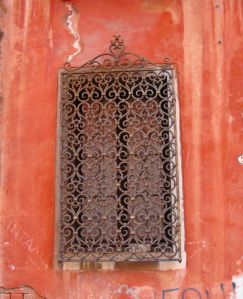
I saw some of those who made it. In Venice, Italy, without support, they bend down hiding their faces, and beg.
city of masks
the beggar hides
her face
.
They hide and live in fear, yet they find this preferable to staying in countries where torture or death awaits them. Unlike those chosen to enter in one of the rare legal, though miniscule, programs of some European countries, these people exist in dire and life-threatening circumstances.
promising the earth
lone star
.
This odyssey is acted out all over the world, sometimes by people seeking work to improve their situation in places where they would not normally be entitled to work; most often by people fleeing conflict and persecution. In the Mediterranean countries, the recent conflicts have multiplied the magnitude of this problem.
Lately, hundreds of people arrived in Lampedusa and the Italian shores:* alive or dead, they reached this other country where those who survived the journey would have at least the opportunity to fight for a chance of a better life. Wouldn’t you too, in their position?

Wouldn’t you? If chance or circumstance placed you in such a predicament? The European Union, though, would not look favorably on your efforts to enter its borders with need and despair as the only passport. For instance, while the talk of new urgent measures is all about increasing funding towards detection of people in flight, as well as (allegedly) improved rescue at sea,* there is also the urge to repatriate and keep the refugees in the place they come from. An out of sight out of mind approach. Except that the situation in their home countries is so desperate that repatriated people try crossing the sea again, and again.
.
.
promising sign?
clouds part
for hunter’s moon
.
A lot more is needed for the nations that make up Europe to acknowledge and accept the plight of the people affected by extreme poverty and poverty-driven wars, often the result of our aggressive policies, economic exploitation, and environmental abuse.
Out of this awareness, the Europeans themselves would be able to develop better policies than this drive to isolate, separate, and remove the perceived problem: a concerted European asylum seeker and immigration policy, grounded on the Universal Declaration of Human Rights (and the full United Nations Charter), with a budget and facilities for care and integration (rather than just border control) to back it up.
 The first models to help us think and plan are already here: A tiny Italian village opened its doors to migrants who braved the sea offering them jobs and homes, creating in the process jobs for the entire village. Even though there is no ideal solution, and new problems arise in new situations, the will, the means, the examples, the aspiration are already here.
……………………………………………………………………………………………
– This post is written for Blog Action Day, 2013 on 16 October 2013. Bloggers from different countries, languages, and interests will have a global conversation about Human Rights. I have published elsewhere a number of stories featuring refugees and their plight – including stories from refugees crossing the Aegean in 1922 – some of which are included in my short story collection: Feeding the Doves, Neusaess, Fruit Dove Press, 2013.
.
*Gazmend Kapplani, Albanian-born journalist, poet, and writer, in one of his FB posts suggests the least the EU could do would be to erect a Monument of the Unknown Refugee. Kapplani’s excellent book, A Short Border Handbook, relates the experiences of Albanian people crossing the border to Greece.
.
**Frontex, the European Agency for external border control, according to a statement of its site, “promotes, coordinates and develops European border management in line with the EU fundamental rights charter applying the concept of Integrated Border Management.” Unfortunately, what this comes down to is that the management of borders takes precedence over human rights.
Frontex has expanded the number of countries where it can send the people it ‘rescues’. “Nobody, however, is monitoring what exactly Frontex is doing in these countries of transit and origin with the goal of “stemming migration”. There is a serious risk of human rights simply being breached or refugees dying in places that are farther away from our attention.”
.
See also Spiegel online
.


