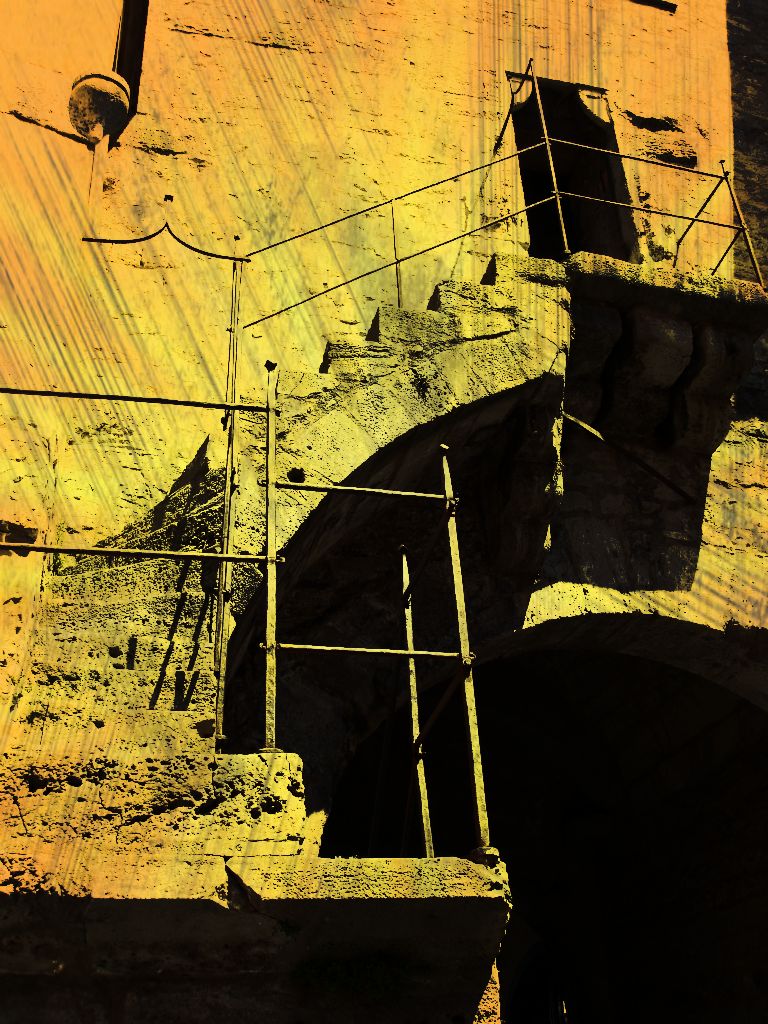
This is the image I created for my blog post “Blind Spots“, over at Haiku
Matters.
It is of a medieval Gate Tower in Rothenburg ob der Tauber, taken on the 18th of May 2013.
The post can be read by clicking here.

This is the image I created for my blog post “Blind Spots“, over at Haiku
Matters.
It is of a medieval Gate Tower in Rothenburg ob der Tauber, taken on the 18th of May 2013.
The post can be read by clicking here.
Romantische Strasse –
lowering the price
of diesel
.

NaHaiWriMo prompt: Romance/Risk
Photo: Rothenburg ob der Tauber, best preserved medieval city in southern Germany.
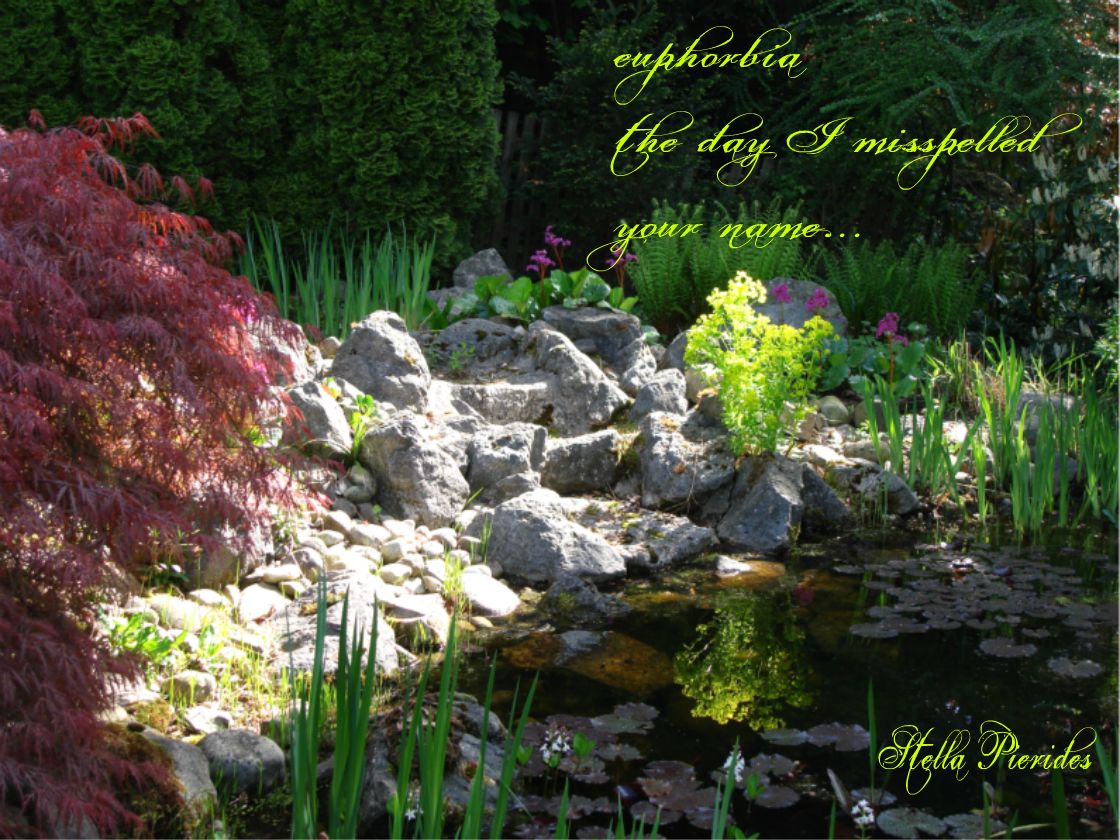
euphorbia
the day I misspelled
your name…
.
NaHaiWriMo prompt: pet

Map-making has been traced back to the earliest of times. Maps help us orient, know our location, what other places there are, how to get there, what landmarks to look out for, depict how places are interconnected. They also help us with perspective-taking: we can picture our place as seen from someone else’s viewpoint, and vice versa. Although maps often turned out to be distorted or inadequate – the ‘flat earth’, for instance – and were replaced by improved ones, they were always part of our shared search for certainty.
Think of the time when maps had to be redrawn to incorporate scientific rather than theological notions of the earth. Reluctantly, we realized we were no longer the unique children of God, at the top of creation, living on an earth at the center of the universe, but tiny dots drifting along in a vast cosmos. The invention of the telescope allowed us to look beyond our narrow confines, revealing our common and humble origin and place in the world. Isn’t there a semblance here to what the internet and social media are doing today: making us realize that, rather than being solipsistic, only children, we are members of a large family sharing similar talents, creative ideas, concerns, ambitions?
Our need for map-making also extends to reading, as well as writing, haiku. While, as readers, we bring along our personal, familial, local, ideological baggage and while we open our hearts as well, we also need a map for finding our bearings in the haiku world, for becoming aware of the various ways this poetic form appears in; to stay with the metaphor, for knowing the position of other ‘planets’ or ‘stellar systems’ and their orbits and gravitational pulls.
Here is an instance of cartography in the haiku universe. In his essay in Frogpond, “Haiku as a Rhetorical Art. Haiku Poetics: Objective, Subjective, Transactional and Literary Theories”, Randy Brooks, following the Aristotelian tradition, considers the relationship between the basic elements of communication in writing – which he lists as reality, writer, reader, and language – and expands on a number of writing theories: the objective, subjective, transactional, and literary. If you bear with me, I’ll try to summarize them in one paragraph (the brevity here does them injustice – I urge you to follow up the link for the full map). But before I do, I’d like to quote Brooks’ caveat:
“…there is no ‘one way’ to write haiku, no single haiku poetic or haiku tradition to guide the writing and reception of haiku as a literary art. There is no final list of ‘do’s and don’ts’ that will codify the art of reading and writing haiku… On the broader level of haiku as a literary genre, we should embrace the observation that there are several ways, a multitude of traditions, a variety of haiku poetic theories. ”
For the purposes of this post, I’d emphasize that there is no ‘one way’ to read, analyze, or enjoy haiku either. There are the various ‘continents’, ‘planets’ in various orbits on the maps, and once we are aware of them, we can keep our direction or change it, if we wish to, more easily.
According to Brooks, the objective way of writing haiku involves perceiving and reporting nature in plain, objective words that convey direct sensory perception to the reader. The reader ‘steps into’ the writer’s perspective and reads the poem as intended. The subjective way emphasizes the inner, subjective world of the writer, expecting from the reader the role of a fan being interested in and understanding of the writer’s intended meaning; being inspired also to explore her own subjective experience. In transactional haiku poetics, reality is constructed and shared along a common language continuum between writer and reader. The reader is a socially aware partner in the creation of meaning. In literary poetics, writer and reader understand they inhabit a fictional world and use liberally the tools of fiction and poetry. The reader remains seated in the haiku audience, judging the literary merits of the artifact. Brooks notes a further poetical category in which some poems fit, that of disjunction, where one of the key elements of communication are intentionally omitted. For instance, the writer may be a software program, producing poems in some cases without even recording them, entirely unconcerned as to the existence of a reader.
All approaches, the latter excepted, require a certain degree of position and attitude from the reader as well as the writer. It may be that the transactional approach is the one which gives the reader the most say, the most ‘power’ vis-à-vis the writer. Through the cut, the season word, the juxtaposition of images, the disjunction, the reader, responding to the tension(s) created by the writer, contributes to the meaning of the poem, using her own experience, imagination, associations, gut response… In such a scenario, the writer may think she wrote a good enough haiku, but a reader’s reading may make it an exceptional one! Unfortunately, the reverse may be the case, too.

Besides Brooks’ classification scheme, other haiku taxonomies have been developed. For instance, in his essay in Simply Haiku, “An Analysis of Haiku in 12-dimensional Space”, Charles Trumbull discusses a taxonomy of 12 independent dimensions, including: haiku ideology/aesthetics/poetics (Japanese vs. Western); haiku point of view (objective vs. subjective); haiku audience (to be shared vs. self-expression).
Basically, such taxonomies conceive of any haiku/poet as occupying a point in a multi-dimensional space or ‘cloud’ where the dimensions are fundamental, independent variables on which each particular haiku/poet is classified. The distribution of haiku matter in this cloud may be unequal, with sets of haiku/poets forming denser ‘galactic systems’ (FB Communities?) and with sparse matter in the inter-galactic space.
I have brought these two essays here for two reasons: first, to illustrate the importance of having a map – as a reader as well as a writer – to see where one is or where one is heading, especially if one reads poems from different traditions several times a day; and second, to remind us of the many varieties of haiku and of writers and readers.
Understanding the varieties of haiku traditions, experiences, forms, histories, and of our own assumptions only helps us be more open to them, navigate the haiku territories, and accept others’ as well as our own position in them. Also, the map-making may help us identify uncharted territories to be discovered and enjoyed in the haiku cosmos. Let’s boldly go… Or?
Let us know your take in this. How do you ‘read,’ place haiku, if at all? Your favorite maps, cool places to hang out?
*
Brooks, Randy: “Haiku as a Rhetorical Art. Haiku Poetics: Objective, Subjective, Transactional and Literary Theories” (Frogpond 34.2, 2011 on the HSA site),
Trumbull, Charles, “An Analysis of Haiku in 12-dimensional Space” in Simply Haiku: Journal of Haiku and Related Forms, September-October 2004, vol. 2, no. 5
Interested in the idea of the “haikuverse”? See Melissa Allen’s series “Across the Haikuverse” in her blog, Red Dragonfly. Here is just one of the series
*
More information about the Peutinger map here:
A copy of this map is displayed in the Augsburg Roman Museum, where about a year ago, I spent an interesting afternoon, tracing roads and countries on it (the Museum is currently closed for repairs).
deep shade
the teeth behind
her coy smile
.
NaHaiWriMo prompt: mannerisms
1
Mother’s Day
the missing iris
from her earring
2
lost the look in her eyes
.
NaHaiWriMo prompt: lost
.

Randy Brooks in his essay “Genesis of Haiku: Where do Haiku Come From?” quotes Makoto Ueda explaining in Modern Japanese Haiku,
“Any poem demands a measure of active participation on the part of the reader, but this is especially true of haiku. With only slight exaggeration it might be said that the haiku poet completes only one half of his poem, leaving the other half to be supplied in the reader’s imagination.”
Half of the poem! This places a huge responsibility on readers’ shoulders. It not only invites us to look more closely into the relationship between the writer and the reader – Brooks addresses this issue in this and other papers; it helps us understand some of the sensitivity haiku writers display towards their readers and reviewers; and raises the mark of how we use our haiku ‘receptors’ to read haiku.
Journal editors have their own personal, professional, and journal-specific list of criteria for “reading” haiku. Seasoned readers too, as Rick’s and Tom’s comments on the last blog post illustrate. But as ‘lay’ readers, this side of the divide, so to speak, what do we use to understand and connect with a haiku? In addition to the individual, general and universally shared perspectives (mentioned in post 1) which help us ‘read’ haiku, might there be an additional tool available to us?
Arguably, any individual perspective the reader – lay or seasoned – might take has a dual, though intrinsically linked aspect: one relating to the mind and one to the heart. Concerning the latter, the question above might be posed differently: do we ‘walk’ with an open heart (rather than mind), open to be touched by the sensitivity or strength of a poem, or do we carry a shield, only allowing certain aspects of the poem in, and not others? For instance, even when appreciating a poem ‘intellectually’, are we allowing its essence, its excellence to touch us? Might the ‘heart’ be our most basic tool?
Michael Dylan Welch reflects on this matter in his essay “Seeing Into the Heart: Vulnerability in Haiku”. Welch understands Bashō, who told haiku poets to learn of the pine from the pine, and of the bamboo from the bamboo, as telling us to be vulnerable to the subjects of our haiku, and
“to humble ourselves so that we might learn something, and speak of it authentically. The full teacup cannot receive more tea, so we must empty ourselves, and become vulnerable, in order to receive.”
I like this: a reader’s open heart responding to the writer’s. Humbling ourselves as readers, recognizing, that is, our limitations, our preferences, perspectives, ideologies, so as to be open to others’ difference.
Here’s how Welch puts it,
“When we click with a poem, it’s because we have let down our guard, allowing our emotions to be affected, feeling what the poet felt. The poet has dared to hint at what he or she has felt, and thus lights a candle, proudly yet vulnerably, against the imminent dark.”
Not an easy task, for both writer and reader, as opening the heart is often experienced as tantamount to undergoing open heart surgery. Yet, once accomplished, may we not deservedly lay claim as readers to our fifty per cent/half of the creation of the poem?
Thinking about it now, I am reminded that several of Henry Moore’s sculptures have a hole in the area of the heart. One can only muse at the openings this allows – and we will come back to this hole later on in the month. For now, the thought: it may well be the case that one needs to have a hole in the heart in order to be — as a reader too — whole.
.
Brooks, Randy: “Genesis of Haiku: Where do Haiku Come From?” in Frogpond 34.1 2011
Welch, Michael Dylan: “Seeing Into the Heart: Vulnerability in Haiku” in Graceguts, Essays
(From the writer’s perspective) You may also be interested in:
Cox, Aubrie: ” Writing With the Reader as Co-Creator” in mind, in Aubrie Cox
*
This essay first appeared in Haiku Matters (07 May 2013)
rain jacket
pots at the clay fest
collecting water
.
NaHaiWriMo prompt: jacket
A photo from today’s Pottery market at Diessen am Ammersee, Bavaria (10 May 2013)

For more information about this annual pottery market please click here
.
.
weak sun
sky the colour of water
.
NaHaiWriMo prompt: ignoring
homemade jam —
taste of redcurrants
holding the sun
.
NaHaiWriMo prompt: Home
hot day –
on the train only the dog
meets my eye
.
In the new Moongarlic E-zine
edited by Sheila Windsor and Brendan Slater, issue 0, May 2013, p. 15
.
(First credit: In the Garden of Absence, Fruit Dove Press, 2012, p.16)
gold rush
on a warm day
each blade of grass
.
golden hair
the newsreader’s answer
to austerity
.
NaHaiWriMo prompt: gold
Picking Haiku
When reading haiku, what is it that attracts you as a reader? What makes you click with one poem and leaves you indifferent towards another? Which qualities speak to you?
Might one draw a parallel between ‘picking’ haiku and beachcombing? Let’s take as an example Henry Moore, the English sculptor (1898-1986). Moore, famous for his monumental semi-abstract sculptures dotted in the landscape all around the world, was inspired by nature. During his walks, he collected stones, shells, driftwood, animal bones, rocks, that he brought back to his studio and kept for inspiration. Some of these ‘found’ objects were singled out as art objects by his artist’s eye, and transformed into works of art. Others became favorite objects to go back to with new questions, kept for inspiration. Like a super-spectator, super-audience or super-reader, he saw the value(s) residing in the shapes, form of sticks, rocks, and stones, picked them up and brought them in from the cold world into his art studio.
In a sense, as writers, we have something in common with Moore and his walks. Through the day, we gather experiences, pick up some in words, discard or ignore others. As readers too, we collect from our walks round the social medialand, from our reading journals and books, from our discussing topics, poetic thoughts or experiences, from the walks in nature and through the cityscapes surrounding us.
From another perspective, appreciating haiku as a crafted, rather than a natural, object may be more akin to appreciating paintings or sculptures on a gallery visit. Works of art hang on gallery walls, are placed in gallery rooms – like haiku sit on the pages of journals and books – for us to observe and mull over; we stand in front of them, around them for a short while, then move on and walk through the rooms – pages – quickly, too quickly often.
Henry Moore’s huge sculptures standing tall or reclining in the landscape demand our attention; whether we see perfection in them or the unruly shapes of our innermost selves, something in them appeals to us as viewers. And while we cannot pick them up physically, they come home with us. So it is with haiku, I believe. Which one speaks to us, creates a reaction in us, which one we pick to remember, to give it a home in our hearts, depends on many factors.
Something in it, in its shape, depth, sensory and sensual appeal resonates with us. There is a personal, familial, local, national, global, colonial, post-colonial, feminist, literary, yet to be named perspective(s) each of us carries, treasures, contributes to and responds with to the world. Often more than one. Hopefully more than one. Naturally, we all differ in our perspectives, ideologies, in our poems, in our choices of haiku.
But there are common, global elements too; essences, values, basics we share as humans that hold together a haiku and bring it to our reader’s eyes fresh from beyond culture, history, limiting perspectives and allegiances. And with our global, in addition to our local, receptors – much like the single neurons and neuronal assemblies we all harbor in the perceptual parts of our brains, each tuned to picking single elements or whole configurations – we are able to pick and enjoy those poems too. Jim Kacian, in his essay “Tapping the Common Well” in Bones: journal for contemporary haiku, while considering what it is about the haiku poem’s universality, points out this extra or underlying dimension:
“It is universal, because what it seeks is not the relative truths of nationalities or religions, but the universal truths between people: that which can be shared, recognized, valued around the world. This does not mean rain and sun mean the same thing to all people: certainly desert-dwellers have very different emotions about such things than those who live in a rain forest… There are always points of view. But haiku express values beyond these regional and economic differences, revealing the truth of things as they are, which is more at the core of how we feel most deeply as people. Haiku finds that which is not superfluous in the hearts of men, and expresses the values found there, as deep as that may go.”
And so in our lives as readers, as well as writers, armed or rather blessed with a variety of sensory and psychological receptors – some uniquely personal, others shared by the whole species – we pick poems that offer us the chance to recognize, come to terms with, or celebrate one moment from the river of our experience, one splinter from the tree of our lives; to reconnect with our humanity and to nourish our being.
So which haiku ‘receptors’ do you use? How do you like your haiku? Let us know here. It would be good to hear your take on this.
.
Kacian, Jim: Tapping the Common Well, in Bones: journal for contemporary haiku, Issue 1, December 15, 2012.
.
This essay was first posted here
.
garden life –
a snail shell floats
in the birdbath
.
NaHaiWriMo prompt: den
curved coastline –
grains of sand taste
of salt
.
Inspired by the NaHaiWriMo prompt: salt, set by Alan Summers of Area 17
The THF Per Diem: Daily Haiku poem by Deborah P Kolodji, on the 3rd of May 2013
and Gabi Greve’s World Kigo Database (WKD) entry on salt

I was delighted to be invited by Colin Steward Jones to guest-blog for the Scotland based Gean Tree Press. Since its inception, its blog, Haiku Matters! has been a hotbed of intellectual storm, liberal thinking, and wisdom… all about haiku.
I posted my first, introductory guest blog post on Haiku Matters! today! More to come soon, as I’ll be blogging for the whole month of May. On the menu: a walk or two, a bit of reading, playing with a couple of wild and not so wild ideas, reaching out to and from other genres, while touching on issues relating to the reader all along. Our reader, ourselves as readers, other poets’ readers.
If you have the time, do visit, take a look, and share your own point of view…
(Picture: Creative Commons)
tracing
my own rough edges –
wildflowers
.
NaHaiWriMo prompt: asperity
alone
with each other
full fish moon and i
.
full fish moon –
floating thoughts of returning
to my roots
.
My entries to the April 2013 Moon Viewing Party
haiku bandit society
feeding the chickens
a headscarf flies off
into the road
.
NaHaiWriMo prompt: farm animals
secret spring
a wild iris bends towards
the light
.
NaHaiWriMo prompt: symbol
aerial roots
the light touch
of your words
.
NaHaiWriMo prompt: roots
luminous garden
why then is the full fish moon
wrapped in cloud?
.
NaHaiWriMo prompt: garden
velvety feel
of the charcoal drawing –
butterfly wings
.
NaHaiWriMo prompt: visual arts
.
hourglass the hole in my pocket
.
NaHaiWriMo prompt: time
storks’ nest
the chimney sweep
holds his breath
.
Kernelsonline, Premier edition, Spring 2013

l
Earth Day
the leaf mold worm
coiling up
.
NaHaiWriMo prompt: wheel (and Earth Day)
granny’s headscarf
scent of lavender
in the fold lines
.
NaHaiWriMo prompt: clothing
Horsehead Nebula –
music of the spheres echoes
through the lyre
.
NaHaiWriMo prompt: music
For Horsehead Nebula see here
.
broken street lights
a mobile phone rings
and rings
.
NaHaiWriMo prompt: dark
oiling shears –
the gardener’s
creaky knees
.
NaHaiWriMo prompt: antique (old)
