.
ivy clinging to the tree trunk her long nails
.
Modern Haiku, 44:1, 2013, p. 109

.
ivy clinging to the tree trunk her long nails
.
Modern Haiku, 44:1, 2013, p. 109
longest day
the storm tips
the balance
.
NaHaiWriMo prompt: fragment

.
From the storm in Neusaess, Germany
I am taking part in the flash story event, FLASH MOB 2013, celebrating International Flash fiction Day. A sort of literary carnival and international competition in one, with over a hundred writers of flash from around the world taking part by posting short stories in their blogs.
 If you love flash fiction, then this is the best place to browse for stories – and if you don’t know anything about flash, this is the place to start! Click here
My own story is in the European writers section here
summer solstice –
a minute longer
in the tree pose
.
NaHaiWriMo prompt: Balance
picture and frame
barefoot on the last bus
home
.

.
NaHaiWriMo prompt: matching
Photo and image manipulation: Stella Pierides
.
catching the sun daylilies

NaHaiWriMo prompt: pairs dance
.
Photo: Whitstable harbour, Kent, UK.
Photo and image manipulation: Stella Pierides
spinning barefoot –
yarn after yarn the fabric
of my tales
.
NaHaiWriMo prompt: spin
‘
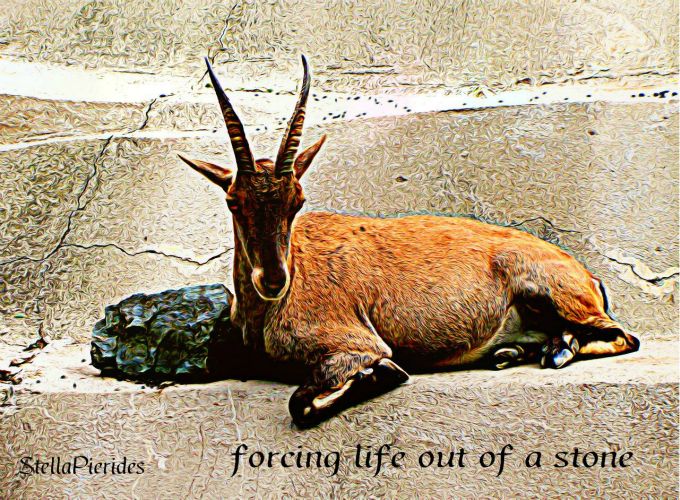
forcing life out of a stone
.
.
NaHaiWriMo prompt: zoo animal moment
Photo and image manipulation: Stella Pierides
spit polishing
her scuffed shoes—
war child
.
Haiku News, Vol. 2 No. 17: Karma Tenzing Wangchuck, Stella Pierdes, Michael Henry Lee
May 13th, 2013
.
First appeared on NaHaiWriMo
screeching tyres
the red camellias
in her front garden
.
Blithe Spirit, vol 23:2
pond fountain
the solar cell gets
little sun
.
NaHaiWriMo prompt: Fountain
poems in waiting
the years I lost for fear
of chrysanthemums
.
9 May 2013 Issa’s Untidy Hut
poacher’s moon
a crocus knows how
to wait
.
Haiku News Vol. 2 No. 20: Sandip Sital Chauhan & Stella Pierides
spring tides
the doctor keeps wiping
his nose
.
A Hundred Gourds 2:3 June 2013
Home Truths
“Spoon sweets are the best. Have you ever had spoon sweets?” She looks at her customer with such intensity from behind the counter that I am surprised to hear the woman find the strength to answer.
“Pardon, spoon sweets?” she replies in her phrasebook Greek.
The shop owner reaches for a jar from a bulging shelf – the cherries preserved in syrup clearly visible.
“Here, this is it; this is a cherry spoon sweet. Here, present for you,” she says, sliding the jar across the counter.
The woman receives it with both hands and a big smile.
I try to decipher the patisserie owner’s expression. She is not smiling, her face pulled into what I read as contempt. I could be wrong, of course. So many years away from this country, I can no longer claim insider knowledge. Still, witnessing the scene the day after my return home, I shudder from shame and envy, in equal measure. The directness of the shop owner embarrasses me; she shows the worst of herself to a stranger: the impetuousness, the loud, gestural arrogance that goes with this kind of self-assurance. I blush on her behalf. At the same time, I envy her unselfconscious manner of being. She’ll never know how she comes across, while I am forever stepping back for fear of appearing wrong, or appearing confident about the wrong things. Something inside me snaps,
“I hate spoon sweets!” I say, “hate them!” Both women turn, their eyes wide.
“Mind your business, Kyria,” the proprietor says. “I’ll be with you in a minute.”
I know she will. But I have made up my mind, and turning swiftly, I walk out. In my head, the lines of a haiku appear:
……………………………spoon sweets / tangy taste of a song / long forgotten
Mosel vineyards
at the end of the steep climb
raising a glass
.
MaHaiWriMo prompt: climb
deluge the remains of dignity
.
Shiki Kukai, May 2013 Kigo entry: 3 pts
.
clothesline
the Persian rug in a cloud
of dust
.
Shiki Kukai, May 2013 Free Format entry: 5 pts
beyond a shadow of a doubt
white geranium
.
NaHaiWriMo prompt: shadows
stepping stones
this time round the river
is wetter

NaHaiWriMo prompt: footsteps
Photo: The Schmutter, near Neusaess, DE.
Photo and image: Stella Pierides
.
gliding through channels
in the Garden of Eden
Marbled Ducks
.
NaHaiWriMo prompt: reeds
Related news article here
dawn chorus /
learning to remain /
silent //

.
.
NaHaiWriMo prompt: wake
.
grandad’s hat telling it as it is
.

Rembrandt’s gaze
the hush in the visiting
school class
.
NaHaiWriMo prompt: Art
Uncanny Attractions
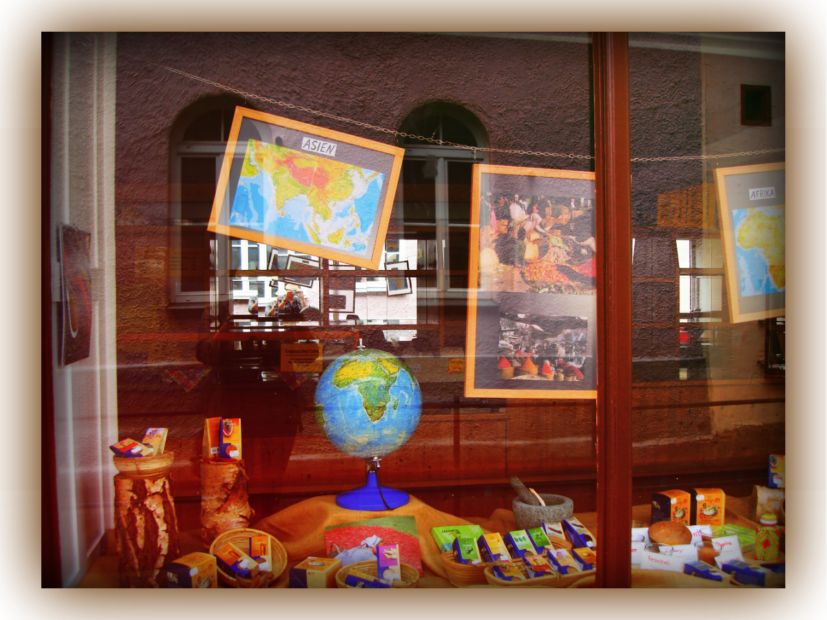
I’ve always been fascinated by the concept of the Uncanny. Freud, the writer often associated with this concept, described the following uncanny experience when he came face to face with his own double. While travelling by train, Freud saw an elderly gentleman enter his sleeping compartment by mistake. Jumping up to let him know of his error, Freud realized it was his own image reflected in the mirror on the connecting door. He had found the appearance of what he thought was another man ‘thoroughly unpleasant.’ Without being frightened, he failed to recognise his ‘double.’ Or was the displeasure he felt, Freud wondered in the last note of his last chapter on “The Uncanny,” “perhaps a vestige of the archaic reaction to the ‘double’ as something uncanny?” He leaves us with a question, perhaps an encouragement to take this further ourselves.
Freud was not the first of course to link the concept of the ‘double’ with mirroring, the image in the mirror as well as the ‘other.’ Ever since Plato conceived of material reality as a poor representation of the true Forms, others have found man’s double in several contexts. In literature, for instance, Mary Shelley made the monster his creator’s ‘double’ and leaving him unnamed, led subsequent generations of readers to refer to him with the name of his creator: “Frankenstein.” Conrad, too, wrote the ‘double’ in his stories (e.g., in “The Secret Sharer”).
So what has this ‘uncanny’ and ‘double’ to do with haiku, and my theme of reader-oriented matters? If you read my previous posts, you may have noticed I like playing with ideas; though more thought games than thought experiments.
Let me throw this thought in the pot: Isn’t there in haiku a situation in which, when you come to the poem, you become slightly disoriented by the presentation of the two separate, juxtaposed ideas? (Remember the field of energy, in the previous post?) I think there is. The ‘cut’ and the pause in the juxtaposition of two ideas/images are device(s) which open up the extra perspective(s), depth, for the reader; they also create a sense of strangeness, a momentary, uncanny disorientation… until there is the spark of realization that transforms what was strange and uncanny into familiar and understood. Once resolved, the two initially puzzling parts of the poem appear to us the way Freud, relating that vignette, stood in front of his earlier self and its reflection; the way we stand in front of a Moore, a Hepworth, a Lucian Freud, or the narrator in Conrad’s novel and his secret sharer.
Are you with me? What do you make of the thought that the moment of insight or realization is preceded by the uncanny? That the uncanny in haiku involves being confronted by the juxtaposition of two on the surface unrelated – but on a deeper level related – ideas within a limited space? That the haiku moment does itself involve overcoming this sensation of the uncanny?
Finally, before I go, and in case you are interested, I’d like to mention a couple of places, amongst others, I like to visit for reading poetry, essays, information, learning, fun (in addition to “Haiku Matters“, haiku journals and the homepages of haiku societies!). Do let me know your favorites.
The The Haiku Foundation’s homepage and blog “Troutswirl.” On the same site, among many brilliant features, the THF “Haiku Registry,” the place to get a flavor of the work of haiku poets writing in various forms, from all over the world; the “Montage Archive,” the “Book of the Week,” the “Per Diem: Daily Haiku” panel, and “Per Diem Archive,” are my favorites (esp. since I help out with Per Diem!).
Also, World Kigo Database (whether you appreciate kigo or not), Graceguts, Issa’s Untidy Hut (esp. Small Press Friday and Wednesday Haiku), Shiki Kukai Temporary Archives, are full of essays, criticism, food for thought, poetry, poetry and poetry.
On this note, hopefully leaving you with more questions than answers, having raised smiles as well as eyebrows, I’d like to say a big thank you to Colin Stewart Jones, and goodbye to folks who found their way here, from both the writer and reader in me.
*
The Wikipedia on the Uncanny here
Sigmund Freud, ‘The Uncanny’ in The Uncanny, ed. by Adam Phillips (London: Penguin Classics, 2003) p. 121-161.
Conrad, Joseph, The Secret Sharer can be read here
.
Photo and image manipulation: Stella Pierides
fireflies
the stars in the embers
.
starry night
in awe of the seas
.
NaHaiWriMo prompt: name
.
the false modesty of sunflowers
.
NaHaiWriMo prompt: yellow
Barbara Hepworth, sculptor, created her first pierced form in 1931, the year she gave birth to her child.
Jeanette Winterson, appraising Hepworth’s creation in her essay “The Hole of Life,” sees this as a breakthrough not only in art, but also in the understanding of human existence. Pointing to the advances in science – in which, far from a universe of oppositions (like mind and matter, space and form), Einstein, Planck, and others conceived of a universe in constant play, forever involved in creative tension – Winterson shows Hepworth’s sculpture to be a timely response to them.
“The atom itself, the supposed building-block of matter, was no longer an object, but an energy – points of light surrounded by empty space.”
and:
“If the scientists were right, and space is as much a part of form as mass, then it is the space we need to see – but how? Hepworth made an astonishing discovery the day she pierced one of her sculptures. She allowed us to see nothing – a privilege previously enjoyed only by God.”
Nothing and everything! Winterson understands Hepworth to have mirrored the new developments in theorizing about the cosmos in her hole forms as the (w)hole of life, expanding space to include the invisible, and connecting to both time (in terms of the past) and timelessness in her sculptures
Henry Moore, who had studied art at the same time as Hepworth, grappled with spatial form and in his attempts to give it an extra perspective, cut holes through his sculptures soon after her. Of the various interpretations this act has received, I prefer the one which conceives of it as offering a 3-D perspective (literally and metaphorically) to the viewer.
What if we were to play with Winterson’s take on the holes in Hepworth’s sculptures, along with Moore’s contribution, and relate them to ‘the cut’ in haiku? What if we ‘saw’ the space between the two juxtaposed ideas, between the two parts (not only the pause created by the punctuation) as being more than an empty hole to be filled-in, or a gap to be crossed, but as an energy field being fueled by and fueling meaning? We wouldn’t be the first of course*, but the thought experiment is exciting… Do you resonate with this idea?
And, even though I am oversimplifying, isn’t there a paradox here: cutting away in order to create extra depth (which is where Hepworth and Moore come in)?

One might see a similar paradox in the writings of Winnicott, the English pediatrician and psychoanalyst. For instance, in “The Capacity to be Alone,” he argues that one achieves creative aloneness if, as a child, one had the experience of being in the presence of a watchful, but non-intrusive parent. The capacity for attachment is required before one can deal with loss; the capacity to foresee and accept loss, before love can be truly there, and so on. – I see the opening or cutting away in order to increase the perceived depth and space to be similar to this approach.
Interestingly, there is another paradox giving rise to a ‘hole,’ if we look at the opposite case scenario – where it seems that everything is being said, without any ‘holes.’ Lucian Freud, the painter, painted men and women in their naked, real, and true form. He studied his sitters over months or years, revealing in the portrait the person they happened to be (as he saw them) through paying particular attention to their skin.
In a perceptive essay, Dodds,** points out:
“there is an evocation of abjection, of the corporeal mother who must be symbolically expelled in order for the subject to come into being. And yet rather than staging a ‘rite of defilement’, there is a fascination, we are drawn in. The ‘glare’ of the portraits refers both to the external sources of light reflected on bodily surfaces, and also glare as in look, the stare… We are caught in the gaze of bodies. After first looking away… there is a return, to the folds, the textures, the touch and smell, the loving portrait of every bump of skin, to a fascination with Freud’s cartography of flesh.”
Even when everything is said and done, the people portrayed by Lucian Freud are there and not there. The person is present and absent at the same time: present in their corporeality, yet – like a psychoanalysis which is never finished – their portrait does not say it all. What it says is what has been rejected by social and cultural values, yet by saying so, by bringing in the abject, it rejects socio-cultural values, thus creating a ‘hole.’ The viewer has work to do.
The haiku reader too. From the monumental portrait to the miniscule text: it is not the physical size or amount of detail that matter when it comes to the energy available and the meaning(s) generated – especially through the cut – in haiku. In the haiku moment that the opening of the ‘hole’ creates, a space is entered that is a whole world.
…
An essay by Jeanette Winterson on Barbara Hepworth and her response to the concept of ‘hole’, originally published in Tate Magazine, can be found here
*For the cut: “like a spark plug that enables a spark to leap the gap” by Michael Dylan Welch in his essay “Haiku . . . Under the Bedsheets: Juxtaposition and Seasonal Reference” in Graceguts
For “The Capacity to be Alone,” an entry point might be here. The paper itself, can be found here
If you are interested in the angle of Lucian Freud and the ‘abject’ you can find a short essay here, together with paintings!
** Based on a paper read to the Czech Psychoanalysis Society on 28 May 2011, “Confronting the Abject: Reflections on Rotraut De Clerck’s (2011) ‘How deep is the skin? Surface and Depth in Lucian Freud´s Female Nudes’” (Dodds 2011b).
On the wider issues relating to space in haiku: “Haiku and its Relationship to Space” by Tracy Koretsky, in the homepage of the New Zealand Poetry Society here
.
Posted in Haiku Matters, the blog of Gean Tree Press
This post is about blind spots, shadows, and the darkness in our minds as readers (and writers). It appeared on Haiku Matters, the blog of Gean Tree Press, and can be read here
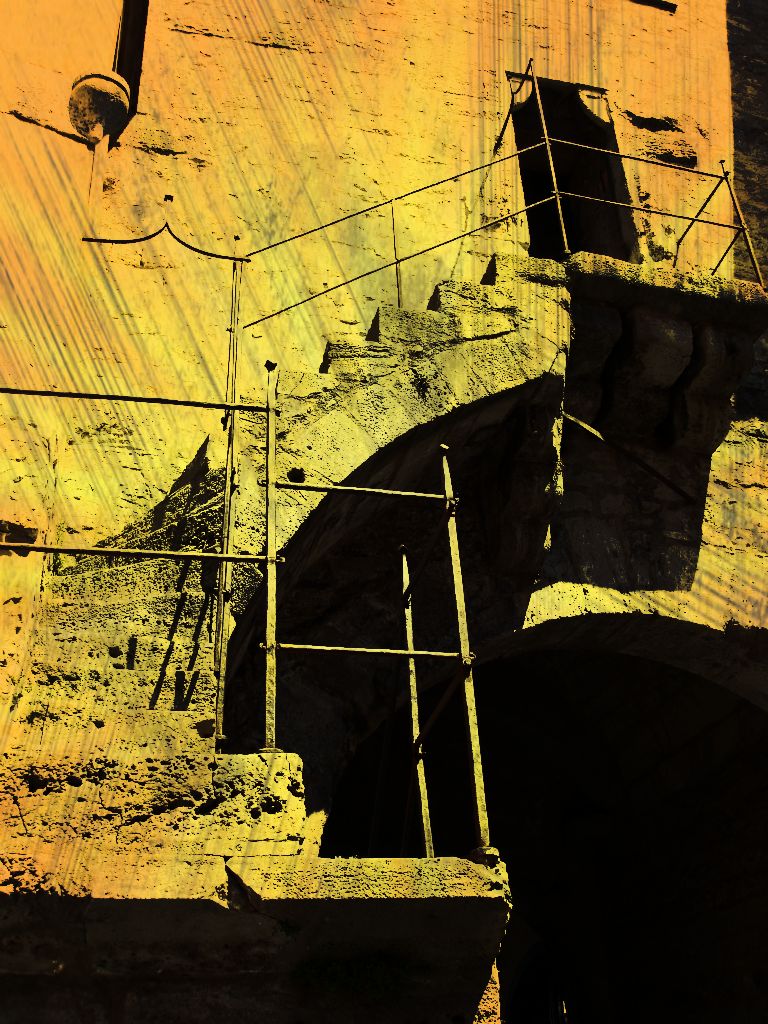
There are corners and alleys in texts into which we, as readers, may be sidetracked, trapped, and lose our way. The best illustration of this affliction I came across is from another genre, Conrad’s novel “Heart of Darkness” – which I very much like – and Achebe’s criticism of it. I will assume that you have either read this novel or a synopsis of it.
There had been huge praise for this novel over the years. Critics had written about aspects of imperialism, hair, clothes, rivers, language in it – yet, one aspect had gone unnoticed in so many readers’ and critics’ reading. I hadn’t noticed it myself either. Achebe, in his reading of the novel, saw a text underpinned by racism, and pointed to a need in Western psychology
“to set up Africa as a foil in Europe, a place of negations at once remote and vaguely familiar in comparison with which Europe’s own state of spiritual grace will be manifest”
The novel presented Africa as ‘the other world’, a chaotic, corrupting continent, sharing with the West only ancient roots of kinship which were, however, long ago overcome. Such an image of Africa, Achebe pointed out, satisfied a psychological need to get rid of, to disavow what had been repressed and disowned; and it was a dangerous image to be challenged. Instead, it had to be reinforced. Achebe’s criticism – that Conrad’s masterpiece, attempting to examine the European psyche, compromised African humanity by this juxtaposition – illustrates a defamiliarization process, in which the familiar common humanity is denied and the ‘other’ is created.
While at first, years ago, I felt shocked by Achebe’s reading of Heart of Darkness (was Achebe being oversensitive, misreading Conrad’s intention of exposing undercurrents in Western culture?), I came to agree with it; it opened my eyes to the blind spots a whole community of writers and readers, every one of us, may be prone to. Achebe, in his interview in Paris Review, “The Art of Fiction” is quoted saying:
“… all these people who see nothing about racism in Heart of Darkness, I’m convinced that we must really be living in different worlds. … Until these two worlds come together we will have a lot of trouble.”
How could such a massive failure to ‘see’ happen? Had readers, before Achebe, been reading ‘passively,’ submitting themselves to Conrad’s words without thinking, or approaching the text indeed from another world? In such a scenario, Achebe was best placed to see, and bring to our attention, the other side.
Returning to the haiku world and its readers: this is not to imply that some haiku readers, or writers, suffer from a particularly dark streak/from prejudiced thinking, but to illustrate how we are all prone to oversights, blind spots, are subject(s) to our cultural, historical, national environments’ influences. How, like Conrad’s earlier readers, we may be led to overlook, or overreact to, certain aspects in others’ and our own work. Achebe again, when asked what pointed him in the direction of writing:
“There is that great proverb – that until the lions have their own historians, the history of the hunt will always glorify the hunter… Once I realized that, I had to be a writer.”
Novels and haiku, perhaps the longest and shortest forms, also belong to different worlds, yet I tend to think we benefit from looking at the history and critical readings of both. It may spark insights, awareness of something we might have been missing. Wouldn’t it be useful to bear the possibility of blind spots in mind when we are differentiating between the various haiku traditions, when we are thinking about the content of haiku poetry? When reflecting on the issue of our identity(ies) as readers and poets? When we ponder, or pen, poems about illness, aging, the young, minorities, disadvantaged groups? When, in other words, we are faced with the ‘other’?
Achebe is widely said to have brought to our awareness the African perspective. Might we say that by doing so, Achebe, like Freud, Jung and others, made it possible to accept that our minds, even when open, even when filled with kindness, generosity, benevolence, and respect, at the same time contain blind spots and darkness?
.
Conrad, Joseph “Heart of Darkness” see Wikipedia for some of the history of the perceptions/reader appreciation of this novel.
.
Achebe, Chinua, “An Image of Africa”, The Massachusetts Review, 18 (Winter 1977), 782-794
.
Achebe, Chinua, interview in Paris Review, “The Art of Fiction”
.
Interested in following this issue in poetry in general? See Poets.org, “Open Letter: A Dialogue on Race and Poetry”, by Claudia Rankine (with Tony Hoagland’s response)
.
And something that caught my eye during my internet travels: If something isn’t there in our field of vision: “what isn’t, what can’t be” from a poem “Blind Spot” by Beth Thomas.
.
Image: Stella Pierides
out of uniform –
on the bus home the nurse
rolls a cigarette
.
NaHaiWriMo prompt: uniform
siesta
emptiness in the heart
of the forest
.
NaHaiWriMo prompt: trees
