poem–
the old soup bowl
filled with cream
.

poem–
the old soup bowl
filled with cream
.
The first edition of the Language/Place blog carnival is out. Why not visit here.
I quote from “virtualnotes,” where this particular blog carnival originated:
“The idea of “> Language > Place” is to create a collaborate virtual journey through different places, in different formats, and with different languages included – the main language is english, yet the idea is that every post also includes snippets or terms of other languages, and refers to a specific place, country, region or city.”
For more information and how to join this monthly event, here
Oh, yes, and I took part too!
15 November 2010
I just watched a short youtube video trailer of a fantastic video poetry project, City Breath, bringing the poetry and art of South African cities to life! The link to this trailer is here
.
I was sent the following information about the City Breath project:
.
“Through their common city theme, these short video ‘gasps’ or ‘breaths’ of South African cities give voice to the private dreams and nightmares of local poets, dancers, performance artists and filmmakers. They interrogate, with or against rational logic, the way South Africans understand their cities and urban life. Rebellious in their nature, under 4 minutes each, the films represent a genre seldom seen in South African film and television.
“Inspiring, sometimes beautiful, sometimes challenging, and over-all very impressive.” (Trevor Steele-Taylor, Director of the National Arts Festival Film Programme)
The City Breath video poetry project was shown in several cities round the world – Johannesburg being the most recent, after Berlin, London, Cape Town, and Vancouver. Curator Kai Lossgott is looking for more venues and festivals around the world interested in showing the project. She can be contacted directly at info@kailossgott.com
Apart from selecting existing works, the CITY BREATH project has initiated and developed new collaborations in the areas of the video poem, screen dance and experimental film.”
For more information and a fab blog see http://www.citybreathproject.blogspot.com
I was impressed and inspired!
I happen to know the work of one of the poets quite well: the immensely talented Tanya van Schalkwyk’s work, fusing imagination with sensitive observation and dynamic expression.
But watching the trailer (a few times!) made me want to see the whole thing!
Tania’s contribution to the video project is her poem “The Electrician” included in her book Hyphen. It can be seen here
Three of my poems have now been published by Vox Humana Literary Journal, “a literary journal focused on international writing, with a sub-focus on works from Israel and Palestine”
Winter Picture started its life at the North London writers’ workshop Word for Word, after a writer circulated photographs she had taken of a snow sculpture: two human-like figures made of snow on a Hampstead Heath bench. In my poem, the sculpture became a war-torn couple… read it and see.
Mystery Train was inspired by a photograph used as a writing prompt in the Tuesday poetry group of Word for Word. The photograph was of Elvis, on a train platform at the beginning of his career in the 1950s… so soon after the War…
The refugee grew out of a scene in my novel “Alexandrias 40: In the Shade of the Lemon Tree.” A refugee from Smyrni lies in her hospital bed in Athens, unable to join the other patients; she is forever caught in her own private despair.
Check out this link. And feel free to comment!
5 October 2010

The Festival of the Trees is “a periodical collection of links to blog posts and other online sites, hosted each month on a different blog.” Bloggers, poets, writers with an interest in arboreal matters post related material on their own blogs and submit the links to the host of each month’s co-coordinator. This month’s host was Arati, of the Bangalore-based blog Trees, Plants and More.
My own contribution to this month’s Festival of the Trees, I wrote some time ago. In “If Trees, then Olive Trees,” I use the olive tree, a precious, almost sacred tree in the Mediterranean, western Asia, and northern Africa countries; a symbol of peace and hope, connecting to the “olive branch,” and the sighting of land after the biblical flood.
Short, gnarled and twisted, the olive tree even looks appropriately old. It is said to live for hundreds of years, as its roots are capable of regeneration even if the trunk above ground is destroyed. Radiocarbon dating has confirmed 2000 year old trees in several countries! A tree known to be situated in the grounds of Plato’s Academy, in Athens, lived till the 1970s. An olive believed to have been planted by Peisistratus, the tyrant of Athens in the 6th century BC, is still to be found in Athens. Even older trees have been found in Israel and Arab lands, dating from 3000 and 4000 years ago. The trees of the Garden of Gethsemane are said to be dating from the time of Jesus.
In literature too, we know of several millenary trees: Homer featured olive trees in his poetry. Remember Odysseus bed?
My own poem is about putting down roots, both literally and metaphorically. You can read it here.
My novel “Alexandrias 40: In the Shade of the Lemon Tree” is also set around a tree, and it includes a number of surprising uses for its fruit. Not long now till the book is out. Watch this space.
For instructions on how to submit to the next Festival of Trees here.
.
Seferis’ Houses
.
The houses he had owned
they took away from him..
.
Seferis carried his home
on his back like a tortoise.
Iron beds in empty hotel rooms
rang through his lines,
and the sounds of loneliness–
the silent screams of souls
left to themselves
in the dark.
.
The houses he had owned they
took away from him.
.
He used his poetry,
he strung words from the stars
stared at them from afar.
Flowers of Agapanthus
he nailed on his lines,
and crickets, beating time
for the machine.
.
Only briefly did he go back to Smyrni.
.
For he knew. Seferis knew. He knew
you have to talk to the dead.
Hades is full of whispers–
the house is always watching.
And waiting.
.
A version of this poem appeared in the “Word for Word” anthology Gathering Diamonds from the Well, London: New Gallery Books, 2007.
George Seferis (1900-1971), Greek poet, originally from Smyrni (now Izmir) in western Turkey, winner of the Nobel Prize for literature 1963.
20 October 2010
Thursday, 7 October 2010 is National Poetry Day in the UK.
“Poetry helps us to revive, heal or endure” and the official website for this day provides a number of resources to help celebrate this poetry day 2010. There is a small selection of poems on this year’s theme of Home here
Andy Jackson, of North Carr Light, “A newsy blog for creative writers in Dundee, Perth & Angus” set out to create a
Patchwork Poem for National Poetry Day 2010
Poets of all shapes, ages and sizes sent in work; 43 of them “from established Scottish poets such as Sheila Templeton and Eleanor Livingstone to a group of schoolchildren from Aberdeenshire and attendees at an Adult Learning Centre on the West Coast…to south of the border and as far away as Germany…” Andy Jackson, who edits the North Carr Light blog, writes. (Indeed, myself included!)
The poem itself can be read online here
The list of contributors is included with the poem.
Happy Poetry Day!
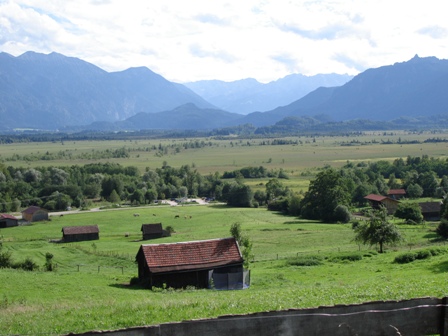
Murnau is a small market town in the foothills of the Bavarian Alps. It is the place where Gabriele Münter, Wassily Kandinsky, and Franz Marc, inspired by the landscape, created The Blue Rider movement.
This is how the tourism office describes Murnau:
In Murnau nature, art and culture form a special bond. World-renowned artists like Kandinsky, Münter and Horváth lived here and found inspiration in the picturesque landscape at the foothills of the Bavarian Alps with its romantic lakes and unique moorlands.
The moor, Murnauer Moos as it is called in German, right next to the town of Murnau, is an enormous nature reserve, the largest in Central Europe and, surrounded by the Bavarian Alps, benefits from a micro-climate that supports an extraordinary range of animals and vegetation.
Meadows, marshes and mires; bog and creeks invite and nourish butterflies, insects, and rare birds. The light is translucent, the air uplifting, and the colors of the wild orchids, irises, grasses, and innumerable other plant varieties are thought to “sing.” Painters, photographers, art, nature, and bird-lovers make their pilgrimage to the moor to hear these songs.
Whenever I can, I go for walks there. My poem Murnau, published in escarp.org on the 8th of August 2010 is a twitter-sized attempt to condense the experience of walking on the moor without losing sight of some of the cultural associations of the area.
I am delighted and honored! My micro-poem They send light to Earth was chosen to be the first piece to be published by new e-zine @textofiction.
Brand new, “Textofiction is an online literary publication dedicated to bringing the best writing in under 140 characters.”
Read my micro-poem and think, it packs a lot in. Better still, let me know your thoughts about it! Read it here
Date of publication: 29 August 2010
Big, tough fella
loud, racy lass
timid Cinderella
prodigy, alas
blow your vuvuzela
if you must.
See also my post: Whatever you think about football
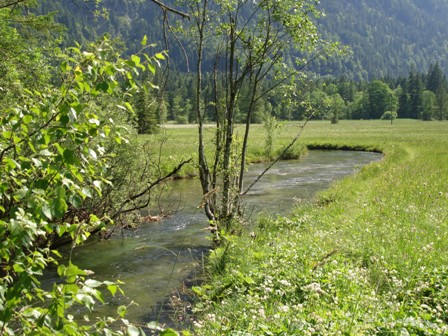 Does the Garden of Eden look like this?
A steady flowing river, whispering reeds and listening fish; a flowering meadow, a gentle mountain breeze, green to delight the eye, colorful mosaic of insects. It certainly felt like the Garden of Eden.
If not, what does the Garden of Eden look like?
Perhaps my twitter poem earlier in the Spring caught something of this quality, though the Cornmill Meadows are in the outskirts of London while the landscape in this picture is in the valley of the river Ammer near Ettal and Oberammergau.
At the Cornmill Meadows
dragonflies rest on nettles
comfrey, buttercups
and the smooth stones
of the shallow stream.
(Published in Escarp, a “review of super-brief literature”)
Photo Credit: Attentive Eye
I went for a walk to the Dragonfly Sanctuary in the Lee Valley Park, near Waltham Abbey, in the outskirts of London. Peaceful and dreamy, idyllic… though a different note entered my mind when I read the information provided about dragonflies: the lower lip technique of the dragonfly nymphs catching their prey, the cannibalism as a way of regulating population…
Reflecting on my experience, I wrote this poem which can be read both as a perfect idyll, with the dragonflies resting within a sssssh soundscape of silence; and as the calm before the next rush of the dragonfly for its prey.
The poem was published in escarp, a text-message-based review of super-brief literature (www.escarp.org).
This poem is a suicide note addressed to a number of unusual addressees, leaving the content of the note to the reader’s imagination. It puzzled and haunted me for the last few weeks: its exquisite, lyrical tone, its mysteries and the ways it brings nature alive through its lines.
A Critical analysis by Tammy Ho Laiming and Jarno Jakonen appeared recently in A Cup of Fine Cha. I thoroughly enjoyed reading both, poem and analysis, and kept them with me for weeks, chewing on words, mulling over the subtle allusions.
Tammy Ho Laiming and Jarno Jakonen’s analysis of the poem, as well as the comments, provide a beautiful and multi-faceted context to the poem. There is whole list of addressees in this “Suicide Note”: “frog, cicadas, rain clouds, gardens, worms, grass, deer, curtains, noise, lights, glass trails, heart, hands, ink, bruises, rivers, summers, monsoons and thunderbolts,” which the analysis and the comments fully and thoroughly explore.
I have nothing to add, except one question: Where are the people? Where are the relationships with people? The nature described in the poem is giving, generous – though providing what is usually offered by humans: warmth is offered by glow worms, for instance. And as if to emphasize the point, neighbours and strangers appear only impersonally as in “the shining lights of the neighbours and their last ashen cigarettes.”
So, for me, there is so much loneliness and sadness in the persona pouring out every time nature stands in for the human touch: friends, family, acquaintances, colleagues, or even kind strangers. What could be more indicative of sadness, and indeed despair, than the need to use “broken glass trails that will show the way to strangers”?
From this perspective, what if, in a well-encrypted way, we are led to ask: does the poem take the line of praising nature instead of criticizing fatal failings of the human heart?
In this beautiful and haunting poem, Tammy Ho offers interesting answers to this question. The poem is part of a project in which she writes poems on demand. She asks that those interested email her something about themselves – an incident, a piece of information, a photograph – and she will then write a poem dedicated to them, inspired by the material they sent.
The poem “Where were you last night?” was written for a photographer friend; his photograph of a pair of bedroom slippers with the words “Her bedroom sippers,” used for inspiration.
The poet rose to the occasion, a difficult one, since it does not simply involve writing in response to a photograph, but a picture by a photographer and friend. How close is the friendship, one wants to ask, how much information is one not privy to, why bedroom slippers, what is the artist’s intention? And yet, on reading the poem, these questions lose their urgency, as we enter, or rather are led into, a world we feel we know, which however appears magical at the same time. From a book launch, to fairy tales, to Moscow, to Chelsea, to hotels and linguistic stops, we are taken round the world and back into the poet’s arms.
There are so many things I like about this poem that to single out one thing would do injustice to the rest. Nevertheless, I will pick out a theme which resonates particularly strongly with me.
The first stanza gives a clue that serves as an entry point. The narrator might be asking herself the question “Where were you …?” The book launch she attended was a boring event, too many writers’ egos, neat piles of books and lots of wine on an empty stomach! But we know you can’t judge a book by its cover. This leads the narrator to crack open the book pile, and the stories, fairy tales, metaphors, characters come tumbling out in the subsequent stanzas. The writer is never bored, or alone… and the reader is certainly entertained and amused, but also puzzled.
At the same time, a sense of longing and loneliness comes across in the poem. “Where were you last night?” might also be a question asked of the “you” in the poem – as if the narrator wished the “you” had been with her. The repeated question suggests feeling excluded, or left; and all that within the context of closer intimacy claimed by the words in the photograph “Her bedroom slippers.” In asking the “where were you” question, the narrator implies “you” could have been with her, “at home,” in her own arms, with her wearing “her bedroom slippers.” Perhaps, the fact that “you” were not is just as well, as one might imagine that, had that “you” been at home with her, the poem might not have been written!
In this sense, for me, this poem also explores the source(s) of creativity: is the feeling of a lack, of longing and of loss an essential ingredient of creative work? What other ingredients are there? And why is inspiration and creative effort so often experienced as capricious, and fragile, needing to be nursed and safeguarded? There is a powerful hint in the poem at our anxieties about the fragility of the creative process: one snowflake and we can be blinded for ever… There is a display of poetic force in this poem which transcends and transforms the longing into a poetic journey well worth embarking on.
Disappearing Act, Eleanor Ross Taylor’s poem can be read in The Guardian by clicking http://bit.ly/c98Rhi
It is a brilliant self-reflective poem, based on experiencing the human body as a thinking as well as a feeling person.
Winner of the 2010 Poetry Foundation’s Ruth Lilly award, she made the news at a time when she was almost forgotten. Poetry magazine editor Christian Wiman, commented on her “sober and clear-eyed serenity,” and her strong reserve. “We live in a time when poetic styles seem to become more antic and frantic by the day, and Taylor’s voice has been muted from the start,” The Guardian reported. Others, commenting on her award, made strong references to her age.
Her poetry, though, speaks for her talent and originality; her making us see the world anew – in this case, our own body.
My Twitter-sized poem Sketch published in Escarp, sketches an idyllic picture of an old city. It also hints at links between old cities, cobbled streets and Silence: http://www.escarp.org/
I wrote this Twitter-sized poem on environmental awareness, the mania of cataloging, and our need, as well as the impossibility, to recreate and return to Eden. Have a look: click here
George Szirtes defends poetry: Poetry conjures the presence of things, their physicality… it is experienced through the body as much as the mind. “…but the chief use of poetry to sense the presence of the toad in language, without which sense nothing happens, without which the language enterprise is all imaginary gardens in which only ghosts can live.” Read it by clicking here: George Szirtes blog Then, go find that toad, say, by reading one of his poems: “Say“
I wrote this poem thinking of the Aegean, the stories attached to it, from the Trojan war, to Odysseus’ crisscrossing the sea to return to Ithaca, to the sponge divers risking their lives to earn a living…
–
This poem appeared in Poetry Monthly, issue 150, October 2008. (This was the last edition of the magazine; afterwards, it came back as the online journal Poetry Monthly International)
Song of the Aegean
Sea, azure, shoal, white sails,
Pines, sponges, diving tales
Winds, caique, bitter waves,
Oars, wreckage, soulful prayer
Odyssey, memory, dolphin leaps,
Marble, Kalymnos, Ariadne sings.
I wrote this poem in response to the painting titled Woman by Robert Campin. The painting can be found in the National Gallery, London. Here is the link: http://www.nationalgallery.org.uk/paintings/robert-campin-a-woman
My poem, Girl, can be found in the print Journal Off the Coast, International/Translation Issue, Spring 2009.
Girl
after ‘Woman’ by Robert Campin, 1378-1444, National Gallery
She rarely smiles. A thick, white veil
frames her face, stops her innocence
from straying too far;
remembering the world outside.
Here she lives, here she is
and here she stays: four walls,
bench, Bible, rosary, Cross,
pair of clogs, glass, pebble,
compass, chair, table.
She would be lost, but
for her little pleasure:
a bowl of coconut ice
refectory Sister leaves
on her windowsill.

This poem was written on the tenth anniversary of Ken Saro-Wiwa’s death. It is included in the anthology Dance the Guns to Silence, edited by nii ayikwei Parkes and Kadija Sesay, London: Flipped Eye Publishing, 2005.
History is on His Side
‘No,’ he said, No to oppression, No to injustice,
No to violence. Even as he stood before the guards.
The sun was rising proper in the East, blushing the soil scarlet.
Sozaboy was with soldiers, arguing with the heart
of darkness. We all stand before history, he thought, and
‘No,’ he murmured through cracked lips. ‘No.’
He could not wipe his sweat mimicking sorrow’s tears.
His tied hands tried. His crowded heart pounding with the fear
of the unknowable. He mouthed ‘No,’ just before
their fifth attempt to hang him. Who will claim
the corpse of free speech, but those with a pen
to their name? History is on his side. And ours. Yes.
This poem was published in the Big Pond Rumours ezine, summer 2006. It won second Prize in the Big Pond Rumours Poetry Competition.
I wrote it for Tania and Jaque’s house-warming party and it is dedicated to them.
If Trees, Then Olive Trees
You ploughed the seas. You crossed the skies. Saw the shipwrecks. Gathered
your wealth in words. Then, like Odysseus seeing the smoke rising, you decided
to become trees. To grow roots, you wrote. To grow. And while the bulldozers
work round you, while the Fates, the Wars, the Envious, the Arrogant,
lay siege to you, as they always do and always will, remember to stand your ground
like thousand year-old olives, twisting golden brown trunks and holding hands. Expand,
burrow deeper and fashion a silky smooth quilt, a glowing oil lamp, a warming hearth,
a spacious kitchen, a deep well and a cool, vine-clad terrace.
Odyssey is a memory. A treasure and a well-kept secret. Your home always yearned
for you. Your olive-tree bed rooted to the ground. Penelope with outstretched
arms will hug you. The lyre and the xylophone. The drum and the flute will lead you.
And you will dance, and dance and sing the life she could only dream of.
And if, like the man of old, you find your journey not yet over,
embark on each new voyage with zest. Plan each trip in language,
build your boats with words. Thread your sails with rays from your joyous souls.
And for fuel, for fuel employ the subtle beating of your hearts.
The emptiness of it. The emptiness of Albert Lambert´s mind. The slow, and fast, draining, slackening, loosening of connections, of language, of life. Parkinsons, he says; Dementia. Depression. There is no healing possible. No repair. No reparation. Continue reading On Jonathan Franzen’s The Corrections