.
meditation
in my cupped hands
a hummingbird
.
Posted on Stella’s Stones and Facebook.
Participating in NaHaiWriMo February 2011
.
meditation
in my cupped hands
a hummingbird
.
Posted on Stella’s Stones and Facebook.
Participating in NaHaiWriMo February 2011
.
daybreak
the taste of tangy sweet apple
on my tongue
.
Posted on Stella’s Stones and Facebook.
Participating in NaHaiWriMo February 2011
.
spring bulbs
the touch of mother’s hand
on my shoulder
.
Published on Stella’s Stones and Facebook
The River of Stones project, organized by Fiona Robyn and Kaspalita, has now come to an end. In January, for a whole month, people from all over the world wrote a ‘stone,’ a polished thought/moment of experience. I wrote and posted mine in this blog, on my twitter stream and on my separate tumblr blog Stella’s Stones. Now that January (2011) is over, you can find more of my very short work in Stella’s Stones: on the right hand side of the front page, just below my twitter feed. A big thank you to Fiona and Kaspalita!
February (2011) is also a special month. Michael Dylan Welch of Graceguts organizes the NaHaiWriMo challenging haiku poets and others to write a haiku a day for the month of February. Can you do it? Can I do it? I will certainly try. You can follow my haiku progress in Stella’s Stones.
For well-writen essays on Haiku and other genres click Graceguts
reaching for the sky
the Shard of Glass,
mast on a proud city
.
This post can also be seen in Stella’s Stones here
.
Pink-footed geese circling the fields,
dot the golden sky
fill the air with their harsh calls
for home.
.
This post can also be found in Stella’s Stones here
The new edition #3 of > Language > Place blog carnival is out!
Hosted by Michael Solender, of “Not From Here, Are You?” it is a feast of stories, personal accounts, poems, photographs. In a number of excellent contributions, several bloggers explore what it means to feel at home, be at home, or indeed, where home is: the theme of belonging.
For information on what the blog carnival is all about, how it came into being and instructions on how to join, please visit Dorothee Lang at Blue Print Review and she will tell you all about it.
In addition, there is a special place to go to for information on the contributors and what they are blogging about http://languageplace.blogspot.com/
The next edition, issue #4, will be hosted and edited by Jean Morris of “tasting rhubarb.” Jean is inviting submissions during the period from the 5th to the 20th of February 2011. For details and also the specific theme of the edition see here
I am happy to report that links to two of my stories are included in edition #3: “Ariadne’s Thread” and “Where Home is.” Both stories first appeared on 52|250 A Year of Flash here; they can also be found in my blog here
Diamond doves are small, beautiful birds, which can be kept as pets, ‘Wiki-Marion’ told me once. Since I knew she enjoys dispensing information, I did not think more about it, until she invited me to see her new pet, “Love”.
A bird of beauty! Light blue-grey head, neck, and breast; dark bill, spotted wings fringed in black; orange eyes. I fell in love with Love. He kept bow-cooing, fluffing his wings, strutting, kissing Marion’s hand. I felt jealous, knowing I could not compete with my friend for the bird’s affections.
Walking back home, I stopped at the park, looking for doves, ducks and this winter’s migratory birds. None had the exquisite and delicate beauty of the diamond dove. I was heartbroken by the time I arrived home, vowing to stop visiting Marion to avoid the pain.
A few weeks later, she phoned me. “Love died,” she announced.
“What?”
“These birds seem to fall in love with their owner if they don’t have a bird partner. I encouraged his bonding to me. But that was all I could do – I could not let him mate with my hand as if it were a female! He felt rejected and died of love.”
“It was only an animal. Animals behave differently,” I said, breaking into hysterical laughter.
I put the phone down struck by an acute pang of unease. Who are the animals here, I asked myself, my face burning with shame.
.
This short story was first published on 52|250 A Year of Flash, January 2011. It can be found here.
For information about the diamond dove, including the dangers of it becoming over-dependent on its owner see here.
Sometimes, like today, with a chilly wind spraying drizzle over grey London, I feel that this city needs the Aegean to be closer.
This post is also in Stella’s Stones here
Silence has lost its shape today.
A single carnation bursts into song.
.
This post is also in Stella’s Stones here
poem–
the old soup bowl
filled with cream
.
The moon is kind tonight, bathing the room in milk.
A breeze rustles the Eucalyptus and I realize I daydream.
.
This post can also be found in Stella’s Stones here
Picking fishnet tights, a shoe, and a pair of torn jeans, the wordsmith assembles her poem; plenty of time in her workshop.
This post can also be found in Stella’s Stones here

Night
As darkness falls over the Thames,
a liquid haze swims in from the sea
and the city steels its heart for the night.
.
This post can be found in Stella’s Stones here
.
In sun-bleached deserts, in mountain caves, on sea-sculpted rocks
the hermit slept, forgetting that the essence of being can be found in a single drop of rain.
.
This post is also in Stella’s Stones
.
When I started learning to crochet I thought of it as a relaxing, stress-reducing act, like counting the amber beads of a komboloi.
Now, looking at my hand holding the crochet hook, the wool, at the next stitch to pick up, the stitches I travelled and the one I have to travel to next, I think it is more than that. It is a process like meditation, without however the religious connotations and significance often associated with it: like counting prayer beads, but without the religion.
I was interested to see that, according to Wikipedia, there are two ways of counting the komboloi beads: “a quiet method, for indoors, and a noisier method that is acceptable in public places.” While crochet is quiet, knitting with two needles is not! I wonder whether there is a way(s) of knitting indoors that keeps the noise down!
Festival of the Trees, issue 55, on the theme of 2011 UN International Year of the Forests, has been published by Jasmine, of Nature’s Whispers. It is an informative, as well as entertaining post, rich in text, visuals, and creative energy. The links are well worth exploring too, covering a plethora of work about nature, trees, forests, gardening, art, and other fascinating topics!
It also includes an alert about the UK coalition government’s plan to sell off many of the best-loved ancient forests and woodlands, and a link to an online petition to save the UK forests.
Jasmine writes:
“In the United Kingdom, the Conservative Party plan on selling ALL of our ancient forests. Once they are gone, they cannot be redeemed. In order to carry out these environmentally unpopular sales, the government is rewriting laws written in The Magna Carta that have protected woodlands and ancient forests since 1215”
For more information about this issue please see The Guardian here, here and the campaign site here
If you enjoy walking in the forests as much as I do, if you care about the environment and the preservation of woodland, then this is the time to voice your concern and support the petition.
You can sign the petition online here
My short story and post appear here
“twentysix,” the second anthology highlighting short stories from a quarter of “52|250 A year of Flash,” is out. The editors of this writing project, Michelle Elvy, John Wentworth Chapin and Walter Bjorkman, challenge writers to produce a short flash of 250 words every week for one year. They provide a different theme each week and the resulting creative work is amazing: wonderful stories, and poems, of high quality from a prolific, creative, friendly, and excellent community of writers.
Each quarter, the editors pick and highlight in an anthology the best of the stories written on each week’s theme. The current edition also includes art work, readings, and reflections by some of the writers on their creating a particular piece and the ways they went about developing their take on the theme.
Beautifully and professionally edited, assembled and illustrated, it is well worth visiting, and reading. As you will see, the editors have put an incredible amount of work into “twentysix.”
I am honored to have two of my short stories included: on theme #25 “A private person” and on theme #26 “A hair raising story.”
.
You can read the anthology here
My stories in 52|250 can be read here

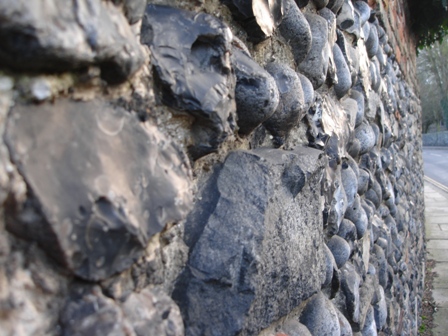
behind the stonework
a spiritual space filled with
calm and stillness
.
Isn’t this exactly what we are trying to achieve with our stones?
Photo: St. Nicholas Church, Blakeney, North Norfolk.
This post can be found on Stella’s Stones
For more pictures of the area see here
Happy New Year’s Day!
Remember though …
.
a river flows
into a new year
every day
.
In a sense this micropoem plays on the theme of Heraclitus‘ Fragment 41: “You cannot step twice into the same river”
Δεν γίνεται να μπει κανείς στο ίδιο νερό του ποταμού που κυλάει δύο φορές.
From today on, though, I, along with others, will be entering the river of stones every single day for a month.
For Heraclitus the appearance of stability is an illusion, “for as you are stepping in [the river], other waters are ever flowing on to you.” However, consider the possibility of re-entering the river of stones: on the one hand, the river consists of the flowing moments of experience as represented by stones; on the other hand, each time we polish and share a stone, we ourselves change, grow through our attending to and encapsulating the moment of experience.
Happy New Year 2011!
This post also appears here
The UN declared 2011 as the International Year of Forests “to raise awareness on sustainable management, conservation and sustainable development of all types of forests.”
Forests are vital to the lives and livelihoods of the people of this planet, to our planet’s existence. Yet, according to UN figures, deforestation continues at the rate of 50.000 square miles per year.
A number of activities have been planned for the year, including high-level panel discussions, film screenings, a United Nations commemorative stamp series, competitions, art and other public events. Look out for them here
While the launch of the Year of Forests will be taking place later, I am posting a short story grown out of the combination of the theme of the Year of Forests with that of “Silence,” a writing prompt set by participants of the “52/250 A Year of Flash.” It was first published there
I copy my short story below:
.
The Weeping of the Trees
Last spring, I hiked up Mount Olympus. The valleys surrounding its peaks are covered in black pine, beech, yew and tall conifers. On its slopes, vineyards spread precariously; olive trees anchor deep with their roots. Streams cascade to thirsty plateaus. No wonder the ancient Gods lived there.
I stayed in refuges, drank from the streams and breathed the pine-scented air. Cicadas serenaded me; butterflies I did not know existed covered my arms. Wolves lusted after me.
Magical. Yet, I dared not return, fearing the strange sightings and the silence: ghostly shadows appearing through the trees, gathering near water, rushing through the meadows, with a heavy, voluminous silence falling all round. At first, I did not believe my senses. Gradually, I came to expect and even look for the shadows.
Whenever I tried to touch a diaphanous apparition – as if made of smoke – it pulled back, avoiding my hand. I thought I saw it sigh, more as a gesture rather than sound, and glide away.
It was recently that I understood – and felt freed to return. The shadows are the souls of trees haunting the Olympian home of their Gods. Felled unjustly, burned in war, famine, and in ruthless profiteering, or carelessness, they return to plead with them.
Next time you visit Olympus, look for the shadows; seek this silence: If it is not disrupted by a leaf falling, a stream’s gurgle or an animal’s light footstep, know you are listening to the silent weeping of the trees.
.
You can find the story in 52/250, together with a number of other excellent stories on the theme of “Silence” here.