Today, the 4th of December, is Rainer Maria Rilke’s birthday. Honoring the poet, three biographies appeared in 2025, which I am about to read: Sandra Richter’s “Rilke or The Open Life”, Manfred Koch’s “Rilke – Poet of Anxiety” and Ruediger Shaper’s Rainer Maria Rilke: The Prophet of the Avant-Garde.
All three in the German Language. In the biogaphy by Manfred Koch, Rilke’s traumatic experiences are shown to be pivotal in forming his psychological make-up and artistic drive. Several reviews confirm that Koch presents Rilke’s anxieties not as much as an obstacle but as the very creative engine for his poetry.
Being interested in ways in which art and literature are utilized to cope with pain, and trauma, I will be reading eagerly…
In time with the first snowfall…my haibun “Pandora’s Box” is now online at Haibun Today. A political haibun, looking back at the period of the Greek Junta and its aftermath.
The entire winter quarterly issue of Haibun Today can be found here
Delighted that my epistolary poem ‘Dear Yannis’ (Ritsos) is given another airing on RE / VERSE, the online journal.
‘Little Eagle Press presents poems previously published. Well worth another look, we think,’ they say. Thank you to Ralph Murre for giving my poem a second chance, and for the photo art image he created that accompanies the poem. Take a look by clicking here
In our hands, you said, we hold
the shadow of our hands. I know
the cold absence of the marbles,
olives sprouting from the cracks.
The coffee grinder turns
slowly, gently. The moon
still kind, bathes our wrinkled
hearts in light. In silver. In sorrow.
Old souls sitting by the river
listening to the boat engine
starting, coughing, spitting,
dying. Starting again.
(to Yiannis Ritsos, in response to his poem “Absence”)
.
Poem written to the poetsonline prompt: Dear Poet: Epistles to the Poets. For the other poems on the poetsonline.org blog, please see Archive, ‘Dear Poet’ on their site.
Please note English spelling of the original Greek name varies (Yiannis [e.g. Wikipedia], Yannis [e.g. Poetry Foundation]). Wikipedia lists a number of variants: ‘Yannis or Yiannis or Giannis (Γιάννης) is a common Greek name, a variant of John (Hebrew) meaning “God is generous.” Variants include Ioannis (Ιωάννης), Yanni, Iannis, Yannakis; and the rare “Yannos”, usually found in the Peloponnese and Cyprus.’
My longer poem Seferis’ Houses, republished in Little Eagle’s RE / VERSE, April 9, 2015. To read the poem, please click here
Artwork by Ralph Murre, after a photo by (or of?) Giorgos Seferis
Little Eagle Press presents poems previously published. Well worth another look, we think
Paying homage to Seferis, the poem directly refers to Seferis’ ‘Thrush’, a poem he wrote in 1946. You can read the poem on the Poetry Foundation site.
For information about Giorgos Seferis, see the Wikipedia entry.
You may also want to take a look at this longer, Princeton Uni. entry with photos, or at Edmund Keeley’s interview with Seferis in the Paris Review.
Recently I visited the Frank Auerbach display of 15 paintings and 29 drawings at the Tate Britain, selected by his fellow painter and friend, Lucian Freud. The collection was offered by the Lucian Freud estate, and accepted by the British Government, in lieu of inheritance tax.
The group of paintings is of international artistic importance and a good ’teaser,’ anticipating a major Tate retrospective planned for 2015.
A fine group of works, including one of my favorites, Rebuilding the Empire Cinema, Leicester Square, 1962.
What a fantastic, bold show of both, imagination and brushwork, deep feeling and insightful depiction of psychologically layered scenes. The same subjects — Julia, his wife; Estella, his mistress; Jake, his son; Mornington Crescent — visited again and again, let the viewer get intimately acquainted with, as well as intrigued by them. Born in 1931 in Berlin, Auerbach came to England in 1939 and has lived and painted in London since. A London painter, and a painter of London, Auerbach has gone under the skin of the capital, making it the prime set of his work. If not Auerbach, then who else captures the energy and multifarious burdens carried by London’s inhabitants so realistically?
In an interview by Hannah Rothschild, Auerbach, from what has been his tiny home and studio since 1954, opens up about his work and life. Surprisingly, a sparse and spare studio and frugal life are juxtaposed to and contrasted with his many-layered, rich encrustations of paint in his work. The charcoal paintings are also ‘rich’ in depth and insight that feels both, inquiring and haunting. I left the room intrigued by his work, troubled, and at the same time, strangely satisfied by his profound achievement. Reading Rothschild’s interview later, I found this which rang true:
“So why does Auerbach paint the same face, the same view over and over again? Wouldn’t it be interesting to try a new landscape or a different nose? Auerbach shakes his head. ‘The closer one is to something, the more likely it is to be beautiful,’ he says. ‘The whole business of painting is very much to do with forgetting oneself and being able to act instinctively. I find myself simply more engaged when I know the people. They get older and change; there is something touching about that, about recording something that’s getting on.’ Amid the frenzy of paint and energy it can be hard to spot the person in an Auerbach portrait. ‘Likeness is a very complicated business indeed,’ he says. ‘If something looks like a painting it does not look like an experience; if something looks like a portrait it doesn’t really look like a person’.”
“Fate” and “destiny” are often used interchangeably to refer to the notion of predetermination; of future events following a predetermined plan or path.
Yet, implicitly, we also make a distinction between the two in terms of the degree to which each is allowing for alterations in the course of events to which it is applied. Fate is usually associated with unalterable events; we are in the hands of the ancient Fates, Gods, or cosmic forces; our lives, and actions, are out of our control. There is a belief in a prescribed future: a higher/supernatural authority (or authorities) has the future laid out for us.
Destiny, on the other hand, involves a course of events where we have a say, or a hand, in preparing or making our future. We may be destined in one sense to higher or lower things, but we can underachieve or push ourselves hard to achieve better than expected.
This month’s The Haiku FoundationPer Diem: Daily Haiku reflects on both of these concepts. Deb Baker, this month’s guest editor, using “Kismet” as the title of her splendid collection, invites us to reflect on the “hinge” moments” or forked paths we encounter and the outcomes that result when we follow one or the other road, believing in fate, in destiny, or a choice we made. She writes,
Poems like these can make a reader feel a sense of momentum, a possible turning or smoothing path. Perhaps such a poem helps a reader discern something happening in the present moment in his or her own life. Or to see a new possibility, a different way forward, through someone else’s hinge moment.
.I’ll be reading with an extra eye for the different ways Kismet appears in the poems. I’ll be having fun too! Join me? You can find the daily poem here
.
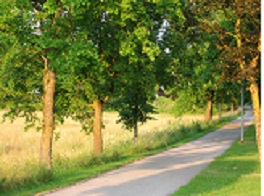
The photo is of a path taken, crossing the river Schmutter, near Neusaess, Germany.
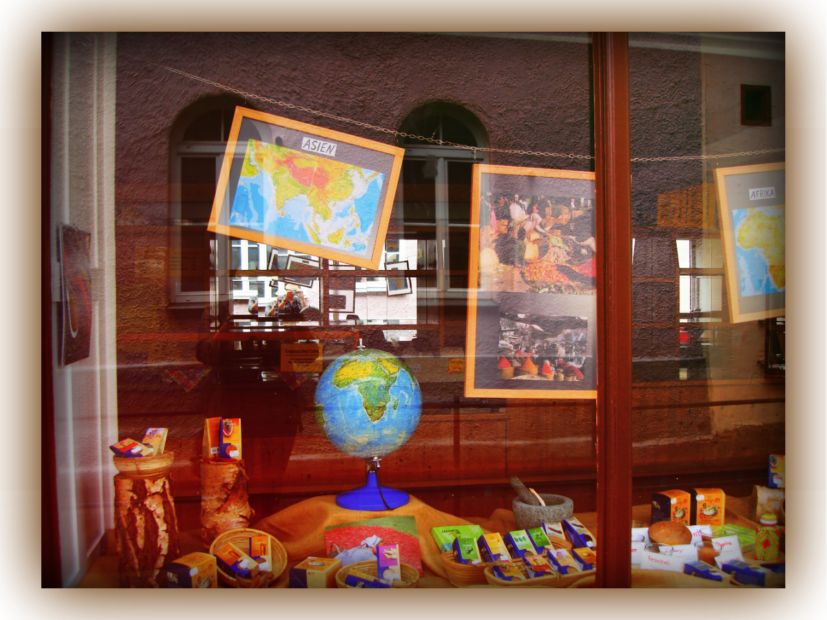
Photo of shopfront in Augsburg, Germany (by Stella Pierides)
I’ve always been fascinated by the concept of the Uncanny. Freud, the writer often associated with this concept, described the following uncanny experience when he came face to face with his own double. While travelling by train, Freud saw an elderly gentleman enter his sleeping compartment by mistake. Jumping up to let him know of his error, Freud realized it was his own image reflected in the mirror on the connecting door. He had found the appearance of what he thought was another man ‘thoroughly unpleasant.’ Without being frightened, he failed to recognise his ‘double.’ Or was the displeasure he felt, Freud wondered in the last note of his last chapter on “The Uncanny,” “perhaps a vestige of the archaic reaction to the ‘double’ as something uncanny?” He leaves us with a question, perhaps an encouragement to take this further ourselves.
Freud was not the first of course to link the concept of the ‘double’ with mirroring, the image in the mirror as well as the ‘other.’ Ever since Plato conceived of material reality as a poor representation of the true Forms, others have found man’s double in several contexts. In literature, for instance, Mary Shelley made the monster his creator’s ‘double’ and leaving him unnamed, led subsequent generations of readers to refer to him with the name of his creator: “Frankenstein.” Conrad, too, wrote the ‘double’ in his stories (e.g., in “The Secret Sharer”).
So what has this ‘uncanny’ and ‘double’ to do with haiku, and my theme of reader-oriented matters? If you read my previous posts, you may have noticed I like playing with ideas; though more thought games than thought experiments.
Let me throw this thought in the pot: Isn’t there in haiku a situation in which, when you come to the poem, you become slightly disoriented by the presentation of the two separate, juxtaposed ideas? (Remember the field of energy, in the previous post?) I think there is. The ‘cut’ and the pause in the juxtaposition of two ideas/images are device(s) which open up the extra perspective(s), depth, for the reader; they also create a sense of strangeness, a momentary, uncanny disorientation… until there is the spark of realization that transforms what was strange and uncanny into familiar and understood. Once resolved, the two initially puzzling parts of the poem appear to us the way Freud, relating that vignette, stood in front of his earlier self and its reflection; the way we stand in front of a Moore, a Hepworth, a Lucian Freud, or the narrator in Conrad’s novel and his secret sharer.
Are you with me? What do you make of the thought that the moment of insight or realization is preceded by the uncanny? That the uncanny in haiku involves being confronted by the juxtaposition of two on the surface unrelated – but on a deeper level related – ideas within a limited space? That the haiku moment does itself involve overcoming this sensation of the uncanny?
Finally, before I go, and in case you are interested, I’d like to mention a couple of places, amongst others, I like to visit for reading poetry, essays, information, learning, fun (in addition to “Haiku Matters“, haiku journals and the homepages of haiku societies!). Do let me know your favorites.
The The Haiku Foundation’s homepage and blog “Troutswirl.” On the same site, among many brilliant features, the THF “Haiku Registry,” the place to get a flavor of the work of haiku poets writing in various forms, from all over the world; the “Montage Archive,” the “Book of the Week,” the “Per Diem: Daily Haiku” panel, and “Per Diem Archive,” are my favorites (esp. since I help out with Per Diem!).
On this note, hopefully leaving you with more questions than answers, having raised smiles as well as eyebrows, I’d like to say a big thank you to Colin Stewart Jones, and goodbye to folks who found their way here, from both the writer and reader in me.
*
The Wikipedia on the Uncanny here Sigmund Freud, ‘The Uncanny’ in The Uncanny, ed. by Adam Phillips (London: Penguin Classics, 2003) p. 121-161. Conrad, Joseph, The Secret Sharer can be read here
Barbara Hepworth, sculptor, created her first pierced form in 1931, the year she gave birth to her child.
Barbara Hepworth – Oval Sculpture
Jeanette Winterson, appraising Hepworth’s creation in her essay “The Hole of Life,” sees this as a breakthrough not only in art, but also in the understanding of human existence. Pointing to the advances in science – in which, far from a universe of oppositions (like mind and matter, space and form), Einstein, Planck, and others conceived of a universe in constant play, forever involved in creative tension – Winterson shows Hepworth’s sculpture to be a timely response to them.
“The atom itself, the supposed building-block of matter, was no longer an object, but an energy – points of light surrounded by empty space.”
and:
“If the scientists were right, and space is as much a part of form as mass, then it is the space we need to see – but how? Hepworth made an astonishing discovery the day she pierced one of her sculptures. She allowed us to see nothing – a privilege previously enjoyed only by God.”
Nothing and everything! Winterson understands Hepworth to have mirrored the new developments in theorizing about the cosmos in her hole forms as the (w)hole of life, expanding space to include the invisible, and connecting to both time (in terms of the past) and timelessness in her sculptures
Henry Moore, who had studied art at the same time as Hepworth, grappled with spatial form and in his attempts to give it an extra perspective, cut holes through his sculptures soon after her. Of the various interpretations this act has received, I prefer the one which conceives of it as offering a 3-D perspective (literally and metaphorically) to the viewer.
What if we were to play with Winterson’s take on the holes in Hepworth’s sculptures, along with Moore’s contribution, and relate them to ‘the cut’ in haiku? What if we ‘saw’ the space between the two juxtaposed ideas, between the two parts (not only the pause created by the punctuation) as being more than an empty hole to be filled-in, or a gap to be crossed, but as an energy field being fueled by and fueling meaning? We wouldn’t be the first of course*, but the thought experiment is exciting… Do you resonate with this idea?
And, even though I am oversimplifying, isn’t there a paradox here: cutting away in order to create extra depth (which is where Hepworth and Moore come in)?
One might see a similar paradox in the writings of Winnicott, the English pediatrician and psychoanalyst. For instance, in “The Capacity to be Alone,” he argues that one achieves creative aloneness if, as a child, one had the experience of being in the presence of a watchful, but non-intrusive parent. The capacity for attachment is required before one can deal with loss; the capacity to foresee and accept loss, before love can be truly there, and so on. – I see the opening or cutting away in order to increase the perceived depth and space to be similar to this approach.
Interestingly, there is another paradox giving rise to a ‘hole,’ if we look at the opposite case scenario – where it seems that everything is being said, without any ‘holes.’ Lucian Freud, the painter, painted men and women in their naked, real, and true form. He studied his sitters over months or years, revealing in the portrait the person they happened to be (as he saw them) through paying particular attention to their skin.
In a perceptive essay, Dodds,** points out:
“there is an evocation of abjection, of the corporeal mother who must be symbolically expelled in order for the subject to come into being. And yet rather than staging a ‘rite of defilement’, there is a fascination, we are drawn in. The ‘glare’ of the portraits refers both to the external sources of light reflected on bodily surfaces, and also glare as in look, the stare… We are caught in the gaze of bodies. After first looking away… there is a return, to the folds, the textures, the touch and smell, the loving portrait of every bump of skin, to a fascination with Freud’s cartography of flesh.”
Even when everything is said and done, the people portrayed by Lucian Freud are there and not there. The person is present and absent at the same time: present in their corporeality, yet – like a psychoanalysis which is never finished – their portrait does not say it all. What it says is what has been rejected by social and cultural values, yet by saying so, by bringing in the abject, it rejects socio-cultural values, thus creating a ‘hole.’ The viewer has work to do.
The haiku reader too. From the monumental portrait to the miniscule text: it is not the physical size or amount of detail that matter when it comes to the energy available and the meaning(s) generated – especially through the cut – in haiku. In the haiku moment that the opening of the ‘hole’ creates, a space is entered that is a whole world.
…
An essay by Jeanette Winterson on Barbara Hepworth and her response to the concept of ‘hole’, originally published in Tate Magazine, can be found here
For “The Capacity to be Alone,” an entry point might be here. The paper itself, can be found here
If you are interested in the angle of Lucian Freud and the ‘abject’ you can find a short essay here, together with paintings!
** Based on a paper read to the Czech Psychoanalysis Society on 28 May 2011, “Confronting the Abject: Reflections on Rotraut De Clerck’s (2011) ‘How deep is the skin? Surface and Depth in Lucian Freud´s Female Nudes’” (Dodds 2011b).
On the wider issues relating to space in haiku: “Haiku and its Relationship to Space” by Tracy Koretsky, in the homepage of the New Zealand Poetry Society here
.
Posted in Haiku Matters, the blog of Gean Tree Press
This post is about blind spots, shadows, and the darkness in our minds as readers (and writers). It appeared on Haiku Matters, the blog of Gean Tree Press, and can be read here
Blind Spots
There are corners and alleys in texts into which we, as readers, may be sidetracked, trapped, and lose our way. The best illustration of this affliction I came across is from another genre, Conrad’s novel “Heart of Darkness” – which I very much like – and Achebe’s criticism of it. I will assume that you have either read this novel or a synopsis of it.
There had been huge praise for this novel over the years. Critics had written about aspects of imperialism, hair, clothes, rivers, language in it – yet, one aspect had gone unnoticed in so many readers’ and critics’ reading. I hadn’t noticed it myself either. Achebe, in his reading of the novel, saw a text underpinned by racism, and pointed to a need in Western psychology
“to set up Africa as a foil in Europe, a place of negations at once remote and vaguely familiar in comparison with which Europe’s own state of spiritual grace will be manifest”
The novel presented Africa as ‘the other world’, a chaotic, corrupting continent, sharing with the West only ancient roots of kinship which were, however, long ago overcome. Such an image of Africa, Achebe pointed out, satisfied a psychological need to get rid of, to disavow what had been repressed and disowned; and it was a dangerous image to be challenged. Instead, it had to be reinforced. Achebe’s criticism – that Conrad’s masterpiece, attempting to examine the European psyche, compromised African humanity by this juxtaposition – illustrates a defamiliarization process, in which the familiar common humanity is denied and the ‘other’ is created.
While at first, years ago, I felt shocked by Achebe’s reading of Heart of Darkness (was Achebe being oversensitive, misreading Conrad’s intention of exposing undercurrents in Western culture?), I came to agree with it; it opened my eyes to the blind spots a whole community of writers and readers, every one of us, may be prone to. Achebe, in his interview in Paris Review, “The Art of Fiction” is quoted saying:
“… all these people who see nothing about racism in Heart of Darkness, I’m convinced that we must really be living in different worlds. … Until these two worlds come together we will have a lot of trouble.”
How could such a massive failure to ‘see’ happen? Had readers, before Achebe, been reading ‘passively,’ submitting themselves to Conrad’s words without thinking, or approaching the text indeed from another world? In such a scenario, Achebe was best placed to see, and bring to our attention, the other side.
Returning to the haiku world and its readers: this is not to imply that some haiku readers, or writers, suffer from a particularly dark streak/from prejudiced thinking, but to illustrate how we are all prone to oversights, blind spots, are subject(s) to our cultural, historical, national environments’ influences. How, like Conrad’s earlier readers, we may be led to overlook, or overreact to, certain aspects in others’ and our own work. Achebe again, when asked what pointed him in the direction of writing:
“There is that great proverb – that until the lions have their own historians, the history of the hunt will always glorify the hunter… Once I realized that, I had to be a writer.”
Novels and haiku, perhaps the longest and shortest forms, also belong to different worlds, yet I tend to think we benefit from looking at the history and critical readings of both. It may spark insights, awareness of something we might have been missing. Wouldn’t it be useful to bear the possibility of blind spots in mind when we are differentiating between the various haiku traditions, when we are thinking about the content of haiku poetry? When reflecting on the issue of our identity(ies) as readers and poets? When we ponder, or pen, poems about illness, aging, the young, minorities, disadvantaged groups? When, in other words, we are faced with the ‘other’?
Achebe is widely said to have brought to our awareness the African perspective. Might we say that by doing so, Achebe, like Freud, Jung and others, made it possible to accept that our minds, even when open, even when filled with kindness, generosity, benevolence, and respect, at the same time contain blind spots and darkness?
.
Conrad, Joseph “Heart of Darkness” see Wikipedia for some of the history of the perceptions/reader appreciation of this novel.
.
Achebe, Chinua, “An Image of Africa”, The Massachusetts Review, 18 (Winter 1977), 782-794
.
Achebe, Chinua, interview in Paris Review, “The Art of Fiction”
.
Interested in following this issue in poetry in general? See Poets.org, “Open Letter: A Dialogue on Race and Poetry”, by Claudia Rankine (with Tony Hoagland’s response)
.
And something that caught my eye during my internet travels: If something isn’t there in our field of vision: “what isn’t, what can’t be” from a poem “Blind Spot” by Beth Thomas.
“Any poem demands a measure of active participation on the part of the reader, but this is especially true of haiku. With only slight exaggeration it might be said that the haiku poet completes only one half of his poem, leaving the other half to be supplied in the reader’s imagination.”
Half of the poem! This places a huge responsibility on readers’ shoulders. It not only invites us to look more closely into the relationship between the writer and the reader – Brooks addresses this issue in this and other papers; it helps us understand some of the sensitivity haiku writers display towards their readers and reviewers; and raises the mark of how we use our haiku ‘receptors’ to read haiku.
Journal editors have their own personal, professional, and journal-specific list of criteria for “reading” haiku. Seasoned readers too, as Rick’s and Tom’s comments on the last blog post illustrate. But as ‘lay’ readers, this side of the divide, so to speak, what do we use to understand and connect with a haiku? In addition to the individual, general and universally shared perspectives (mentioned in post 1) which help us ‘read’ haiku, might there be an additional tool available to us?
Arguably, any individual perspective the reader – lay or seasoned – might take has a dual, though intrinsically linked aspect: one relating to the mind and one to the heart. Concerning the latter, the question above might be posed differently: do we ‘walk’ with an open heart (rather than mind), open to be touched by the sensitivity or strength of a poem, or do we carry a shield, only allowing certain aspects of the poem in, and not others? For instance, even when appreciating a poem ‘intellectually’, are we allowing its essence, its excellence to touch us? Might the ‘heart’ be our most basic tool?
Michael Dylan Welch reflects on this matter in his essay “Seeing Into the Heart: Vulnerability in Haiku”. Welch understands Bashō, who told haiku poets to learn of the pine from the pine, and of the bamboo from the bamboo, as telling us to be vulnerable to the subjects of our haiku, and
“to humble ourselves so that we might learn something, and speak of it authentically. The full teacup cannot receive more tea, so we must empty ourselves, and become vulnerable, in order to receive.”
I like this: a reader’s open heart responding to the writer’s. Humbling ourselves as readers, recognizing, that is, our limitations, our preferences, perspectives, ideologies, so as to be open to others’ difference.
Here’s how Welch puts it,
“When we click with a poem, it’s because we have let down our guard, allowing our emotions to be affected, feeling what the poet felt. The poet has dared to hint at what he or she has felt, and thus lights a candle, proudly yet vulnerably, against the imminent dark.”
Not an easy task, for both writer and reader, as opening the heart is often experienced as tantamount to undergoing open heart surgery. Yet, once accomplished, may we not deservedly lay claim as readers to our fifty per cent/half of the creation of the poem?
Thinking about it now, I am reminded that several of Henry Moore’s sculptures have a hole in the area of the heart. One can only muse at the openings this allows – and we will come back to this hole later on in the month. For now, the thought: it may well be the case that one needs to have a hole in the heart in order to be — as a reader too — whole.
When reading haiku, what is it that attracts you as a reader? What makes you click with one poem and leaves you indifferent towards another? Which qualities speak to you?
Might one draw a parallel between ‘picking’ haiku and beachcombing? Let’s take as an example Henry Moore, the English sculptor (1898-1986). Moore, famous for his monumental semi-abstract sculptures dotted in the landscape all around the world, was inspired by nature. During his walks, he collected stones, shells, driftwood, animal bones, rocks, that he brought back to his studio and kept for inspiration. Some of these ‘found’ objects were singled out as art objects by his artist’s eye, and transformed into works of art. Others became favorite objects to go back to with new questions, kept for inspiration. Like a super-spectator, super-audience or super-reader, he saw the value(s) residing in the shapes, form of sticks, rocks, and stones, picked them up and brought them in from the cold world into his art studio.
Henry Moore sculpture “Large Four Piece Reclining Figure”, Harvard University, Cambridge, Massachusetts, USA. Photo by Daderot
In a sense, as writers, we have something in common with Moore and his walks. Through the day, we gather experiences, pick up some in words, discard or ignore others. As readers too, we collect from our walks round the social medialand, from our reading journals and books, from our discussing topics, poetic thoughts or experiences, from the walks in nature and through the cityscapes surrounding us.
From another perspective, appreciating haiku as a crafted, rather than a natural, object may be more akin to appreciating paintings or sculptures on a gallery visit. Works of art hang on gallery walls, are placed in gallery rooms – like haiku sit on the pages of journals and books – for us to observe and mull over; we stand in front of them, around them for a short while, then move on and walk through the rooms – pages – quickly, too quickly often.
Henry Moore’s huge sculptures standing tall or reclining in the landscape demand our attention; whether we see perfection in them or the unruly shapes of our innermost selves, something in them appeals to us as viewers. And while we cannot pick them up physically, they come home with us. So it is with haiku, I believe. Which one speaks to us, creates a reaction in us, which one we pick to remember, to give it a home in our hearts, depends on many factors.
Something in it, in its shape, depth, sensory and sensual appeal resonates with us. There is a personal, familial, local, national, global, colonial, post-colonial, feminist, literary, yet to be named perspective(s) each of us carries, treasures, contributes to and responds with to the world. Often more than one. Hopefully more than one. Naturally, we all differ in our perspectives, ideologies, in our poems, in our choices of haiku.
But there are common, global elements too; essences, values, basics we share as humans that hold together a haiku and bring it to our reader’s eyes fresh from beyond culture, history, limiting perspectives and allegiances. And with our global, in addition to our local, receptors – much like the single neurons and neuronal assemblies we all harbor in the perceptual parts of our brains, each tuned to picking single elements or whole configurations – we are able to pick and enjoy those poems too. Jim Kacian, in his essay “Tapping the Common Well” in Bones: journal for contemporary haiku, while considering what it is about the haiku poem’s universality, points out this extra or underlying dimension:
“It is universal, because what it seeks is not the relative truths of nationalities or religions, but the universal truths between people: that which can be shared, recognized, valued around the world. This does not mean rain and sun mean the same thing to all people: certainly desert-dwellers have very different emotions about such things than those who live in a rain forest… There are always points of view. But haiku express values beyond these regional and economic differences, revealing the truth of things as they are, which is more at the core of how we feel most deeply as people. Haiku finds that which is not superfluous in the hearts of men, and expresses the values found there, as deep as that may go.”
And so in our lives as readers, as well as writers, armed or rather blessed with a variety of sensory and psychological receptors – some uniquely personal, others shared by the whole species – we pick poems that offer us the chance to recognize, come to terms with, or celebrate one moment from the river of our experience, one splinter from the tree of our lives; to reconnect with our humanity and to nourish our being.
So which haiku ‘receptors’ do you use? How do you like your haiku? Let us know here. It would be good to hear your take on this.
.
Kacian, Jim: Tapping the Common Well, in Bones: journal for contemporary haiku, Issue 1, December 15, 2012.
Thrilling news: A new book brimming with wonderful poetry is out this month. The even more thrilling news: it includes two of my own short poems!
“A Blackbird Sings: a book of short poems” edited by Kaspalita and Fiona Robyn, is now available on Kindle and will be available in print from the 1st of November 2012.
This book is the second anthology of ‘small stones.’ What is a small stone? “A small stone is a short piece of writing that precisely captures a fully-engaged moment.” It may or may not be a haiku, tanka, or other form.
The editors say:
“This is a book you can dip into and be nourished by again and again. It will surprise you, shock you, move you and delight you. It’ll remind you of the important sparkling details in your own life, and inspire you to pay more attention to what’s around you.”
Well, I can only say I am very excited to be part of this project! Buy the book! You will find yourself coming back to it again and again!
The National Poetry Month is now over. What a month it has been! Such wonderful celebrations!
The big, month-long party at ‘Couplets,’ the multi-author poetry blog tour, organized by Joanne Merriam of Upper Rubber Boot Books, has now finished. If you are already missing the buzz, missing seeing more of the new poet friends you’ve made, then you can at least look back and reminisce; leaf through the posts again: the whole month is summed up (posts and links, names and titles of posts) here
See if you can find my entries there!
A big THANK YOU to Joanne Merriam; and a big WELL-DONE!
Every year on the 21st of March UNESCO celebrates World Poetry Day. A decision to proclaim 21 March as World Poetry Day was adopted during the UNESCO’s 30th session held in Paris in 1999.
For UNESCO, “the main objective of this action is to support linguistic diversity through poetic expression and to offer endangered languages the opportunity to be heard within their communities. Moreover, this Day is meant to support poetry, return to the oral tradition of poetry recitals, promote teaching poetry, restore a dialogue between poetry and the other arts such as theatre, dance, music, painting and so on, support small publishers and create an attractive image of poetry in the media so that the art of poetry will no longer be considered an outdated form of art…” Link here
The National Haiku Writing Month, February 2011, is now over. This was a month of writing at least one haiku each day. It has been a wonderful experience: the writing was great, the organizer and host Michael Dylan Welch (Graceguts) guided the group gently but steadily and the comments were very helpful without being overwhelming. Thank you Michael Dylan Welch, Alan Summers, and fellow participants!
I treated this writing month as a writing retreat. Reading up on haiku technique, enjoying other people’s haiku and getting into the habit of observing my own personal responses to the world. It is like learning to frame in words moments, like a photographer captures them in pictures or an artist sketches them. It is a form of mediation of experience and meditation in one.
Now that it is over, while I miss the discipline of the writing challenge, the support and energy of the community, I also know I gained enough to continue the practice.
I was chaffed when one of my own haiku was one among those highlighted in Red Dragonfly by Melissa Allen. You can read her whole post and enjoy her selections; better still, read her blog! By the way, she writes great experimental as well as ‘normal’ haiku.
While the actual NaHaiWriMo is now officially over, Alan Summers of With Words and Area 17 has agreed to continue prompting eager haiku poets for the month of March. I look forward to responding to the prompts as well as Alan’s, and the participants’ most helpful comments
I am finding out about the plethora of haiku groups and communities writing and commenting on each other’s work. I will be catching up with them soon. Meanwhile, I am exploring The Haiku Foundation’s site and blog: a vital resource for those bitten by the haiku bug.
As of today, I will be posting my haiku in my main blog, in my growing collection of haiku and also in Stella’s Stones; as usual, I will tweet it as well! Haiku published elsewhere will be presented with fanfare!
The file NaHaiWriMo (National Haiku Writing Month) will be active again next year, in February, when the next official NaHaiWriMo will be taking place.
The first edition of the Language/Place blog carnival is out. Why not visit here.
I quote from “virtualnotes,” where this particular blog carnival originated:
“The idea of “> Language > Place” is to create a collaborate virtual journey through different places, in different formats, and with different languages included – the main language is english, yet the idea is that every post also includes snippets or terms of other languages, and refers to a specific place, country, region or city.”
For more information and how to join this monthly event, here
I just watched a short youtube video trailer of a fantastic video poetry project, City Breath, bringing the poetry and art of South African cities to life! The link to this trailer is here
.
I was sent the following information about the City Breath project:
.
“Through their common city theme, these short video ‘gasps’ or ‘breaths’ of South African cities give voice to the private dreams and nightmares of local poets, dancers, performance artists and filmmakers. They interrogate, with or against rational logic, the way South Africans understand their cities and urban life. Rebellious in their nature, under 4 minutes each, the films represent a genre seldom seen in South African film and television.
“Inspiring, sometimes beautiful, sometimes challenging, and over-all very impressive.” (Trevor Steele-Taylor, Director of the National Arts Festival Film Programme)
The City Breath video poetry project was shown in several cities round the world – Johannesburg being the most recent, after Berlin, London, Cape Town, and Vancouver. Curator Kai Lossgott is looking for more venues and festivals around the world interested in showing the project. She can be contacted directly at info@kailossgott.com
Apart from selecting existing works, the CITY BREATH project has initiated and developed new collaborations in the areas of the video poem, screen dance and experimental film.”
I happen to know the work of one of the poets quite well: the immensely talented Tanya van Schalkwyk’s work, fusing imagination with sensitive observation and dynamic expression.
But watching the trailer (a few times!) made me want to see the whole thing!
Tania’s contribution to the video project is her poem “The Electrician” included in her book Hyphen. It can be seen here
Three of my poems have now been published by Vox Humana Literary Journal,“a literary journal focused on international writing, with a sub-focus on works from Israel and Palestine”
Winter Picture started its life at the North London writers’ workshop Word for Word, after a writer circulated photographs she had taken of a snow sculpture: two human-like figures made of snow on a Hampstead Heath bench. In my poem, the sculpture became a war-torn couple… read it and see.
Mystery Train was inspired by a photograph used as a writing prompt in the Tuesday poetry group of Word for Word. The photograph was of Elvis, on a train platform at the beginning of his career in the 1950s… so soon after the War…
The refugee grew out of a scene in my novel “Alexandrias 40: In the Shade of the Lemon Tree.” A refugee from Smyrni lies in her hospital bed in Athens, unable to join the other patients; she is forever caught in her own private despair.
The Festival of the Trees is “a periodical collection of links to blog posts and other online sites, hosted each month on a different blog.” Bloggers, poets, writers with an interest in arboreal matters post related material on their own blogs and submit the links to the host of each month’s co-coordinator. This month’s host was Arati, of the Bangalore-based blog Trees, Plants and More.
My own contribution to this month’s Festival of the Trees, I wrote some time ago. In “If Trees, then Olive Trees,” I use the olive tree, a precious, almost sacred tree in the Mediterranean, western Asia, and northern Africa countries; a symbol of peace and hope, connecting to the “olive branch,” and the sighting of land after the biblical flood.
Short, gnarled and twisted, the olive treeeven looks appropriately old. It is said to live for hundreds of years, as its roots are capable of regeneration even if the trunk above ground is destroyed. Radiocarbon dating has confirmed 2000 year old trees in several countries! A tree known to be situated in the grounds of Plato’s Academy, in Athens, lived till the 1970s. An olive believed to have been planted by Peisistratus, the tyrant of Athens in the 6th century BC, is still to be found in Athens. Even older trees have been found in Israel and Arab lands, dating from 3000 and 4000 years ago. The trees of the Garden of Gethsemane are said to be dating from the time of Jesus.
In literature too, we know of several millenary trees: Homer featured olive trees in his poetry. Remember Odysseus bed?
My own poem is about putting down roots, both literally and metaphorically. You can read it here.
My novel “Alexandrias 40: In the Shade of the Lemon Tree” is also set around a tree, and it includes a number of surprising uses for its fruit. Not long now till the book is out. Watch this space.
For instructions on how to submit to the next Festival of Trees here.
“Poetry helps us to revive, heal or endure” and the official website for this day provides a number of resources to help celebrate this poetry day 2010. There is a small selection of poems on this year’s theme of Home here
Poets of all shapes, ages and sizes sent in work; 43 of them “from established Scottish poets such as Sheila Templeton and Eleanor Livingstone to a group of schoolchildren from Aberdeenshire and attendees at an Adult Learning Centre on the West Coast…to south of the border and as far away as Germany…” Andy Jackson, who edits the North Carr Light blog, writes. (Indeed, myself included!)
Using a line from each poet’s contribution he produced a wonderful poem:
Murnau is a small market town in the foothills of the Bavarian Alps. It is the place where Gabriele Münter, Wassily Kandinsky, and Franz Marc, inspired by the landscape, created The Blue Ridermovement.
This is how the tourism office describes Murnau:
In Murnau nature, art and culture form a special bond. World-renowned artists like Kandinsky, Münter and Horváth lived here and found inspiration in the picturesque landscape at the foothills of the Bavarian Alps with its romantic lakes and unique moorlands.
The moor,Murnauer Moos as it is called in German, right next to the town of Murnau, is an enormous nature reserve, the largest in Central Europe and, surrounded by the Bavarian Alps, benefits from a micro-climate that supports an extraordinary range of animals and vegetation.
Meadows, marshes and mires; bog and creeks invite and nourish butterflies, insects, and rare birds. The light is translucent, the air uplifting, and the colors of the wild orchids, irises, grasses, and innumerable other plant varieties are thought to “sing.” Painters, photographers, art, nature, and bird-lovers make their pilgrimage to the moor to hear these songs.
Whenever I can, I go for walks there. My poem Murnau, published in escarp.org on the 8th of August 2010 is a twitter-sized attempt to condense the experience of walking on the moor without losing sight of some of the cultural associations of the area.
Anuradha Vijayakrishnan’s poem “Suicide Note” was published in Cha: An Asian Literary Journal
This poem is a suicide note addressed to a number of unusual addressees, leaving the content of the note to the reader’s imagination. It puzzled and haunted me for the last few weeks: its exquisite, lyrical tone, its mysteries and the ways it brings nature alive through its lines.
A Critical analysis by Tammy Ho Laiming and Jarno Jakonen appeared recently in A Cup of Fine Cha. I thoroughly enjoyed reading both, poem and analysis, and kept them with me for weeks, chewing on words, mulling over the subtle allusions.
Tammy Ho Laiming and Jarno Jakonen’s analysis of the poem, as well as the comments, provide a beautiful and multi-faceted context to the poem. There is whole list of addressees in this “Suicide Note”: “frog, cicadas, rain clouds, gardens, worms, grass, deer, curtains, noise, lights, glass trails, heart, hands, ink, bruises, rivers, summers, monsoons and thunderbolts,” which the analysis and the comments fully and thoroughly explore.
I have nothing to add, except one question: Where are the people? Where are the relationships with people? The nature described in the poem is giving, generous – though providing what is usually offered by humans: warmth is offered by glow worms, for instance. And as if to emphasize the point, neighbours and strangers appear only impersonally as in “the shining lights of the neighbours and their last ashen cigarettes.”
So, for me, there is so much loneliness and sadness in the persona pouring out every time nature stands in for the human touch: friends, family, acquaintances, colleagues, or even kind strangers. What could be more indicative of sadness, and indeed despair, than the need to use “broken glass trails that will show the way to strangers”?
From this perspective, what if, in a well-encrypted way, we are led to ask: does the poem take the line of praising nature instead of criticizing fatal failings of the human heart?
In this beautiful and haunting poem, Tammy Ho offers interesting answers to this question. The poem is part of a project in which she writes poems on demand. She asks that those interested email her something about themselves – an incident, a piece of information, a photograph – and she will then write a poem dedicated to them, inspired by the material they sent.
The poem “Where were you last night?” was written for a photographer friend; his photograph of a pair of bedroom slippers with the words “Her bedroom sippers,” used for inspiration.
The poet rose to the occasion, a difficult one, since it does not simply involve writing in response to a photograph, but a picture by a photographer and friend. How close is the friendship, one wants to ask, how much information is one not privy to, why bedroom slippers, what is the artist’s intention? And yet, on reading the poem, these questions lose their urgency, as we enter, or rather are led into, a world we feel we know, which however appears magical at the same time. From a book launch, to fairy tales, to Moscow, to Chelsea, to hotels and linguistic stops, we are taken round the world and back into the poet’s arms.
There are so many things I like about this poem that to single out one thing would do injustice to the rest. Nevertheless, I will pick out a theme which resonates particularly strongly with me.
The first stanza gives a clue that serves as an entry point. The narrator might be asking herself the question “Where were you …?” The book launch she attended was a boring event, too many writers’ egos, neat piles of books and lots of wine on an empty stomach! But we know you can’t judge a book by its cover. This leads the narrator to crack open the book pile, and the stories, fairy tales, metaphors, characters come tumbling out in the subsequent stanzas. The writer is never bored, or alone… and the reader is certainly entertained and amused, but also puzzled.
At the same time, a sense of longing and loneliness comes across in the poem. “Where were you last night?” might also be a question asked of the “you” in the poem – as if the narrator wished the “you” had been with her. The repeated question suggests feeling excluded, or left; and all that within the context of closer intimacy claimed by the words in the photograph “Her bedroom slippers.” In asking the “where were you” question, the narrator implies “you” could have been with her, “at home,” in her own arms, with her wearing “her bedroom slippers.” Perhaps, the fact that “you” were not is just as well, as one might imagine that, had that “you” been at home with her, the poem might not have been written!
In this sense, for me, this poem also explores the source(s) of creativity: is the feeling of a lack, of longing and of loss an essential ingredient of creative work? What other ingredients are there? And why is inspiration and creative effort so often experienced as capricious, and fragile, needing to be nursed and safeguarded? There is a powerful hint in the poem at our anxieties about the fragility of the creative process: one snowflake and we can be blinded for ever… There is a display of poetic force in this poem which transcends and transforms the longing into a poetic journey well worth embarking on.
It is a brilliant self-reflective poem, based on experiencing the human body as a thinking as well as a feeling person.
Winner of the 2010 Poetry Foundation’s Ruth Lilly award, she made the news at a time when she was almost forgotten. Poetry magazine editor Christian Wiman, commented on her “sober and clear-eyed serenity,” and her strong reserve. “We live in a time when poetic styles seem to become more antic and frantic by the day, and Taylor’s voice has been muted from the start,” The Guardianreported. Others, commenting on her award, made strong references to her age.
Her poetry, though, speaks for her talent and originality; her making us see the world anew – in this case, our own body.
George Szirtes defends poetry: Poetry conjures the presence of things, their physicality… it is experienced through the body as much as the mind. “…but the chief use of poetry to sense the presence of the toad in language, without which sense nothing happens, without which the language enterprise is all imaginary gardens in which only ghosts can live.” Read it by clicking here: George Szirtes blog Then, go find that toad, say, by reading one of his poems: “Say“
Literature, Art, and Life through the Lens of Haiku