secrets of a life
lived underground…
harvest day
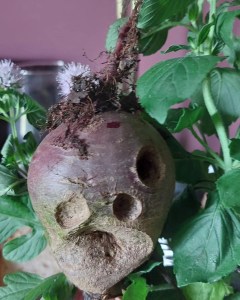
secrets of a life lived underground… harvest day


Rebetiko, the blues of the Greek refugees from Asia Minor, and of Turkey, is alive and well. A “Byzantine blend of the Turkish rhythms brought by the immigrant Greeks uprooted from their homes in Asia Minor with the contemporary Greek music of the twenties and thirties,” it can be heard Monday nights haunting the corridors and the JCR (Junior Common Room) of SOAS, the School of Oriental and African Studies, in London. I went to listen to the Rebetiko band this week and was amazed at the quality of sound and soulful singing.
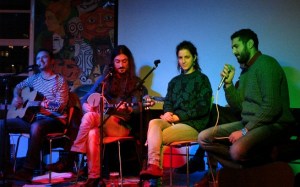
The band SOAS Rebetiko describe themselves as follows:
“The Famous SOAS Rebetiko Band plays Rebetiko music of Greece, a broad genre of urban songs and instrumental music which developed in and around the major port areas of Eastern Mediterranean — Smyrna/Izmir, Istanbul, Syros, Piraeus and Thessaloniki.”
I listened to this music growing up in a community of first- and second-generation refugees from Asia Minor, in Athens, and hearing it being played again, reminded me of the depth of feeling expressed through it; through the songs of loss and mourning, but also resistance, survival and life affirmation sang by the refugees.
Publisher on hiatus
The waiting for Alexandrias 40: In the Shade of the Lemon Tree is getting longer. Voxhumana-books has gone on hiatus. My publisher has been seriously ill for some time, and is now no longer able to continue with the work. I am very sad about Philip’s fight with cancer and wish him all the best.
I will keep you posted about the book when I have more news. Meanwhile, I hope to see you around this blog and twitter (@stellapierides.com) for short stories, haiku and other forms of prose and poetry.
I have listed below some of my “Sources and Related Material” for Alexandrias 40: In the Shade of the Lemon Tree. I will be updating this list, so please, come back for more!
Online
Alice James, 2001, ‘Memories of Anatolia: generating Greek refugee identity,’ in http://balkanologie.revues.org/index720.html
Thalia Pandiri, 2007, ‘Narratives of Loss and Survival: Greek voices from the Asia Minor Catastrophe,’ in http://www.interlitq.org/issue1/thalia_pandiri/job.php
Raymond Bonner, 1996, ‘Tales of Stolen Babies and Lost Identities; A Greek Scandal Echoes in New York,’ in http://www.nytimes.com/1996/04/13/nyregion/tales-of-stolen-babies-and-lost-identities-a-greek-scandal-echoes-in-new-york.html
http://en.wikipedia.org/wiki/Greek_Civil_War
In Print
Bruce Clark, Twice a Stranger: How Mass Expulsion Forged Modern Greece and Turkey (London: Granta Books, 2007)
Renee Hirschon, Heirs of the Greek Catastrophe: The Social Life of Asia Minor Refugees in Piraeus (Oxford: Clarendon Press, 1989)
Marjorie Housepian Dobkin, Smyrna 1922: The Destruction of a City (New York: Newmark Press, 1988)
Esther P Lovejoy, Certain Samaritans (New York: Macmillan, 1933)
Mark Mazower, Inside Hitler’s Greece: The Experience of Occupation, 1941–1944 (New Haven and London: 1993)
Mark Mazower, After the War Was Over: Reconstructing the Family, Nation, and State in Greece, 1943–1960 (Oxford: Princeton University Press, 2000)
Leyla Neyzi, ‘Remembering Smyrna/Izmir: Shared History, Shared Trauma,’ in History and Memory, Bloomington: 2008, 20:2
Arnold J Toynbee, The Western Question in Greece and Turkey: A Study in the contact of civilizations (Boston: Houghton Mifflin, 1922)
Fiction
Louis de Bernieres, Birds without Wings (New York: Random House, 2004)
Jeffrey Eugenides, Middlesex (London: Bloomsbury, 2002)
Ernest Hemingway, ‘On the Quai at Smyrna,’ in The Short Stories (New York: Scribner, 2003)
Nikos Kazantzakis, The Fratricides (London: Faber and Faber, 1974; 1967)
Nikos Kazantzakis, Christ Recrucified (London: Faber and Faber, 1962; 1954)
Dido Sotiriou, Farewell Anatolia (Athens, Greece: Kedros, 1991)
Films
Theo Angelopoulos, The Weeping Meadow
Costas Ferris, Rembetiko
Elia Kazan, America America
Pantelis Voulgaris, Psychi Vathia, With Heart and Soul
In the years after World War II, a Civil War raged in Greece until 1949 which proved to be one of the worst disasters that befell Greece. Greek against Greek, the Right fought with the Left a war of the utmost cruelty.
This war left many wounds in Greek society. Memories of it still scar the Greek psyche, even across several generations, influencing the current social and political climate.
An important aspect of this war, and the horrendous atrocities inflicted during it, often by members of the same family fighting each other, has been the silence it generated. The trauma robbed people of the words to describe what happened to them, or what they did to others. Whole families stopped communicating; individuals refrained from speaking about the period of the war; history books omitted important events that took place as if they never had happened.
Over the years, the situation slowly changed, especially after the fall of the military Junta and the opening up of the political system in Greece – though even now sections of Greek society insist that there are still many unspoken matters that need to be talked about and worked through.
In my story Postcards, I allude to the period of the Greek Civil War, and to this silence, symbolized by the fighter/husband: he stops using words/language when writing to his wife and instead communicates through drawings in his postcards.
You can read the short story “Postcards” here

This month’s theme of the Festival of the Trees is “The Magic of Faerie Trees.” Hosted by Salix of Windy Willow, it is an interesting if bewitching topic. If you are into magic and fairies, fine. If you are not, what can you say about mystery or magic in a tree?
On the other hand, how is it that the olive tree is capable of living thousands of years? Is there magic involved? With its strong roots surviving underground, even when the trunk looks dead, the olive tree can make a claim to magic – though less so to mystery, if the strong roots explain its longevity! Then there is its outstanding beauty: its silvery foliage, almost like a whispering cloud, fused with its ragged, gnarled, twisted trunk, providing a unique image. This tree has so many associations for me that I decided to find a space for it in my second novel, When the Colours Sing. An olive tree in pre-alpine Bavaria! We’ll see how this strand is going to develop. But first things first.
There is the lemon tree (for which I made space in my first novel, Alexandrias 40: In the Shade of the Lemon Tree) to talk about. Glossy foliage, waxy, white-purple flowers, divine fragrance, fruit to grace any table, book or poem!
Lemon trees are said to have originated in Asia and spread in the Mediterranean regions after Alexander the Great’s soldiers brought them back from India. They are treasured trees in the Mediterranean lands. They are as important as olive trees and vines. They are vital to the health and well-being of the people living in those lands, as they have numerous medicinal, hygienic, cooking and culinary uses. From the abundant vitamin C, to the taste-enhancing addition to salads, soups, and various dishes, to decorative and aesthetic uses, to the perfume industry, lemons are most versatile.
In Northern Europe and America, there are additional associations which emphasize the lemon’s bitter taste, as in the expression “when life gives you lemons,” or the “lemon car,” referring to a defective, multi-flaw car. In a painting by Paolo Morando, The Virgin and Child, Saint John the Baptists and an Angel, Christ as a child is being offered a lemon, an act frequently associated with learning a variety of tastes and therefore being weaned off baby food.
In this sense, the lemon bridges opposites in taste (bitter-sweet), between cultural perceptions, and generations (weaning the baby off baby food). Is that a clue for interpreting the Italian, unknown artist’s painting Man and Wife, in the National Gallery of London, which has a lemon tree as a background?
Readers’ Digest lists 34 uses for the lemon. In Alexandrias 40: In the Shade of the Lemon Tree, there is a whole number of other uses – some surprising ones – for the lemon. But please note: try them at your own risk!
(Forthcoming: Alexandrias 40: In the Shade of the Lemon Tree: www.voxhumana-books.com)
18 November 2010
The Acropolis and the violence
Giorgos Seferis, the Greek poet and Nobel laureate, 1900-1971 (born in Smyrni, lived everywhere else, almost), wrote:
I woke with this marble head in my hands;
It exhausts my elbows and I don’t know where to put it down.
It was falling into the dream as I was coming out of the dream.
So our life became one and it will be very difficult for it to separate again.
(From “Mythistorima,” quote: Wikipedia; read the whole poem here)
Seferis was expressing an important element in the Greek identity, an element which weighs heavily on the Greek psyche. But while this has been written about, there are other “marble in the hands” issues in modern Greece. Take the recent “reporting” on the demonstrations, discontent, and rioting that has been taking place in Athens in the last year. The last event to make the news was the one that took place on the Acropolis.
The Persians sacked the Parthenon while it was still being built on the Acropolis of Athens, along with the rest of the city in 480BC. The Athenians raised it to the ground – I should say: rock – and then rebuilt it. There had been temples on the site earlier, and more were added later. It served as a mosque after the Ottomans took Athens in the 15th century. The Acropolis survived millennia of attacks and war damage, including being bombarded by the “Venetian Army” when it was used as a weapons arsenal by the Ottomans. Only last year, 2009, the new museum was opened at the foot of the Acropolis. And now, the Acropolis is being used as a place of protest. Culture Ministry employees, protesting about working for 22 months without pay, barricaded themselves inside, not allowing the tourists in until their demands were met.
A sad story, for the tourists were reported to have been unimpressed by the protest. They had travelled a long way to see the ancient site and were understandably disappointed. Sad for those Athenian workers too, those seeing no other way of exercising their legitimate right to protest and no other venue. Perhaps they thought this was going to make the world sympathize with their plight: after all, what would you do if you hadn’t been paid your salary for twenty two months? Sad, also, that the violence continues.
And yet, the people of Athens, and of Greece must be equally disappointed that their social, political, and financial predicament is not being put in the context of the unique Greek experience and history, but is instead too readily compared with ‘that of Western European countries. Brendan O’Neill, in an interesting article in Spiked, writing about the riots at the time of the killing of the Greek teenager, argued that the Greek problems were not simply due to the credit crunch (the pet idea of the Press) but stemmed from a historical crisis of legitimacy. Without necessarily agreeing with all the points O’Neill makes in this article, one might say that by putting the situation in a wider, complex historical perspective, O’Neill went beyond the usual media fascination with violence and money. Sad that this kind of writing is not found more often in the media. Because absence of interest in what lies beneath the “news” is a form of violence too.
16 October 2010
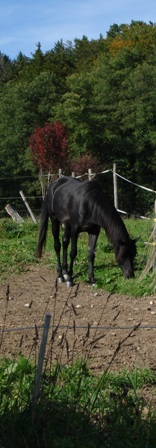
In Oberammergau they waited for ten years – they prepared for several. And finally, this year, 2010, they performed the Passion Play all summer. For those new to his event, it is laid on by the villagers of Oberammergau once every ten years, to fulfil a vow made by their ancestors in 1633. They had pledged to stage the Passion of Christ in exchange for protection from the devastating plague, wars, and poverty that had been raging in the area in the 17th century.
Now, the last performance of this decade’s Passion Play, the 109th of the season, has taken place; more than half a million people from all over the world attended this year’s production.
The costumes have already been mothballed for the next set of performances in 2020! The performers have been allowed to have their hair cut (after a year of growing it long in order to appear “authentic”), and the village to relax for the time being.
There is cause for celebration and merriment. The village has done well in this climate of global depression and economic unease. The performance was excellent and the hospitality unique.
A sad note, however, must not be left unheard. The animals that took part in the performances will be returning to their usual, mundane jobs. This would be unremarkable if it did not involve a heart-breaking separation. According to the Sueddeutsche Zeitung, the camels (Campari and Opi) and the black horse (Garko) – who starred in and enriched various scenes of the play, strutting their stuff nonchalantly on stage day after day – became infatuated with each other. Now however, they must go their separate ways: Campari and Opi to their home farm in Schwabmuenchen, and Garko back to his job of pulling coach-loads of tourists around Oberammergau.
Date: 5 October 2010
A few days ago I visited Bremen, Northern Germany, and was fascinated by the
number of statues, photographs, and references to the Grimm brothers’ fairy tale The Bremen Town Musicians.

In this tale, four animals: a donkey, a dog, a cat and a cock, having worked hard for their human owners, but getting on in years, are facing redundancy, abandonment, abuse, and slaughter. This unsavoury predicament brings them together and they decide to set off for the town of Bremen to find work as official musicians there.
Before reaching the town, however, they come across a house in the forest, as one does in fairy tales, and agree to try to scare away a gang of robbers feasting inside it. The dog stands on top of the donkey, the cat on top of the dog, the rooster on top of the cat, and each making its own, unique cry – their concerted braying, barking, meowing, and crowing – they crash through the window inside the house and scare the robbers off. In this remarkable way of co-operation, the four animals repel an attack by the robbers during the subsequent night, and settle to live there for the rest of their lives.
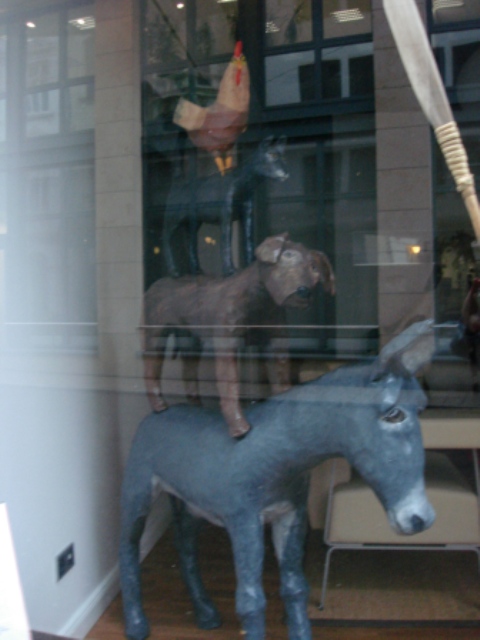
(I took a picture of this sculpture from the street; it is made of papier mache by Gaby Bertram of scrap-pap.de)
I wonder why this fairy tale has become so important to the city. Might it have to do with a wish for all kinds of people, of all backgrounds, ages, ethnic origins to live together happily, like those seemingly incompatible animals did in the story? I hope so anyway.
Readers of this blog will know about my novel Alexandrias 40: In the Shade of the Lemon Tree, and my interest in the ways people (in this novel, mainly Greeks and Turks) come together – or not. It seems that having a sense of shared humanity and a common purpose, and project helps: this Grimm tale shows us how.
In any case, I had fun walking around and finding depictions of the animals to photograph.
How Time Dilates…

I just read that Einstein’s Theory of Relativity was shown to apply to altitude differences as small as 33 centimeters. Scientists at the US National Institute of Standards and Technology in Boulder, Colorado, using the latest and most accurate atomic clocks, found that the higher you are above sea level, the faster time runs for you.
In addition, as Einstein had also suggested, the scientists found that travel through space influences clock speed. A stationary clock ticks slower than a moving one. So, if your clock is moving rather than stationary and, in addition, you live high up, then you might start thinking about botox, moving to sea-level, or buying a bungalow!
x
The time differences at these small distances are minuscule, but now measurable.
x
This demonstration of time dilation leads me on to another, though I believe related, track. Einstein conceived of his Relativity Theory more than one hundred years ago, and yet we are only now able to confirm its predictions on our, human level! Atomic theory, stating that matter is composed of discrete units called atoms, according to Wikipedia, “began as a philosophical concept in ancient Greece and India” and only entered scientific thinking in the early nineteenth century. Thus, “time” is also relative, depending on the prevailing culture, socio-political conditions, etc., when it comes to the interval between ideas being born and their progressing to proof and acceptance. Just think of the effect of certain periods of the Middle Ages on the progression of ideas!
x
Moving on to a more experiential level: In my forthcoming novel Alexandrias 40: In the Shade of the Lemon Tree, a little girl is obsessed with time. She fears changes of plan, the adults changing their mind, things happening unexpectedly – “Can you do that?” she wants to know. If you change your plans, then time becomes unpredictable. She keeps comparing the time on her watch with that of other family members, to reassure herself of the stability of her world. Like most of us, she confuses the subjective timeline of our lives, and its curves, ambits, u-turns and roundabouts, with the instrument of its measurement, her watch.
x
On the other hand, shrinking or speeding up time, for instance through time-lapse photography, can provide us with a new, marvelous perspective on the world. The BBC has a great video on this, “Timelapse: Speeding up life” Watch it; I added it to my previous post.
x
For musings and poetry on Time, read Asian Cha’s Random musings on Time: “Pray, my dear, quoth my mother, have you not forgot to wind up the clock?” They claim their clock does not tick. Not even tock?
x
Perhaps this, the dilation of time, the arrhythmia of time, where the interval between “tick” and “tock” is unpredictable, or different to what our current understanding would lead us to expect, is a major, crucial point where the arts and the sciences intersect – where the subjective and objective meet. Let us stay with this thought for a minute. Stop all the clocks!

At this year’s (2010) Munich Film Festival I watched Nikos Perakis’ new film “ArTherapy”. I found it an intelligent, exciting and enjoyable film, mixing documentary with fiction.
The protagonists, young students of the National Theatre School of Drama, mostly middle-class, politically conscious and wholly devoted to their art, work tirelessly in the face of adversity in the Athenian capital. The portrayal of the young, the intensity and aliveness of Athenian life, the wonderful development of the culture centre in the centre of historic and multicultural Athens, aptly named Technopolis, made me feel proud of my Greek roots. And yet, however much I enjoyed the movie, I felt there was something missing: something about the context, the place, the area was lacking. There were interviews with a few locals, but overall, I was left wondering who was the art therapy for, who is in need of it and why? An unfair question, perhaps, or even an irrelevant one. And yet.
Of course one answer to this question might be that it is the young generation addressed in the film that needs it, the generation of Greeks facing high unemployment, debt and deficit, of a politically traumatized youth, but this too did not seem enough to help understand my unease. In addition, a more complete answer might be that the fans need the art therapy too: “There is no better time to offer your fans an artistic therapy against the period of an economic crisis and fear from the forthcoming social shock. Told in the style of Fame Story…” the GR reporter wrote about the film. Of course…and perhaps!
I followed my usual pattern when in doubt: I googled Gazi. Taking its name from the Public Gas Works, which existed there for over a century, Gazi was, for most of its existence a poor area, where poverty, prostitution and immigration went hand in hand. And then I came across an article in Balkanologie about the people of Gazi.
The author of the paper, Dimitris Antoniou, wrote about the late immigrants to the area who arrived from the 1980ies and 1990ies onwards: Muslims from Northern Greece, from the Western Thrace migrating internally to Athens. Influenced by the Treaty of Lausanne, as well as the Greco-Turkish volatile relations and tit-for-tat policies, these people had found it hard to settle in Western Thrace, with scores migrating to Turkey, other countries, as well as to Athens, whenever possible. Antoniou followed their settlement patterns in the capital, their struggle for survival from earning a living through establishing cultural and religious associations to working out a distinct identity as a group.
Five years after the publication of this paper, I cannot find any further information about the people described and how they fared in the face of the massive redevelopment of the area.
Given the importance of this area as migration destination of Muslim Thracians, I now wonder what impact development has already had or might have on this group of people. Would it lead to the complete demise of this community in the name of progress, or might there be a new way of helping to engage and support the community in its search for and expression of its social and cultural identity? Would there be a way that the arts and crafts flourishing in the Gazi Technopolis might aid the survival of this community? That could also be a form of art therapy!
(Picture credit: http://en.wikipedia.org/wiki/File:Gazi_Technopolis.jpg)
The 1951 Refugee Convention establishing the United Nations refugee agency declares: a refugee is someone who “owing to a well-founded fear of being persecuted for reasons of race, religion, nationality, membership of a particular social group or political opinion, is outside the country of his nationality, and is unable to, or owing to such fear, is unwilling to avail himself of the protection of that country.” http://bit.ly/aix15K
Refugee Day (20th June 2010) has come and gone. Refugee week too. Congratulations to the people taking part and above all, to those organizing the events, the publicity, the media, those attracting attention to displaced persons fleeing persecution as well as those celebrating the achievements of refugees.
But what now? What comes the day after? And the day after that? Will our attention be drawn somewhere else, to another, no doubt, worthy cause? The refugees are still here, many under the skies, lacking water, food, warmth, traumatized. Let us not wait for next year’s refugee day to remember them. Let refugee awareness become part of our everyday consciousness and conscience. Part of our lives.
Here are some pointers to organizations that help:
Facts about refugees: see information http://www.refugeeweek.org.uk/InfoCentre/Facts
Though the 2010 refugee week has come and gone, the information on this site is valid and useful: http://www.refugeeweek.org.uk/Events
For the best resource, see the United Nations Refugee Agency website: http://www.unhcr.org/cgi-bin/texis/vtx/home
Highlighting the plight of tens of thousands of refused asylum seekers who are destitute, homeless and not allowed to work in the UK: http://stillhumanstillhere.wordpress.com/
“The largest refugee organization in the UK providing advice and assistance to asylum seekers and refugees”: http://www.refugeecouncil.org.uk/

I just read The Hungry Tide, a novel by Amitav Ghosh, published in 2004. It has taken me a long time to find out about it, as well as its author, but, as they say, better late than never.
Such a well-written, well-researched, good read! But the added reason I bring it here is that it includes, among a number of other topics, the story of a Bengali refugee group, settled on Morichjhanpi island of the Sundarbans, forced to flee by the newly elected government of West Bengal, and the massacre of 1978-79. I have an interest in refugee groups, their experiences, itineraries and development – a refugee group appears in my forthcoming novel, Alexandrias’ 40: In the Shade of the Lemon Tree, as well as the one I am currently working on – and Ghosh’s story describes one such group, in a different part of the world, in a sensitive and engaging manner. In such a manner, in fact, that one might say that the refugees find a home and a voice in Ghosh’s novel. While they flee one way, and then the other, like the ebb and flow of the tide, they are given a presence, a ‘stable’ place in history by Ghosh.
He writes in English, weaving fact and fiction into a wonderfully clear, informed and at the same time enchanting tale.
While the refugee group is an important pivot to the story, the ebb and flow of the tides in the Sundarban islands off the easternmost coast of India, and the ebb and flow of language and silence, are the true stars of the novel. The main characters, an American Indian female researcher, an Indian male translator and an Indian male illiterate fisherman, carry the tidal shifts and currents between language and the areas around it, those places which inhabit the heart and the elemental areas of the psyche shared by all humans. This shared humanity provides the ground for the – unfortunately often undervalued – capacity to communicate with one another. “…Words are just air,” a character says, “When the wind blows on the water, you see ripples and waves, but the real river lies beneath, unseen and unheard.” (see also my comment: http://bit.ly/aGNY1P)
Ghosh’s achievement in this novel is to illustrate this ability through the relationships between these three characters and someone who, through his diary, is telling the tale of the refugees, using political, philosophical, and religious themes linked with passages from Rilke. In this novel, history, politics, poetry, biography, religion and myth are brought together in their varying forms of narrative language and yes, narrative silence, to tell a seamless story of incredible beauty.
More than that, however, the novel – through its metaphorical and symbolic richness and its assumption of the perspective of the American Indian scientist and the Indian translator, while contrasting them with the different qualities of the Indian fisherman’s discourse, and its unfortunate reception – reaches further into the colonial and post-colonial waters and invites critical reflection.
I cannot recommend this book highly enough, especially for the outstanding achievement of bringing together so many strands, including the horrific tale of the refugee group, loss, history and a love story with so much humanity and humility.
A Tale of Two Passions
 It is often said that life is stranger than fiction. Fair enough, I wouldn’t argue with this. Here I wish to point out two cases where fiction, narrative, or stories influence life. Admittedly, this is not any story, but the story based on the Passion.
Kazantzakis, perhaps best known for having written that other passionate character, Zorba the Greek, published his version of the Passion, Christ Recrucified, in 1948. It is a novel set in a Greek village in Asia Minor during the Ottoman Empire. The villagers are given a free hand in the running of their village affairs as long as they keep quiet, and the Agha (the local Ottoman governor), who likes to enjoy life’s little pleasures, happy.
Trouble, and the plot, comes to the village with the sudden arrival of a group of refugees led by their priest – their village was destroyed by the Turks in the fermenting tensions between Greece and the crumbling Empire. The locals don’t want the refugees in their village, but turn a blind eye, initially, to their camping on a barren mountainside just outside the village.
It is Easter Week approaching, and the village elders are preoccupied with allocating the roles of the Passion story to the locals: who will be “Judas,” “Christ,” or “Mary Magdalene?” Once the preparations for the Holy Week are underway, the chosen actors begin to identify with their allocated characters; they become more saintly, with the exception of “Judas” who becomes treacherous. The novel then takes off, with the actors coming in between the newly arrived refugees and their needs for food and shelter, and the resenting and increasingly intolerant locals. It has a terrific climax, wonderful psychological portraits both of individuals and social groups; it is one of my favourite Greek novels.
Well, in the Bavarian village of Oberammergau, in the foothills of the Alps, another Passion Play has been performed for centuries. In the year 1633, the village suffering from the plague, struck a deal with God: they would perform the Passion Play every ten years if God, in return, kept them free from the plague. Both sides seem to have kept their bargain – though the villagers did not hold the metaphorical plague of the World War II against God – and the play goes on. This year, 2010, sees the 41st performance.
The village performs the Play wholeheartedly, with villagers living and growing up with the preparations and performances all through their lives. Their aspirations, dreams and competition for the main roles achieve the status of basic needs. However, only those born and bred there, or those who have lived for at least twenty years in the village, are allowed to take part. Over two thousand locals (half the village) are involved in the performances that last the whole summer, from May to October, performing to an audience of over four thousand people daily! The rest are involved in the catering for and accommodating of the thousands of visitors in a small village.
Now the reason I brought these two together here, the novel by Kazantzakis and the performances of the Passion Play in real life Oberammergau, is more than that they share the same basic story; more important than the fact (and my need to brag about it) that I will be going to see the Play this year; more than the influence that Kazantzakis’ novel had on the background to my own novel, Alexandria’s 40: In the Shade of the Lemon Tree. It is how in both, Kazantzakis’ novel and the village of the Passion Play, a similar psychological phenomenon seems to be taking place. The actors tend to become more like the characters of the Passion story. The villages tend to show similarities with the folk of the original story.
In Oberammergau, one of the locals cast as Virgin Mary, I read, refused to marry afterwards; one of the “Jesuses” kept ‘blessing people’ long after the performance was over. One of the actors playing this year’s “Jesus” is reportedly tempted to defer to the actors who played previously “Jesus” and let them mount the donkey entering Jerusalem. There is also the story of King Ludwig II, making presents of silver spoons to the actors of the performance he attended, with the exception of “Judas,” to whom he gave a tin spoon. As for the village politics, they are reported to be tinged with the sometimes polarizing passions of the original story.
In the Kazantzakis novel, a similar but more pronounced process seems to be taking place. The main characters of the Play take on the qualities of those they portray. The actor Judas behaves like “Judas,” the local prostitute starts behaving like “Mary Magdalene,” similarly “apostle Peter” and “Christ.” The villagers and the mob equally seem to become caught in a web that almost dictates a necessity of action that follows the Passion. It is as if a need arises for the Play to become embodied and concretely played out in the village of the novel.
It is this unsettling echo between the two depictions I wish to highlight. Even on the side of the spectator, newspaper articles about the Oberammergau Play, inchluding the Spiegel online, attract our attention by reporting that one of this year’s chosen inhabitants to portray “Jesus” is a psychologist; “Mary Magdalene” a Lufthansa flight attendant. This points to an expectation in ourselves to weld together the roles in the Passion Play with the Oberammergau locals playing them. When they do not fit – after all who would have thought of Christ been played by a psychologist? – a sense of discrepancy, perhaps a sense of the Uncanny arises.
An interesting analogy may be found in the discrepancy between what one wants to say and the way one expresses it through language, which is smaller in one’s native language than in a second/adopted language. While in the first case the metaphor of “bathing in language” is appropriate, in the second – when the gap between what one wishes to say and the way it is said is too wide – the expression “like bathing in a ski-suit” has been used by Tammy Ho Lai-Ming. A shift from the latter, uncanny experience to the more comfortable one of having the appropriate linguistic tools (the “bathing suit”) to express oneself is accomplishable through practice. In real-life Oberammergau, the endless rehearsals, revisions and reworking of the text, the advice sought and given, ensure that the fit between the Passion and its performance improves with each passing decade.
Kazantzakis’ novel, of course, has the advantage of setting this theme of the actor, the role and reality on a fictional stage. On this stage, the actors no longer simply perform but rather re-enact – as if the role fitted them like a glove. Better still, as if there were no distance between the narrative of the Play, the specific role, and the self. Or, as if: “World and dream are one,” as a boy in the novel sings to the Agha.
But then perhaps I am making too much of this: after all, one of the Oberammergau inhabitants who played Christ in the year 2000 performance is now, in the year 2010, playing Judas!
Two writers writing about the refugees:
Renee Hirschon, Heirs of the Greek Catastrophe: The Social Life of Asia Minor Refugees in Piraeus (Oxford: Clarendon Press, 1989)
Hirschon draws on her research as an anthropologist in one of the refugee areas of Piraeus, Kokkinia, in 1972. Living within the refugee community, Hirschon was able to observe people’s customs and traditions, listen to their stories, and witness their lives. The fact that they referred to themselves as refugees and they were addressed as such in 1972, fifty years from the 1922 catastrophic events in Asia Minor, becomes the pivot of the book, and underpins the facts she discusses.
Hirschon was able to follow the grievances, alienation, marginalisation and suffering of this group of people living in Piraeus, and their attempts to cope with their situation by forging a separate identity within the Greek nation. While later years brought prosperity and the option to move out of the area, large numbers decided to stay in overcrowded properties for economic, socio-political, and to some degree, psychological reasons. Hirschon’s work focuses on a moment in time in the lives of this group of Mikrasiates, which tells a story of their continuing need for an identity and a way of coming to terms with their situation.
From the iconostasi (icon corner/alcove) to the proxenio (the procedure of arranging the marriage), to the dowry, to the seeming contradiction of religious practice with left-wing commitment, and to the surprising ratio of chairs per head, the book presents and explores a society both alive and struggling to maintain its identity. Hirschon relates a woman refugee saying that while the catastrophic events in Asia Minor and their consequences were traumatic experiences to the older generation, they are heard only as fairy tales by their offspring.
This book paints an alive picture of the people and the society it describes.
————————————————————————————————————————————————–
Leyla Neyzi, ‘Remembering Smyrna/Izmir: Shared History, Shared Trauma’ in History and Memory, Bloomington: 2008, 20:2
Gülfem Kaatcilar Iren, a woman from Smyrna/Izmir, born in 1915, talks to Leyla Neyzi about her experiences of war, and the destruction of Smyrna and Manisa in particular, events central to the history of Greece and Turkey. These events are referred to in Greece as the Smyrna ‘disaster’, while in Turkey as the ‘liberation’ of Izmir. This paper provides a unique account of the co-existence of two contradictory discourses framing the identity of the witness interviewed, as well as a wonderful illustration of shared humanity between people on the opposite sides of the political divide of the Aegean.
In a sensitive manner and with an ability to hold conflicting approaches in balance, Neyzi identifies two separate discourses in this narrative: a nationalist discourse which rationalises the events in Izmir and the ‘silence’ that followed them, and a discourse based on personal experience, which empathizes with those who lost the war and were forced to emigrate to another country (in this case, Greece) for safety.
Neyzi explores the coexistence and intersection between the two discourses while placing them within the wider socio-political context of the discussion about identity and history in modern-day Turkey.

Alexandrias 40: In the Shade of the Lemon Tree is a novel about identity. It asks how we know who we are and how events, as well as thinking, change our understanding of ourselves and of others. This theme is explored through a group of characters thrown accidentally together in Athens, Greece, in 1957, renting rooms in the house of the Pagidis.
Post World War II; post German occupation; post Civil War; and not even a century free from Ottoman rule, Greece itself has an identity problem. The refugees that fled the catastrophic 1922 war with Turkey (they comprise a fifth of the existing population) are both compounding the problem for the rest of Greece and bringing innumerable gains to it. Their traumatic past and struggle for survival, in a country that is both home and hostile to them, require extreme psychological resources of generosity and masochism, denial and ruthlessness – and above all, humour and forgiveness.
The mood, timing and rhythm of the novel reflect the survival mechanisms of the refugees as they, and their offspring, work out their lives as refugees and identities as Greeks. Tragic-comic threads run through the story, charging the atmosphere with hilarious ethnic colour, sensuality and psychological insight. Underneath this tightly woven fabric, the weight of history of Asia Minor, the Greek Civil War, collaboration and blackmail, adoption and betrayal, informs the minds and the hearts of the characters. And question their identities as Greeks, as parents, as individuals.
Sources and Related Material
Online
Alice James, 2001, ‘Memories of Anatolia: generating Greek refugee identity’, in
http://balkanologie.revues.org/index720.html
Thalia Pandiri, 2007, ‘Narratives of Loss and Survival: Greek voices from the Asia Minor Catastrophe’, in
http://www.interlitq.org/issue1/thalia_pandiri/job.php
Raymond Bonner, 1996, ‘Tales of Stolen Babies and Lost Identities; A Greek Scandal Echoes in New York’ in
http://en.wikipedia.org/wiki/Greek_Civil_War
In Print
Bruce Clark, Twice a Stranger: How Mass Expulsion Forged Modern Greece and Turkey (London: Granta Books, 2007)
Renee Hirschon, Heirs of the Greek Catastrophe: The Social Life of Asia Minor Refugees in Piraeus (Oxford: Clarendon Press, 1989)
Marjorie Housepian Dobkin, Smyrna 1922: The Destruction of a City (New York: Newmark Press, 1988)
Esther P Lovejoy, Certain Samaritans (New York: Macmillan, 1933).
Mark Mazower, Inside Hitler’s Greece: The Experience of Occupation,1941 – 1944 (New Haven and London: 1993)
Mark Maazower, After the War Was Over: Reconstructing the Family, Nation, and State in Greece, 1943 – 1960 (Oxford: Princeton University Press, 2000)
Leyla Neyzi, ‘Remembering Smyrna/Izmir: Shared History, Shared Trauma’ in History and Memory, Bloomington: 2008, 20:2
Arnold J Toynbee The Western Question in Greece and Turkey: A Study in the contact of civilizations (Boston: Houghton Mifflin, 1922)
Fiction
Louis de Bernieres, Birds without Wings (New York: Random House, 2004)
Jeffrey Eugenides, Middlesex (London: Bloomsbury, 2002)
Ernest Hemingway, ‘On the Quai at Smyrna’, in The Short Stories (New York: Scribner, 2003)
Nikos Kazantzakis, The Fratricides (London: Faber and Faber, 1974; 1967)
Nikos Kazantzakis, Christ Recrucified (London: Faber and Faber, 1962; 1954)
Dido Sotiriou, Farewell Anatolia (Athens, Greece: Kedros, 1991)
Films
Theo Angelopoulos The Weeping Meadow
Costas Ferris, Rembetiko
Elia Kazan, America America