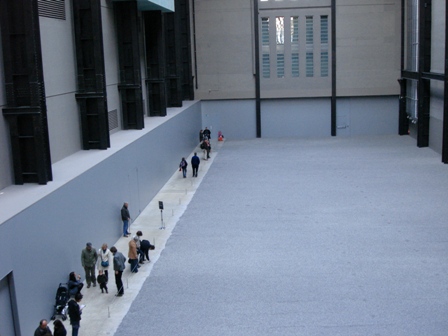
Following the enormous disappointment at the Tate’s stopping the public from walking on Ai Weiwei’s seed landscape, Tate Modern had a better idea: for all those wishing to at least touch the seeds, there is now a narrow corridor to the side of the sunflower seed installation. Now, we can walk on the edge, and we can touch.
Thank you Tate!
Guardian article about the Tate rethink (and the guards offering seeds in mugs for people to feel!),here
I visited Ai Weiwei’s sculptural installation Sunflower Seeds at Tate Modern just after they stopped the public walking through the field of seeds at the Turbine Hall. Like many others, I found myself feeling disappointed. The seeds looked beyond my reach (I had looked forward to walking on them, listening to their crunching sound), and pale compared to those in the pictures I had seen. A message in front of the installation explained that Tate had been advised that interaction with the installation (such as visitors walking on the seeds) could cause dust to be emitted which could be dangerous to health.
I stood in front of the pale mass of more than one hundred million seeds on the floor feeling lost, thinking that had they glazed the seeds, I would now be walking on them! At the same time, knowing something about clay, I could understand the concern. So there I was, standing perplexed and disapointed, being faced with a case of dust to dust, or rather, dust, clay, ceramic seed, dust, with a short interval in between.
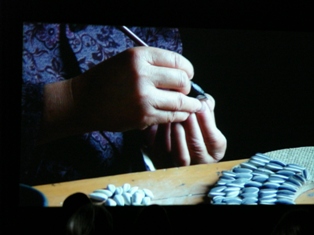
Then my eye caught the video screens right next to the seeds, and my whole experience took another turn! A fab-fun-fantastic video tracing the creation of the seeds – from the mixing of the clay to the forming of the seeds, the painting and firing and selecting the best seeds – the stories of the craftspeople in it were engaging and the colors, the scenes both breathtaking and remarkably informative.
I loved the idea of the amount of co-operative work that went into producing the installation. A whole community – more than 1600 people of Jingdezhen, a Chinese city with 1700-year-old history of porcelain manufacturing: it is known as the Porcelain capital – was involved in creating something together (the porcelain seeds), something that gave them employment, as well as purpose and community spirit. If the sunflower seeds symbolize the people of China, as suggested, then these symbols have been lovingly created and treated with respect.
Standing there, in front of the video images, next to the seeds and the playing of the visitors’ videos, it occurred to me that the Tate installation consisted of the seeds and the video together. That they were inseparable. No, more than that. That the seeds, the video, the dust, the message about the danger from clay dust (after all, which potter/ceramic artist has not heard of this hazard?), even the interactive videos made by visitors to the Gallery addressing the artist Ai Weiwei, all were part of the same installation! After all, Ai Weiwei is an interactive performance artist, merging life and art. I still believe that this is the case. Even if unintended, unconscious, a chance happening, I think even retrospectively, the lot belongs together.
In an article “From Seeds to Dust” Ulara Nakagawa alluded to the dust possibly belonging to the installation. I consider the Seeds installation as offering the possibility of a total/comprehensive/whole art work, where the art object consists of multiple layers: tangible visible object(s), sound, video, text, interaction with the artist, and an ongoing archiving of the viewers’ experience and thinking in their communication with the artist. After all, the Tate tells us: “…what you see is not what you see, and what you see is not what it means.” Well done, Ai Weiwei!
What is a blog carnival? And do you have to wear carnival costume?
You can tell I am a late learner. I found out about blog carnivals yesterday! I immediately liked the idea. I learnt that a blog carnival is the regular appearance of a central post containing links to other blog posts on a previously specified theme. This post is written by the blogger who hosts the carnival. Hosts rotate. I quote from the originator of this particular blog carnival:
“there’s a given theme, and to join, you put up a relating blog post in your blog, and then send the link to the host of the carnival – who then puts a central page with links to all participating blogs / posts together.”
The > Language > Place Carnival will be of particular interest to bilingual authors living outside the country of their birth, or learning another language. There are so many of us… I take this to mean emigrants, immigrants, expats, exiles, also refugees of all kinds…all those finding refuge, or asylum, or arbour in a second language/place … travellers… after the Fall wanderers…
Visit the site for the full details.
Finally, no, you don’t have to wear carnival costume, though respecting the dress code of others is essential. And no, you don’t have to worry about eating/avoiding meat (carne). http://en.wikipedia.org/wiki/Carnival Though the idea is to beef up your content!
For a succinct definition of “blog carnival” and festival have a look here
Papa Osmubal’s poem “A Bum’s Demise,” published in Asian Cha, is nominated for a Pushcart. You can read the poem here. A very perceptive and thorough analysis of this poem is also published by Asia Cha, in their section A Cup of Fine Cha, here
I felt both moved and haunted by this poem; compelled to comment on it. It kept me thinking. It is a powerful poem, with many levels and even more twists of meaning. Verlaine is implicated. His liver also, though I was more interested in the state of his heart. Read my own comment in the comments section of A Cup of Fine Cha. You can also find it copied in my own Scrapbook.
Researching my novel When the Colors Sing, I came across information about a new memorial to the victims of National Socialism that has opened in Munich. It is a virtual memorial, with personal accounts of the victims being read out from the specific locations where the events described occurred across the city.
Michaela Melian, artist, musician, professor for time-based media in Hamburg, won the first prize for this audio art work in the competition “Victims of National Socialism: New forms of remembering and remembrance” held by the city of Munich in 2008. She was awarded the city’s art prize in 2010.
Melian collected material from newspapers and Holocaust archives, interviewed survivors herself and put together a sensitive and remarkable collection. The individual accounts, read out by actors, are indicated by blue circles superimposed on a digital map of the city, and people can click on them to hear the stories.
The digital memorial can be accessed from across the globe, especially by the younger generation more interested in digital forms of communication. In Munich, some museums are lending their mp3 players to those wishing to tour the places where the events described took place. Bayerischer Rundfunk supports the project, broadcasting narratives in special programmes. The Munich Department of Arts and Culture is also offering its support.
Incidentally, the visual image of Memory Loops reminds me of Anselm Kiefer paintings: “the dark light falling from the stars” for instance. Here is the link to Memory Loops, by artist Michaela Melian.
Giorgos Seferis, the Greek poet and Nobel laureate, 1900-1971 (born in Smyrni, lived everywhere else, almost), wrote:
I woke with this marble head in my hands; It exhausts my elbows and I don’t know where to put it down. It was falling into the dream as I was coming out of the dream. So our life became one and it will be very difficult for it to separate again.
(From “Mythistorima,” quote: Wikipedia; read the whole poem here)
Seferis was expressing an important element in the Greek identity, an element which weighs heavily on the Greek psyche. But while this has been written about, there are other “marble in the hands” issues in modern Greece. Take the recent “reporting” on the demonstrations, discontent, and rioting that has been taking place in Athens in the last year. The last event to make the news was the one that took place on the Acropolis.
The Persians sacked the Parthenon while it was still being built on the Acropolis of Athens, along with the rest of the city in 480BC. The Athenians raised it to the ground – I should say: rock – and then rebuilt it. There had been temples on the site earlier, and more were added later. It served as a mosque after the Ottomans took Athens in the 15th century. The Acropolis survived millennia of attacks and war damage, including being bombarded by the “Venetian Army” when it was used as a weapons arsenal by the Ottomans. Only last year, 2009, the new museum was opened at the foot of the Acropolis. And now, the Acropolis is being used as a place of protest. Culture Ministry employees, protesting about working for 22 months without pay, barricaded themselves inside, not allowing the tourists in until their demands were met.
A sad story, for the tourists were reported to have been unimpressed by the protest. They had travelled a long way to see the ancient site and were understandably disappointed. Sad for those Athenian workers too, those seeing no other way of exercising their legitimate right to protest and no other venue. Perhaps they thought this was going to make the world sympathize with their plight: after all, what would you do if you hadn’t been paid your salary for twenty two months? Sad, also, that the violence continues.
And yet, the people of Athens, and of Greece must be equally disappointed that their social, political, and financial predicament is not being put in the context of the unique Greek experience and history, but is instead too readily compared with ‘that of Western European countries. Brendan O’Neill, in an interesting article in Spiked, writing about the riots at the time of the killing of the Greek teenager, argued that the Greek problems were not simply due to the credit crunch (the pet idea of the Press) but stemmed from a historical crisis of legitimacy. Without necessarily agreeing with all the points O’Neill makes in this article, one might say that by putting the situation in a wider, complex historical perspective, O’Neill went beyond the usual media fascination with violence and money. Sad that this kind of writing is not found more often in the media. Because absence of interest in what lies beneath the “news” is a form of violence too.
The poet Constantine P. Cavafy, or Konstantinos Petrou Kavafis, one of my favorite poets, wrote the following about his origins:
.
“I am from Constantinople by descent, but I was born in Alexandria—at a house on Seriph Street; I left very young, and spent much of my childhood in England. Subsequently I visited this country as an adult, but for a short period of time. I have also lived in France. During my adolescence I lived over two years in Constantinople. It has been many years since I last visited Greece. My last employment was as a clerk at a government office under the Ministry of Public Works of Egypt.”
.
I have pasted his poem Ithaca below – he knew what he was talking about. For more of his poetry and resources on the web, see the Cavafy Archive
The poem, quotation, and Wikipedia url can be found here
Ithaca
English Translation
When you set sail for Ithaca,
wish for the road to be long,
full of adventures, full of knowledge.
The Lestrygonians and the Cyclops,
an angry Poseidon — do not fear.
You will never find such on your path,
if your thoughts remain lofty, and your spirit
and body are touched by a fine emotion.
The Lestrygonians and the Cyclops,
a savage Poseidon you will not encounter,
if you do not carry them within your spirit,
if your spirit does not place them before you.
.
Wish for the road to be long.
Many the summer mornings to be which with
pleasure, with joy
you will enter ports seen for the first time;
stop at Phoenician markets,
and purchase the fine goods,
nacre and coral, amber and ebony,
and exquisite perfumes of all sorts,
the most delicate fragances you can find,
to many Egyptian cities you must go,
to learn and learn from the cultivated.
.
Always keep Ithaca in your mind.
To arrive there is your final destination.
But do not hurry the voyage at all.
It is better for it to last many years,
and when old to rest in the island,
rich with all you have gained on the way,
not expecting Ithaca to offer you wealth.
.
Ithaca has given you the beautiful journey.
Without her you would not have set out on the road.
Nothing more has she got to give you.
.
And if you find her threadbare, Ithaca has not deceived you.
Wise as you have become, with so much experience,
you must already have understood what Ithacas mean.
“Poetry helps us to revive, heal or endure” and the official website for this day provides a number of resources to help celebrate this poetry day 2010. There is a small selection of poems on this year’s theme of Home here
Poets of all shapes, ages and sizes sent in work; 43 of them “from established Scottish poets such as Sheila Templeton and Eleanor Livingstone to a group of schoolchildren from Aberdeenshire and attendees at an Adult Learning Centre on the West Coast…to south of the border and as far away as Germany…” Andy Jackson, who edits the North Carr Light blog, writes. (Indeed, myself included!)
Using a line from each poet’s contribution he produced a wonderful poem:
In Oberammergau they waited for ten years – they prepared for several. And finally, this year, 2010, they performed the Passion Play all summer. For those new to his event, it is laid on by the villagers of Oberammergau once every ten years, to fulfil a vow made by their ancestors in 1633. They had pledged to stage the Passion of Christ in exchange for protection from the devastating plague, wars, and poverty that had been raging in the area in the 17th century.
Now, the last performance of this decade’s Passion Play, the 109th of the season, has taken place; more than half a million people from all over the world attended this year’s production.
The costumes have already been mothballed for the next set of performances in 2020! The performers have been allowed to have their hair cut (after a year of growing it long in order to appear “authentic”), and the village to relax for the time being.
There is cause for celebration and merriment. The village has done well in this climate of global depression and economic unease. The performance was excellent and the hospitality unique.
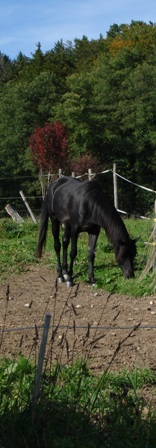
A sad note, however, must not be left unheard. The animals that took part in the performances will be returning to their usual, mundane jobs. This would be unremarkable if it did not involve a heart-breaking separation. According to the Sueddeutsche Zeitung, the camels (Campari and Opi) and the black horse (Garko) – who starred in and enriched various scenes of the play, strutting their stuff nonchalantly on stage day after day – became infatuated with each other. Now however, they must go their separate ways: Campari and Opi to their home farm in Schwabmuenchen, and Garko back to his job of pulling coach-loads of tourists around Oberammergau.
A few days ago I visited Bremen, Northern Germany, and was fascinated by the
number of statues, photographs, and references to the Grimm brothers’ fairy tale The Bremen Town Musicians.
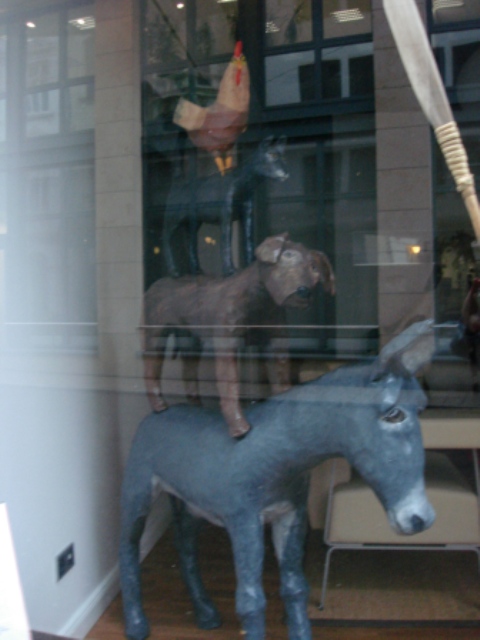
Bremen Musicians
In this tale, four animals: a donkey, a dog, a cat and a cock, having worked hard for their human owners, but getting on in years, are facing redundancy, abandonment, abuse, and slaughter. This unsavoury predicament brings them together and they decide to set off for the town of Bremen to find work as official musicians there.
Before reaching the town, however, they come across a house in the forest, as one does in fairy tales, and agree to try to scare away a gang of robbers feasting inside it. The dog stands on top of the donkey, the cat on top of the dog, the rooster on top of the cat, and each making its own, unique cry – their concerted braying, barking, meowing, and crowing – they crash through the window inside the house and scare the robbers off. In this remarkable way of co-operation, the four animals repel an attack by the robbers during the subsequent night, and settle to live there for the rest of their lives.
Bremen Town Musicians
(I took a picture of this sculpture from the street; it is made of papier mache by Gaby Bertram ofscrap-pap.de)
I wonder why this fairy tale has become so important to the city. Might it have to do with a wish for all kinds of people, of all backgrounds, ages, ethnic origins to live together happily, like those seemingly incompatible animals did in the story? I hope so anyway.
Readers of this blog will know about my novel Alexandrias 40: In the Shade of the Lemon Tree, and my interest in the ways people (in this novel, mainly Greeks and Turks) come together – or not. It seems that having a sense of shared humanity and a common purpose, and project helps: this Grimm tale shows us how.
In any case, I had fun walking around and finding depictions of the animals to photograph.
Literature, Art, and Life through the Lens of Haiku