A tribe in India has won a stunning victory over one of the world’s biggest mining companies. The Dongria Kondh, a tribe of 8000 people, with the help of Survival International and others, has won a victory over a multibillion company which proposed to mine bauxite on the sacred hills of the tribe. The Dongria Kondh’s struggle had a happier ending than that of the film Avatar, in which a tribe was pitted against a ruthless mining company. The Dongria Kondh’s perseverance, courage, and victory will encourage indigenous tribes everywhere.
Well done to Dongria Kondh, their supporters, and to Survival!
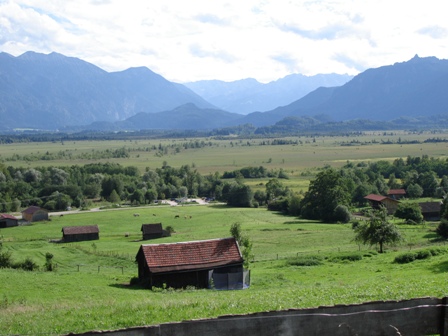
I brought back from my holiday this picture of the Frisian landscape ( I’ve never seen so much sky! ) and a freshly-penned poem. Read it in escarp, “a text-message-based review of super-brief literature.”
I wrote this poem during the 2010 World Cup, when everyone was talking about vuvuzelas. It appeared in escarp: ” a text-message-based review of super-brief literature,” 17 June 2010.
Having seen an exhibition of Emile Nolde’s“unpainted pictures” in the Berlin branch of the Nolde Foundation earlier on this year, I came to visit his house in Seebüll, North Friesland, Germany, where he lived and worked.
The house is built on higher ground – this used to be a tidal area – providing a panoramic view of the garden below and the surrounding flatlands. The “unpainted pictures” refer to the small-scale watercolors Nolde produced from 1941 onwards, after he was formally forbidden to paint by the Nazi regime. Even before that, the Nazis considered his work to be “un-Germanic” and “degenerate.”
In order to continue working, Nolde used watercolors since they do not emit the typical smell of oil paint and turpentine that would have been easily detectable by the Gestapo during unannounced inspections. Nolde considered the watercolors of this period “unpainted,” because he had planned to render them in oil after the fall of the regime.
Some of the “unpainted pictures” are of flowers, with vibrant colors that overflow the boundaries set by the line and spill over. Perhaps this is one expression of Nolde – like Kandinsky – seeing music in color: his color notes blending across space in the way musical notes blend in time.
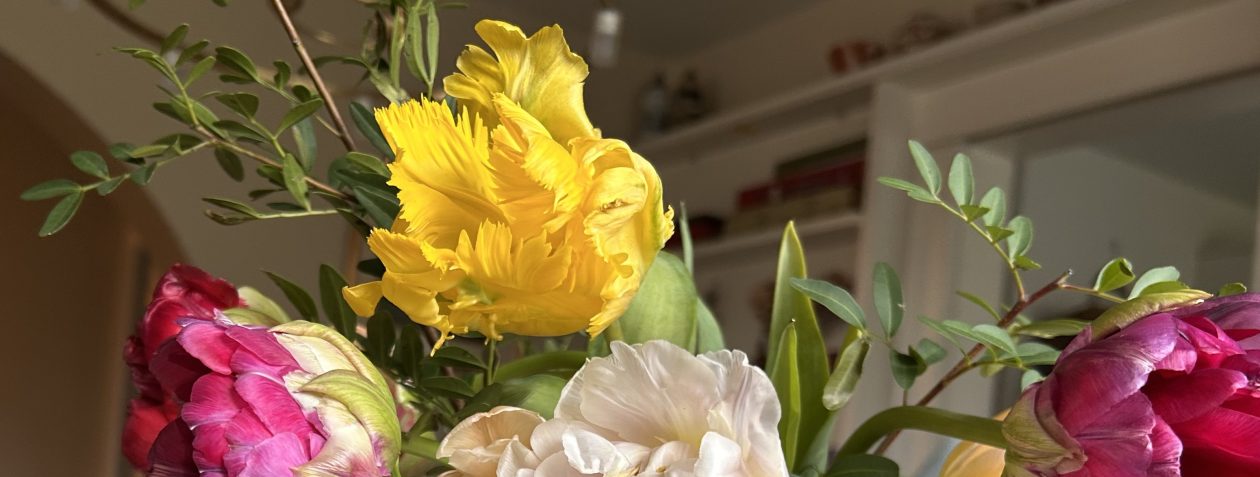
Nolde found ample inspiration for these motives in his own garden, which abounds with joyous color and diversity of form illuminated by the immense skies of North Friesland.
Literature, Art, and Life through the Lens of Haiku