“Some great paintings are inexhaustible wells, forever self-replenishing,” Michael Glover writes in The Independent’s Great works: Annunciation (1438-45), Fra Angelico. In a well-written article, he refers to a number of other works on the same, very popular subject. Most of these other paintings include symbolic elaborations and allusions which may be said to clatter the subject.
Fra Angelico’s image is sparse: there is no holy book on Mary’s lap, other paraphernalia or decorative allusions pointing elsewhere. Mary and the angel, both with folded arms mirroring one another and looking into each other’s eyes, seem to be quietly and calmly accepting of the message of the conception – of the realisation (incarnation) of the divine. There is an acknowledgement of the gravity of the situation, respect, as well as certainty that it will be carried through.
More importantly, in this Annunciation there is a pervading sense of stillness. In the instant depicted, contact, communion, acceptance have taken place and now there is stillness and silence. Mary and the Angel face one another in a moment pregnant with meaning. They, and we, know that a whole new chapter is to follow.
For me, great works of art, or literature, are great because they are timeless representations of humanity’s most precious treasures. In this case, The Annunciation is the metaphor for the creative moment, when the “aha!” experience is reached (in-spire), when a new thought, a new conception arises in the mind. In this sense, the annunciation transcends the narrower context of Christian belief to emerge as a universal symbol of the creative, generative moment.
A print of Fra Angelico’s Annunciation – which for me captures the universality of inspiration at the moment it materialises in the mind, as it becomes flesh, or ink, poem or book – hangs on the wall of my house. I pass it with pleasure several times a day, always looking and waiting for the “Angel” to appear.
At this year’s (2010) Munich Film Festival I watched Nikos Perakis’ new film “ArTherapy”. I found it an intelligent, exciting and enjoyable film, mixing documentary with fiction.
The protagonists, young students of the National Theatre School of Drama, mostly middle-class, politically conscious and wholly devoted to their art, work tirelessly in the face of adversity in the Athenian capital. The portrayal of the young, the intensity and aliveness of Athenian life, the wonderful development of the culture centre in the centre of historic and multicultural Athens, aptly named Technopolis, made me feel proud of my Greek roots. And yet, however much I enjoyed the movie, I felt there was something missing: something about the context, the place, the area was lacking. There were interviews with a few locals, but overall, I was left wondering who was the art therapy for, who is in need of it and why? An unfair question, perhaps, or even an irrelevant one. And yet.
Of course one answer to this question might be that it is the young generation addressed in the film that needs it, the generation of Greeks facing high unemployment, debt and deficit, of a politically traumatized youth, but this too did not seem enough to help understand my unease. In addition, a more complete answer might be that the fans need the art therapy too: “There is no better time to offer your fans an artistic therapy against the period of an economic crisis and fear from the forthcoming social shock. Told in the style of Fame Story…” the GR reporter wrote about the film. Of course…and perhaps!
I followed my usual pattern when in doubt: I googled Gazi. Taking its name from the Public Gas Works, which existed there for over a century, Gazi was, for most of its existence a poor area, where poverty, prostitution and immigration went hand in hand. And then I came across an article in Balkanologie about the people of Gazi.
The author of the paper, Dimitris Antoniou, wrote about the late immigrants to the area who arrived from the 1980ies and 1990ies onwards: Muslims from Northern Greece, from the Western Thrace migrating internally to Athens. Influenced by the Treaty of Lausanne, as well as the Greco-Turkish volatile relations and tit-for-tat policies, these people had found it hard to settle in Western Thrace, with scores migrating to Turkey, other countries, as well as to Athens, whenever possible. Antoniou followed their settlement patterns in the capital, their struggle for survival from earning a living through establishing cultural and religious associations to working out a distinct identity as a group.
Five years after the publication of this paper, I cannot find any further information about the people described and how they fared in the face of the massive redevelopment of the area.
Given the importance of this area as migration destination of Muslim Thracians, I now wonder what impact development has already had or might have on this group of people. Would it lead to the complete demise of this community in the name of progress, or might there be a new way of helping to engage and support the community in its search for and expression of its social and cultural identity? Would there be a way that the arts and crafts flourishing in the Gazi Technopolis might aid the survival of this community? That could also be a form of art therapy!
The Wise Silence before and alongside Words: The Calcutta Chromosome by Amitav Ghosh
Silence
In The Calcutta Chromosome, Amitav Ghosh explores the different and overlapping worlds of (scientific, written-down) language, and intuitive, oral folk tradition, and silence. This exploration takes the reader through an experiential process in which the customary way of reading a novel is challenged.
The novel begins at an unspecified time in the near future, when Antar, an employee of LifeWatch, a public health consultancy, is asked to find out what happened to another employee, L. Murugan, who disappeared in Calcutta in 1995. The plot is complicated (reviewers described it as “mind boggling” and “Rubik’s Cube of a novel”), and demands a special sort of concentration, as it shifts between different time periods and perspectives. The major plotline being that Murugan had asked to be transferred to Calcutta to investigate the life of Sir Ronald Ross – Nobel Prize winner for his work on how malaria enters the organism – but had disappeared under mysterious circumstances. I shall not attempt to summarize the novel here, as this has been done already quite competently.
Ghosh explores a complex web of themes: science, myth, language, silence, society and the individual. It is a web skilfully span, as he pairs the most unexpected themes, only suddenly to juxtapose them in the most astonishing patterns. For instance, silence is presented in various relationships to language, including scientific language. A character says about silence: “I see signs of her presence everywhere I go, in images, words, glances, but only signs, nothing more…”
Perhaps wisely, Ghosh does not attempt to describe in words this kind of silence. The implication being that by using language, we enter into a relationship with the background of silence similar to that we have as train travellers through a landscape, though infinitely more complex. For to say something is to change it. In a manner reminding me of the observer effect (in Quantum Mechanics) – the observer and the act of observation affecting the system being observed, regardless of the specific method used – the novel presents scientific knowledge as altering the landscape of the silence it tries to describe. Ghosh rather provides allusions, hints, pointers to it.
Language introduces other drawbacks. A scientist investigating a topic is burdened by scientific language, with particular ways of seeing and describing the world in the scientific community. A lay person, on the other hand, free from the restraints that scientific community and its language impose on him/her is well placed to make new discoveries, Ghosh is saying. It is as if, if you don’t know where to look, you may be in a better position to find what you don’t know you are looking for. Except in the novel, the natives know what they are looking for, and they are using the scientists’ results, and the results’ by-products, to gather the information they are seeking.
Taking the two major ways of knowing, scientific effort and language on the one hand and intuition, wisdom and silence on the other, Ghosh skilfully explores the opposition and mistrust that exist between the followers of the two. The setting being India, he also takes the reader on a reflective journey between the British colonial attitude of knowing best scientifically, and the native Indian one, of also knowing best, intuitively! There is more opposition and antagonism between the two ways of knowing in this book than there is in The Hungry Tide.
It may well be the case, as John Thieme wrote in The Literary Encyclopaedia, that in The Calcutta Chromosome, Ghosh explores “the possibility of an alternative subaltern history, which exists in parallel with colonial history as an equally – or possibly more – potent epistemological system, albeit one which has traditionally operated through silence.”
One of my own associations is to W. R. Bion, the British psychoanalyst born in India, who also wrote about knowledge and the processes of transformation that it has to go through in the mind before it reaches the potential of being knowable. Describing this process, Bion wrote about the shared human preconceptions and their journey to become concepts in the mind of the individual.
Bion valued the state of reverie, in which the mind sits quietly and allows things to unfold “without memory or desire,” or without expectation and aim-directed behavior. In this state, he believed, what had been obscured by the glare of expectation, wishful thinking, knowledge and assumptions would be allowed to show its true color, to shine through its own presence. In such a state of mind, one does not identify with, but rather becomes the thing thought about.
Bion wrote in a style which – although described as “not reader-friendly” – invites the reader to work with the text, to associate, feel and think for herself, i.e., to make or become its meaning. It seems to me that Ghosh too, in this novel, through his weaving of text and plot, knowledge, not-knowing, and guessing, attempts such a feat – risking, however, leaving the reader in a state of bafflement rather than becoming. Ultimately, the reader of the novel has to go through the process of experiencing it and form her/his own idea about it.
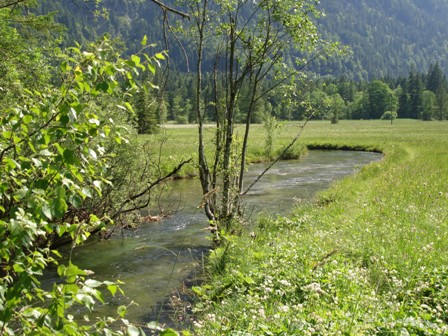
A steady flowing river, whispering reeds and listening fish; a flowering meadow, a gentle mountain breeze, green to delight the eye, colorful mosaic of insects. It certainly felt like the Garden of Eden.
If not, what does the Garden of Eden look like?
Perhaps my twitter poem earlier in the Spring caught something of this quality, though the Cornmill Meadows are in the outskirts of London while the landscape in this picture is in the valley of the river Ammer near Ettal and Oberammergau.
At the Cornmill Meadows
dragonflies rest on nettles
comfrey, buttercups
and the smooth stones
of the shallow stream.
(Published in Escarp, a “review of super-brief literature”)
think again. There is a story in the New York Times article “To Those with Nothing, Soccer is Everything,” about howJessica Hilltout documented the continent’s love of the game. The Belgian-born photographer loaded her car with soccer balls and drove through southern and western Africa taking pictures.
Driving through villages, Hilltout found a genuine love for the game, people playing soccer for the sheer joy of it. In this sense, I would say the people playing the game, instead of nothing, do have something very important: the capacity to find enjoyment and pleasure in their environment.
The article, by Celia W. Dugger, singles out the most soulful of Ms. Hilltout’s images: those of homemade balls using the most improbable materials in the most ingenious ways: paper, plastic, strings, socks and rags, bark, amongst others. I must say I agree with her. The balls and the other pictures – look at those goalposts – look wonderful. You can see for yourself here.
Her photographs are exhibited in Cape Town, Johannesburg and Brussels galleries; there is an accompanying book “Amen: Grassroots Football,” published with the help and encouragement of her British father, and some of the photographs can be seen on her website.
What did she do with the factory-made soccer balls in the car? She gave them to the children in the villages who were reported to be delighted to get what they considered to be the real thing!
Perhaps the pleasure of the game, which we all share, whichever continent or country we live in, expresses our common humanity; realizing this may help to create a better atmosphere when acknowledging and coming to terms with colonial memories and wounds.
Yesterday, I tweeted the “11 of the most craziest things about the universe,” a short photo essay by Marcus Chown, science writer. Chown alerted us to the fact that “if you squeezed all the empty space out of all the atoms in all the people in the world, you could fit the entire human race in the volume of a sugar cube.” He explained that this is because matter is “empty.” An atom, the most basic element of matter, orbited by electrons, is an incredibly empty thing with immense distances, relatively speaking, between the electrons and the central nucleus.
I was reminded of Sartre’s “Hell is other people.” Not the way he meant it – which was that if our relationship with a particular person is bad, then our being with them becomes hell; but the way it is usually understood, namely, that all other people are, and our relating with them is, torture.
I wonder what Sartre would have made of the idea that all humankind could theoretically be squeezed into a sugar cube! Horror of horrors! He might well have been a bit more appreciative of the already existing space inside and in-between other people’s atoms.
Now that’s a thought (for a short story).
I see that the ideas in the photo essay are explored in Chown’s “The Matchbox That Ate A Forty-Ton Truck: What everyday things tell us about the universe.” Well then, I am off to get this book…